Bitcoin’s value: highly fluctuant with a volatile trading history
You can safely assume that everyone has heard about Bitcoin by now. The popular and mostly valuable cryptocurrency is known for having earned some lucky people, a lot of money. It was first introduced to the public more than a decade ago through an anonymous creator. Since then, the value has been highly fluctuant with a volatile trading history. If you bought Bitcoins early and owned some in 2010, you were very lucky.
The early highs and lows
This year, the value of a single Bitcoin jumped from around $0.0008 to $0.08. The cryptocurrency was created by Satoshi Nakamoto, the creator’s alias, and was meant to be used or daily transactions and as a way to challenge the traditional banking infrastructure after the terrible financial collapse in 2008.
Bitcoin had another large jump during the spring of 2011, when the price jumped from $1 per Bitcoin in April to $32 in June. This answers to a 3200% jump in only three months. However, this was followed by a sharp recession and the price for Bitcoin ended up at a mere $2 in November the same year.
Bitcoins value today
These numbers are from the early days of bitcoin and seems small when comparing it to today’s value. During the pandemic that started in 2020 the price of Bitcoin would decrease due to financial issues. We can still see an increase during the course of this year when the value increased by 224% in the 12 months. This was mostly because of an institutional interest in cryptocurrencies in general. January 2021 was a historical month for Bitcoin when it beat all its previous price records, selling at more than $40.000.
What are cryptocurrencies and where can you buy them
Cryptocurrencies is a payment method and a strictly digital asset that can be purchased, used, held and sold online. It is a currency that is regulated by supply and demand, as many other currencies. However, it is not reregulated by a national bank or financial institute.
Cryptocurrencies are known for having highly fluctuating value which makes them risky to buy and trade. However, many cryptocurrencies’ owners have experienced and extreme increase in value when it comes to currencies such as Bitcoin. Buying cryptocurrencies can be done online by everyone that wishes to be a part of this world and own a coin or two. Some online brokers offer cryptocurrency purchases, other places to buy is at
Where can you use it?
Following the increasing popularity, more and more places offer cryptocurrencies as a valid payment form. You will meet this at many online stores but also some physical. Some uudet pikakasinot also allow you to finance the games using cryptocurrencies such as Bitcoin. Bitcoin can either be bought online or in Bitcoin ATMs, which you will find in some countries. You can bot buy and sell Bitcoins in the ATMs; however, most people choose to buy and hold cryptocurrencies to be used as a financial investment.
Nakamoto’s vision
In other words, Bitcoin is not used exactly how Nakamoto visioned it when he created the asset in 2008, but stores and online website are slowly but surely picking it up. In general, cryptocurrencies are becoming a more “everyday phenomenon” and people are more prone to it. While it used to be highly associated with crime and illegal acts, people are starting to realize that the currency itself is not illegal at all. The reason why it has been used for such, is because it is viewed as a more safe and anonymous payment method. This is because It uses blockchain technology.
Blockchain technology
Bitcoin is famous for using blockchain technology, making it more anonymous and safer. This can be described as a digital accounting book that is both decentralized and distributed, which makes it possible to register, track and make visible all digital transactions. It also stores data in blocks that are linked to each other using cryptography.
Blockchain is especially suitable in situations where there is a lack of trust in those who store and manage data because it is highly difficult to change it. This is because data that has already been stored cannot be changed without changing all the data stored afterwards, which is very difficult to do in practice. Blockchain is therefore resistant to changes in data stored in the ledger.
Bitcoin have had a highly changing value and a history rich in content. Following its ups and downs are interesting and it is difficult to imagine just how important it has become.
Next up: Malta Week
Don’t miss out on amazing networking opportunities and exclusive industry insights at Malta Week. Four leading shows will bring the best of the business back-to-back to a first-class meeting point. Malta Week will consist of events of SiGMA, AIBC, Med-Tech World and AGS, each presenting the top developments of their focal industries.
The cross-collaboration of each brand make Malta Week the number one destination for leading think-tanks of the gaming sector, emerging tech, digital health and digital marketing. The middle of the Mediterranean is the perfect place for multi-faceted business deals and face-to-face conversations with leading affiliates, policy makers and thought leaders.
Sacramento Kings owner Vivek Ranadive plans to give his players a bitcoin option, further proving that the NBA team is the most crypto-forward team in professional sports
Vivek Ranadive confirmed on Clubhouse that the Sacramento Kings will become the first major sports franchise that will offer bitcoin as a form of payment to its players and staff. More moves like this may see America take centre stage in the crypto industry.
Coindesk further confirmed these claims via a speaker on the Clubhouse platform, hosted by Tim Draper.
This move further establishes Ranadive’s claims that the Sacramento Kings are the most forward thinking franchises when it comes to cryptocurrencies. The NBA team had accepted bitcoin payments for hot dogs back in 2014 while in the year of 2019, the franchise launched reward tokens for fans.
The NBA is one of the most proactive franchises in the US when it comes to cryptocurrency and blockchain technology. The basketball association is already topping the list in digital collectibles through NBA TopShot.
Furthermore, NBA franchise owners, including Vivek Ranadive, have formed an NBA Blockchain advisory committee. The committee also includes crypto enthusiast and investor Mark Cuban of the Dallas Mavericks, Joe Tsai (Brooklyn Nets), Ted Leonsis (Washington Wizards), Steve Pagliuca (Boston Celtics) and Ryan Smith (Utah Jazz).
The aim of this committee is to advise the NBA on how to incorporate blockchain and crypto solutions for the league such as:
Ticket systems and purchasing
Giveaways
Digital signed memorabilia
Retirement of jerseys and numbers
About AIBC Dubai:
AIBC UAE will take place on the 25th to 26th May, 2021, in the emirate of Dubai. The event will bring together key brands and individuals from the converging sectors of AI, blockchain, IoT, Quantum Tech to discuss and shape the future of emerging tech.
It is one of the leading events globally for blockchain, AI, crypto, and other emerging technologies, and gathers together an elite selection of delegates, policymakers and thought leaders from across the globe. Such international recognition has helped propel AIBC Summit become a favourite on the world circuit for emerging tech conferences and expos.
Bitcoin’s decrease in volatility has made it attractive to investors that are looking for low-correlation assets to diversify their portfolios
JP Morgan has stated that Bitcoin’s decrease in volatility is making it more attractive to institutional investors.
Bitcoin’s price volatility, which will be discussed in our next AIBC Summit, has decreased in recent weeks and has subsequently become more attractive to investors seeking low-correlation assets to diversify their portfolios. This is encouraging news for Bitcoin enthusiasts and early adopters of the cryptocurrency as Bitcoin’s major barrier to many was the volatility factor.
JP Morgan said that the recent changes may increase bitcoin adoption and the global also evaluated how much Bitcoin must cost to reach the level of gold investments in the private sector:
“The recent change in the correlation structure of bitcoin relative to traditional asset classes. Mechanically, the bitcoin price would have to rise [to] $130,000, to match the total private sector investment in gold.”
JP Morgan also believes that once bitcoin’s volatility is in line with gold’s volatility, then the long-term price goal would be $130k, adding:
“Considering how big the financial investment into gold is, any such crowding out of gold as an ‘alternative’ currency implies big upside for bitcoin over the long term.”
This new estimate is lower than their initial prediction of $146,000 due to the fall in price of gold.
“The decline in the gold price since then has mechanically reduced the estimated upside potential for bitcoin as a digital alternative to traditional gold, assuming an equalization with the portfolio weight of gold.
A convergence in volatilities between bitcoin and gold is unlikely to happen quickly and is likely a multi-year process. This implies that the above $130,000 theoretical bitcoin price target should be considered as a long-term target.”
JP Morgan bitcoin’s price is based on the bank’s expectation that gold and bitcoin’s volatility will become close but there is still a long way to go as Bitcoin’s volatility stands at 86% while gold is at 16%. This is a long term target but one that is looking likely.
News: news.bitcoin
About AIBC Dubai:
AIBC UAE will take place on the 25th to 26th May, 2021, in the emirate of Dubai. The event will bring together key brands and individuals from the converging sectors of AI, blockchain, IoT, Quantum Tech to discuss and shape the future of emerging tech.
It is one of the leading events globally for blockchain, AI, crypto, and other emerging technologies, and gathers together an elite selection of delegates, policymakers and thought leaders from across the globe. Such international recognition has helped propel AIBC Summit become a favourite on the world circuit for emerging tech conferences and expos.
Vietnam is moving to establish its first licensed cryptocurrency exchanges as authorities seek to regulate trading in one of the world’s most active crypto markets. The government plans to launch a pilot programme for locally operated digital-asset platforms, with five companies—including affiliates of Techcombank, VPBank, LPBank, VIX Securities, and Sun Group. Having passed an initial qualification round, according to a Finance Ministry document reported by Reuters.
Sun Group and VPBank have confirmed they have applied for licences, while the other firms have yet to respond to requests for comment. A Finance Ministry spokesperson said authorities are continuing to review the process but declined to comment on individual applicants.
Government’s move toward regulation
Earlier on January 20, 2026, Vietnam launched a pilot programme for licensed cryptocurrency exchanges as part of efforts to regulate its fast-growing digital asset market. The framework, overseen by the State Securities Commission with licensing rules set by the Ministry of Finance, is designed to run for five years and initially allows around five exchanges to operate under strict supervision, aiming to improve oversight, limit capital outflows, and strengthen consumer protection.
Key players competing for licences
Several important Vietnamese organisations are contesting cryptocurrency trading licences. The entry of Techcombank, one of the largest private banks in the country, suggests that traditional finance is starting to show more interest. Its strong background in digital banking could help with the incorporation of bitcoin services if approved.
In an effort to establish itself early in a market that it believes has long-term promise, VPBank has also verified its application. Several banks are hesitant to remain on the sidelines, as evidenced by LPBank’s participation as well, but nothing is known about its strategy.
Beyond banking, VIX Securities is applying its experience in trading and investor behaviour, while Sun Group, a major conglomerate, has also stepped in. Sun Group’s participation reflects how crypto is drawing attention from diverse sectors, not just financial institutions, as companies look to expand into digital finance.
World’s fourth-most active crypto market
Despite the lack of legal infrastructure up until now, Vietnam has become the fourth most active cryptocurrency market in the world, with yearly transactions topping $200 billion. As more individuals interact with digital assets, activity keeps increasing, and the emergence of licensed exchanges—which provide a controlled environment—is anticipated to provide additional momentum.
In contrast to economies where institutions predominate, a large portion of this increase is driven by retail investors. A substantial portion of participants are professionals, students, and small business owners who see cryptocurrency as a means of accumulating wealth. This broad participation has accelerated adoption, but it also emphasises the need for more regulation and education to shield people from dangers like fraud and financial loss.
Advantages of local exchanges
Domestic exchanges in Vietnam are being positioned as an alternative to global platforms. Supporters argue they provide stronger regulatory oversight, better security, and easier integration with local banking systems, while also keeping transaction fees and profits within the country.
However, there are still difficulties. At first, local exchanges could have trouble with liquidity and lack some of the sophisticated features provided by global platforms. Successful domestic exchanges might boost state revenue and foster the expansion of Vietnam’s digital economy, according to Phan Duc Trung, chairman of the Vietnam Blockchain and Digital Assets Association. Additionally, he issued a warning that the legal system is still lacking, especially in areas like risk management, taxation, and oversight.
Vietnam’s cryptocurrency market is expected to keep expanding, and future developments will likely be greatly influenced by regulations. If clear policies are implemented, the country might become a regional leader in digital finance.
Crypto trading and lending firm BlockFills has filed for Chapter 11 bankruptcy protection in the United States following weeks of financial turmoil and a temporary halt on client withdrawals.
Reliz Ltd., the entity that operates BlockFills, submitted a voluntary petition to restructure under Chapter 11 of the U.S. Bankruptcy Code at the U.S. Bankruptcy Court for the District of Delaware on Sunday. Three related entities also filed alongside the company as part of the restructuring process.
According to court filings, the firm listed estimated assets between $50 million and $100 million. Its liabilities were significantly higher, ranging from $100 million to $500 million. The figures highlight the scale of the financial difficulties faced by the company.
In a statement released on Sunday, BlockFills said the restructuring process was the most responsible option after discussions with investors, clients and creditors.
The company said the Chapter 11 process would allow it to implement an orderly restructuring while maintaining transparency under court supervision. BlockFills added that the goal is to stabilise the business, pursue additional sources of liquidity and explore possible strategic transactions while prioritising client interests.
Liquidity pressures triggered the crisis
The bankruptcy filing comes after weeks of mounting challenges for the Chicago based firm. In February, BlockFills suspended client deposits and withdrawals as it attempted to address liquidity shortages and ongoing negotiations with stakeholders.
The company said at the time that the move was necessary due to recent market and financial conditions affecting its operations. The suspension raised concerns among clients and investors about the firm’s financial position.
BlockFills provides a range of services to institutional clients including liquidity provision, trade execution and crypto lending. The company operates in more than 95 countries and serves over 2,000 institutional clients globally.
Despite the recent crisis, the firm had reported strong activity in the previous year. According to its 2025 review, BlockFills processed more than $61 billion in transaction volume during the year. This represented a 28 percent increase compared with the previous year.
Legal dispute adds further pressure
Legal challenges also intensified the company’s difficulties. Earlier this month, a US federal judge issued a temporary restraining order against BlockFills in a lawsuit filed by Dominion Capital.
The order temporarily froze certain assets connected to the dispute. Dominion Capital accused BlockFills of misappropriating customer funds and refusing to return millions of dollars worth of crypto assets that had been stored on the BlockFills platform.
According to a court filing dated 27 February, Dominion claimed the assets were held on the platform for custody and trading purposes but were not returned when requested.
The legal action added to the pressure on the firm as it attempted to address liquidity issues and negotiate with stakeholders.
Investors and next steps
BlockFills has received backing from several well known financial investors. These include Susquehanna Private Equity Investments and the venture arm of CME Group.
The company said the Chapter 11 process will allow it to evaluate strategic options while maintaining operations under court supervision. Such processes are commonly used by US companies seeking to restructure debts and continue operating while negotiating with creditors.
The filing marks a significant development for the firm, which built a presence in the institutional crypto trading market over recent years. The outcome of the restructuring will determine whether BlockFills can stabilise its operations and recover from the liquidity crisis that forced it into bankruptcy protection.
South Korea is facing a digital asset custody crisis after several incidents revealed weaknesses in how public institutions handle cryptocurrency. Concerns around security and oversight were raised in early 2026 by issues ranging from police losing access to substantial quantities of Bitcoin to tax officials releasing wallet data. These mistakes have undermined public trust and brought attention to the difficulties governments encounter in handling the technological requirements of digital assets.
Deputy Prime Minister and Finance Minister Koo Yun-cheol has acknowledged the shortcomings and promised reforms to improve how agencies secure, audit, and manage digital holdings. The situation reflects broader questions about how governments worldwide will adapt to the complexities of crypto oversight.
What triggered reform push
Koo Yun-cheol has become a central figure in the country’s response to its digital asset custody problems. On 1 March, he announced plans for urgent reviews and reforms across public institutions that hold or manage cryptocurrency seized through enforcement actions.
One of the key triggers for South Korea’s push to reform digital asset management was a serious mistake by the National Tax Service. In a press release highlighting the seizure of delinquent taxpayer assets, officials accidentally published wallet recovery details, including a seed phrase tied to a seized crypto wallet.
최근 국세청의 디지털자산 정보 유출 사건과 관련하여, 정부는 금융위•금감원 등 관계기관과 함께 체납자로부터 압류 등으로 보유•관리하고 있는 정부•공공기관의 디지털자산 현황 및 관리 실태를 점검하고, 디지털자산 보안 관리강화 등 재발 방지 방안을 조속히 마련•시행하겠습니다.
The mistake happened when pictures of seized goods were circulated, and one picture showed the handwritten seed phrase and a hardware wallet. The vulnerability instantly jeopardised the contents of a wallet because seed words grant complete access to it. Blockchain data revealed that about 4 million Pre-Retogeum (PRTG) tokens had been removed from the wallet in a matter of hours. The incident demonstrated how vulnerable public organisations might be when managing cryptocurrencies without stringent controls, even though the tokens had low liquidity.
Details of Gangnam case
Another major incident involved 22 Bitcoins, valued at about $1.4 million, disappearing from police custody. Although they were unable to hold the private keys, detectives in the Gangnam case kept the confiscated Bitcoin in a cold wallet. The police never had the seed phrase since the wallet was linked to third-party possession. An outsider was able to access and move the Bitcoin to a different address because of this error.
Suspects linked to the crime were later detained by the authorities, but the incident brought to light a crucial flaw: keeping a hardware wallet is useless if the keys are not secured. The case raised more general questions about internal procedures and the government’s capacity to properly handle digital assets.
Broader crypto sector failures
Other shortcomings in South Korea’s cryptocurrency industry, in addition to the improper management of confiscated funds, increased calls for reform. Regulators were criticised earlier in 2026 for failing to notice a significant internal problem at Bithumb, one of the biggest exchanges in the nation, even after the Financial Supervisory Service and the Financial Services Commission conducted many reviews. The event raised worries about oversight gaps throughout the system by implying that institutions and regulators lacked the technical know-how required to supervise vital crypto infrastructure.
Joint review with FSS and FSC
The Financial Supervisory Service (FSS) and the Financial Services Commission (FSC) have joined forces with the South Korean government to conduct a joint evaluation of public institutions’ digital asset management practices. The evaluation will examine agency-wide storage, monitoring, and security policies, paying particular attention to any gaps in staff training, technology, procedures, and risk management.
Weaknesses including the use of third-party custodians without stringent access controls, the reliance on single-party seed storage rather than multi-signature wallets, and the lack of hardware security modules or transparent governance structures have previously been identified by experts. These flaws have resulted in actual monetary losses and sparked questions about the state’s capacity to adequately protect digital assets.
Future of digital asset oversight
In response to recent custody breaches, South Korea is drafting legislation to improve monitoring of digital assets. Although specifics are still being worked out, experts anticipate that improvements will include frequent audits with staff training, required use of multi-signature wallets and secure hardware, and uniform custodial procedures across public institutions.
In addition to technical solutions, the government is considering changing the regulatory structure to include more precise roles and harsher sanctions for mismanaging state-owned cryptocurrency. These actions are intended to close loopholes that have already resulted in monetary losses and reputational harm while also bringing oversight closer to international standards.
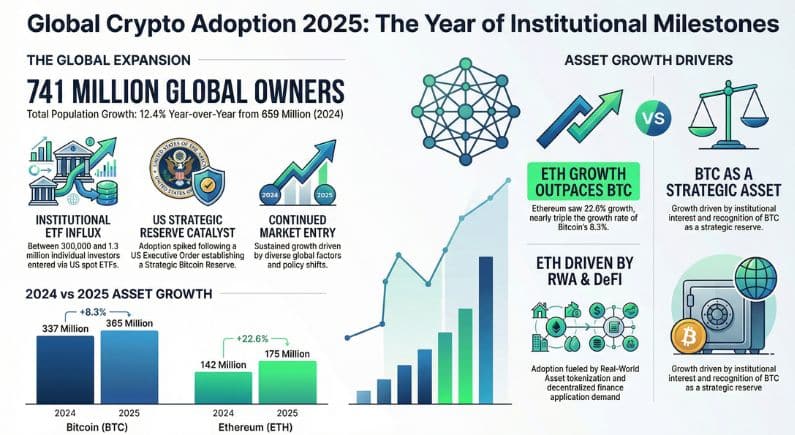
Global cryptocurrency adoption reached a major milestone in 2025, with the number of digital asset holders rising to 741 million, according to Crypto.com’s latest Crypto Market Sizing Report. The 12.4 percent increase from the previous year signals crypto’s transition from a niche technology to a firmly established part of mainstream finance, driven by clearer US regulations and growing institutional interest.
A new milestone for global adoption
Global crypto adoption reached a new peak in 2025, with 741 million people worldwide owning digital assets, up from 659 million the year before, a 12.4 percent increase. Numerous factors contributed to the surge, including political developments such as US President Donald Trump‘s executive order in March 2025 establishing a Strategic Bitcoin Reserve, which provided digital assets with a more formal policy framework. Later, states such as Texas, Arizona, and New Hampshire revealed their own plans for digital reserves, indicating that the government was paying closer attention.
Throughout 2025, there were noticeable fluctuations in the use of cryptocurrencies, influenced by corporate and political events. Owing to expectations of a pro-crypto US government, January saw a 3.4 percent increase, with Ethereum recording an 8.9 percent gain.
Adoption increased once again in March as a result of the Strategic Bitcoin Reserve’s announcement, which brought digital assets back into the spotlight. A further rise of 1.9 percent in September was attributed to businesses integrating digital assets into their treasury plans, reflecting an increase in institutional engagement.
Bitcoin’s path to a strategic national asset
With a global ownership increase of 8.3 percent to 365 million units, or almost half of all cryptocurrency users, Bitcoin maintained its dominant position in 2025. The United States’ announcement of plans for a Strategic Bitcoin Reserve, which would have integrated the asset into a broader national strategy rather than viewing it as merely a speculative investment, marked a significant policy move for the year. The action suggested greater government participation in the industry, as did growing state-level discussions about creating digital reserves.
With a 22.6 percent increase in global ownership to 175 million users, or about a quarter of all cryptocurrency holders, Ethereum experienced significant growth in 2025. The fact that Ethereum remains a key platform for decentralised finance, smart contracts, NFTs, and other tokenisation initiatives helped to drive this increase. Furthermore, a number of businesses integrated Ethereum into their Digital Asset Treasury plans; in September 2025, there was a noticeable rise in these corporate allocations.
In 2025, Ethereum introduced two major network upgrades that contributed to its continued development. The Pectra upgrade, released in May 2025, enhanced validator performance and made the network more efficient for users. Later in the year, the Fusaka upgrade focused on expanding scalability to support growing demand from tokenisation and other applications. These technical improvements helped strengthen confidence among developers and institutions, leading to increased activity and investment across the Ethereum ecosystem.
Spot ETFs open floodgates
Both institutional and individual investors can now acquire digital assets through standard brokerage accounts without the need for wallets or private keys thanks to the US government’s approval of spot crypto ETFs. According to estimates, between 300,000 and 1.3 million new investors entered the market by July 2025, with Bitcoin ETFs holding approximately $11.8 billion and Ethereum ETFs holding approximately $42.3 million.
Approximately $4.5 billion was managed by banks, advisers, and brokerage firms in these products, indicating a shift away from treating cryptocurrency as a purely speculative asset and towards incorporating it into broader portfolio strategies.
Portfolio diversification trends
More crypto users today are spreading their investments across different assets, with over 43 percent of Bitcoin holders also owning Ethereum. Many investors also rely on several platforms—an average of 3.36 exchanges—to balance risk and reduce costs. At the same time, around 42 percent of users choose neither Bitcoin nor Ethereum, instead exploring a variety of alternative digital assets built for specific use cases. These trends show a maturing market where diversification and broader participation have become the norm.
Cryptocurrency is also becoming more integrated into everyday financial life. Digital assets now appear in political discussions, financial planning, and corporate strategy, while digital wallets are becoming more common alongside traditional bank accounts. The industry is continuing to evolve from a specialised alternative to a well-established component of the financial system as institutions become more involved, reflecting how the function and significance of digital assets are continually changing.
Thinking beyond the ordinary? AIBC Eurasiain Dubai and Ras Al Khaimah from 8–11 February 2027, brings together 14,000 leaders shaping the future of frontier technology, crypto and AI
Germany’s online entertainment market has grown sharply in recent years, driven by the convenience of streaming, gaming and other digital services. Many people have embraced platforms that are quick to access and easy to use. But for a long time, customers have also been wary of what can go wrong online, from fraud to privacy risks.
German regulators have moved to address that anxiety. Authorities and oversight bodies have made consumer protection a priority, tightening rules in areas such as content moderation, data privacy and financial safeguards. What stands out is how the system has tried to balance security with the speed users expect, and how widely businesses have adapted to the new requirements.
How Germany is regulating digital media
A recent German study suggested a broader problem behind the digital shift: distrust. Around half of those surveyed expressed dissatisfaction with major companies they deal with. The concern was not limited to online services, but it has shaped how regulators approach the digital market. For officials, figures like these have helped underline the need for tougher rules and clearer standards.
Germany’s digital regulations have not only influenced domestic platforms. They have also had an effect internationally, particularly in heavily regulated areas where trust is crucial. One example in the iGaming sector is Neobet, which has positioned itself as a platform that follows German standards on fraud prevention and verification while still managing to offer fast transactions.
The regulatory push is sometimes discussed in broad terms, but the details matter. A number of specific laws and requirements are designed to help businesses keep services convenient while making them safer for users. Below are some of the measures that have shaped how digital media is regulated in Germany.
Content moderation reduces harm
Germany’s content moderation rules, especially those aimed at hate speech, have attracted criticism. Even so, supporters say they have helped maintain an online environment that places more emphasis on tolerance and safety, particularly in spaces tied to entertainment communities.
A central part of this approach is the Network Enforcement Act, known as NetzDG. It requires platforms to remove unlawful content within a tight timeframe once it has been reported. In cases where content is clearly illegal, removal is expected within 24 hours of a complaint. For other illegal material, platforms are expected to act within a week.
NetzDG was designed with large platforms in mind, applying to services with more than two million users in Germany. While smaller sites fall outside its scope, the law has become one of the best-known examples of Germany’s attempt to push faster enforcement online.
Informed user consent is important in Germany
Germany has also strengthened its rules around privacy and user consent. The Telecommunications Digital Services Data Protection Act (TDDDG), passed four years ago, is intended to give users clearer protections around data storage and tracking. Its core requirement is straightforward: businesses must inform users about the data they store and the access they want to have, so people know what they are agreeing to.
The law was introduced as part of an effort to align German rules with the European Union’s ePrivacy framework. Over the past decade, concerns about tracking and the erosion of anonymity online have become more prominent, particularly as targeted advertising and data collection have expanded.
That debate helps explain why some users have turned to alternatives that promise greater privacy, including cryptocurrency. The appeal has persisted even as the market has faced turmoil, including periods when falling Bitcoin prices led some crypto liquidity providers to pause deposits and withdrawals.
It would be unrealistic to expect tracking and data storage to disappear altogether. But the German approach is often presented as a practical step: ensuring that users are at least aware of what they are consenting to before they click through privacy notices.
Crypto and other digital assets in Germany
Cryptocurrency has become a regular feature of discussions about online entertainment and digital payments. Bitcoin and its offshoots are no longer limited to private trading communities. In Germany, banks and some government-owned companies have begun exploring crypto-related services in response to rising interest.
Here too, regulators have focused on safety. Germany’s financial watchdog has built a framework intended to make cooperation between traditional banks and crypto providers more secure, with licensing and compliance requirements designed to reduce fraud and protect consumers.
For online entertainment platforms, the relevance is partly practical. Many services have offered crypto deposits and withdrawals for years, even as users are warned about the volatility of assets such as Bitcoin and Ethereum. The draw for customers is often speed: transactions can be quicker than some conventional methods. In that sense, crypto is sometimes presented as one way platforms try to meet demand for rapid payments while operating within a stricter security environment.
German digital entertainment is at an all-time high. People across the country are more willing than ever to embrace streaming and online gaming. A swift regulatory response to this surge in interest has helped Germany build an industry that is both safe and strong. And, if current trends continue, the next chapter of the country’s digital sector looks set to be even more interesting.
Standard Chartered has reduced its end of year price target for XRP by 65 percent following February’s sharp crypto market selloff. The British investment bank now expects XRP to reach $2.80 by the end of 2026, down from its earlier forecast of $8, according to DL News.
Geoffrey Kendrick, the bank’s global head of digital assets research, said recent price action across digital assets has been challenging. He added that the bank expects further near term declines and has lowered forecasts across the asset class.
Crypto market faces sharpcorrection
The revision comes amid one of the worst crypto market downturns in almost four years. Bitcoin fell 28 percent over the past month, dropping to a low of $60,000 before staging a partial rebound. Other major tokens recorded similar losses during the same period.
XRP briefly fell to $1.16, its lowest level in 15 months. Although the token has since recovered from that low, it remains around 28 percent down over the past month.
The correction has also affected investor flows. Data from crypto analytics platform SoSoValue shows that assets under management in XRP exchange traded funds peaked at $1.6 billion on 5 January. As of 13 February, that figure had declined to just over $1 billion, marking a drop of about 40 percent.
Forecasts lowered across major tokens
Standard Chartered did not limit its revisions to XRP. The bank cut its end of year target for Bitcoin from $150,000 to $100,000. It also reduced its forecast for Ethereum from $7,000 to $4,000 and for Solana from $250 to $135.
Kendrick said the bank expects XRP to keep pace with Ethereum over the medium term. He noted that both assets could benefit from continued growth in stablecoins and tokenised real world assets.
Earlier this year, XRP had shown strong momentum. The token rose 25 percent in the first week of 2026, supported by ETF inflows and regulatory developments. However, the broader market downturn reversed much of those gains.
Clarity Act seen as potential catalyst
Market participants are closely watching developments in the United States, where lawmakers are considering the Clarity Act, a wide ranging crypto market structure bill currently moving through the Senate.
US Treasury Secretary Scott Bessent said on Thursday that the passage of the Clarity Act would support recovery in the crypto market. The bill aims to provide clearer regulatory rules for digital assets and market participants.
Last month, Katherine Dowling, president of Bitcoin Standard Treasury Company, told that XRP stands to gain significantly if the legislation passes. She said clearer rules could improve institutional participation and investor confidence, according to DL News.
Progress on the bill slowed after banking leaders and crypto executives disagreed on certain provisions. However, discussions appear to have resumed.
On 10 February, Stuart Alderoty, chief legal officer at Ripple, said he held a productive session at the White House and called for swift action on crypto legislation. He stated that bipartisan support remains for sensible crypto market structure rules and urged lawmakers to move forward while momentum remains.
For now, Standard Chartered’s revised outlook reflects caution across digital assets. The bank expects near term volatility to continue as investors assess macroeconomic conditions, regulatory developments and capital flows within the crypto market.
Thailand is advancing plans to integrate cryptocurrencies into its regulated derivatives market, marking a significant step in the country’s broader digital asset strategy.
The Securities and Exchange Commission (SEC) of Thailand recently announced it will expand the range of permissible underlying assets under its derivatives framework to include digital assets and carbon credits. The move follows Cabinet approval of proposals aimed at aligning Thailand’s derivatives market with international standards, while maintaining strong supervision, risk management and investor protection.
Crypto recognised as eligible underlying asset
Under the proposed changes, digital assets, including cryptocurrencies, will be formally recognised as legitimate investment asset classes capable of underpinning regulated derivatives products.
The reform could pave the way for futures, options and other structured contracts linked to assets such as bitcoin, potentially traded on platforms including the Thailand Futures Exchange (TFEX).
“The expansion of permissible goods and variables under the Derivatives Act aims to support new forms of goods and variables,” said SEC Secretary-General Pornanong Budsaratragoon. “This development will help promote more inclusive market growth, facilitate diversification and more effective risk management, and expand investment opportunities for a broader range of investors.”
The inclusion of carbon credits alongside digital assets reflects Thailand’s broader push towards sustainable finance and emerging asset classes.
Regulatory framework and next steps
The SEC confirmed it will begin drafting supporting regulations, including amendments to derivatives business licences. These amendments would allow licensed digital asset operators to offer contracts referencing cryptocurrencies and other digital assets.
In parallel, the regulator will review licensing and supervisory frameworks governing derivatives exchanges and clearing houses to ensure they can accommodate crypto as a new class of underlying products.
The SEC also said it will work closely with TFEX to finalise contract specifications for digital asset-linked products, ensuring they are structured to support effective risk management and real-world market participation.
Part of broader digital economy ambitions
The integration of crypto into Thailand’s derivatives market forms part of the country’s wider ambition to position itself as a regional hub for the digital economy.
Earlier this year, the SEC outlined plans to introduce comprehensive regulations covering digital asset-related products and activities, including crypto exchange-traded funds (ETFs).
Crypto payments for tourists
Last year, Thailand launched TouristDigiPay in August to help the country’s tourism sector, which faced headwinds due to a sharp decline in Chinese visitors and a sluggish global recovery in travel. TouristDigiPay enables foreign tourists to convert cryptocurrency into Thai Baht for local spending. The initiative aimed to revitalise tourism through alternative payment options.
Thailand took a cautious approach to cryptocurrency-based travel payments. The Bank of Thailand regulates e-money providers, the Securities and Exchange Commission (SEC) oversees bitcoin exchanges, and the Anti-Money Laundering Office (AMLO) will ensure that AML regulations are followed. Authorities are overseeing the TouristDigiPay programme’s deployment and managing any potential risks.
Crypto.com co-founder and CEO Kris Marszalek has acquired AI.com domain for approximately $70 million in cryptocurrency and plans to launch a consumer-facing artificial intelligence platform under the brand.
Marszalek confirmed the purchase in a post on X on 6 February, revealing that he bought the domain in April 2025 and has been quietly building a team since then. The domain had previously been listed for sale with a $100 million asking price in March 2025.
I purchased https://t.co/ac2AqjBNxj in April. Since that time, we created a team that has been steadily building. There are always twists and turns, but I’m excited with our first launch this Sunday during the Super Bowl. pic.twitter.com/BbqVo1bQLZ
According to a LinkedIn post by domain broker Larry Fischer, Marszalek paid $70 million for AI.com in what is believed to be the largest domain name transaction ever publicly disclosed.
As reported by The Block, the deal surpassed earlier record-setting domain sales, including CarInsurance.com, which sold for $49.7 million in 2010, and OpenAI’s reported purchase of Chat.com for more than $15.5 million in late 2024. While Gizmodo previously noted that Cars.com was valued at $872.3 million as an intangible asset during a 2014 acquisition, that figure was part of a broader corporate transaction rather than a standalone domain sale.
AI.com platform launch and capabilities
Marszalek will serve as CEO of both Crypto.com and AI.com. The AI.com platform launched on 8 February (Sunday). The company’s press release stated that the platform will allow users to create personal AI agents capable of sending messages, executing actions across applications, trading stocks and building projects. User data will be encrypted using individual encryption keys. “We are at a fundamental shift in AI’s evolution as we rapidly move beyond basic chats to AI agents actually getting things done for humans,” Marszalek said in the release.
As reported by Adweek, the AI.com platform launched with a 30-second fourth-quarter commercial that caused a massive traffic surge, briefly crashing the website.
Broader Crypto.com strategy and policy ties
The AI.com launch comes just days after Crypto.com spun out its prediction markets business into a standalone app called OG, also timed around Super Bowl-related marketing activity. Crypto.com claims more than 150 million retail users worldwide and approximately $1.5 billion in annual revenue.
In comments to the Financial Times, Marszalek said he has already received what he described as “an absolutely insane amount of money” in offers for the AI.com domain but plans to retain ownership.
“When we started Crypto.com there were around a thousand different exchanges, and we somehow managed to make it work,” he said. “We will make this work one way or another.”
Event trading platform for US users
In 2024, Crypto.com unveiled its first-ever sports event trading platform exclusively for US users via its application. This platform enabled participants to trade predictions on sports event outcomes, with the inaugural offering centred on the upcoming Super Bowl. Users could predict which team will clinch the NFL championship in the app, with various teams listed alongside their probabilities, enabling straightforward selection. Operating under the oversight of the Commodity Futures Trading Commission (CFTC), Crypto.com adheres to stringent regulatory requirements, ensuring a compliant trading environment for its users, such as UpDown Options and Strike Options.
In 2024, President‑elect Donald Trump met Crypto.com CEO Kris Marszalek at Mar‑a‑Lago to discuss crypto policy, including a proposed Bitcoin reserve, the same day the company dropped its lawsuit against the US Securities and Exchange Commission (SEC).
Serious about Frontier Tech? Dubai is waiting for you. AIBC Eurasia, 09–11 February 2026, brings 14,500 leaders to the heart of MENA’s tech revolution. Show up where the deals happen.
India’s Union Budget for 2026–27, introduced on 1 February (Sunday), has left the country’s controversial crypto tax regime untouched, while introducing a new penalty framework to tighten reporting compliance and unveiling a broader push to position India as a long-term hub for AI, data centres, and semiconductor manufacturing.
Despite sustained lobbying from the domestic crypto industry, the government chose to retain the existing 30 percent tax on crypto gains and the 1 percent tax deducted at source (TDS) on transactions. However, amendments proposed in the Finance Bill, 2026, signal a sharper enforcement approach toward crypto-asset reporting.
New penalties target crypto transaction reporting
Under the proposed amendments, entities required to report crypto-asset transactions under Section 509 of the Income-tax Act would face financial penalties for non-compliance, effective 1 April 2026.
As noted in the Budget, failure to file the mandated statement would attract a penalty of ₹200 ($2.2) per day for the duration of the default. Meanwhile, filing incorrect information or failing to correct errors after notification would result in a flat penalty of ₹50,000 ($555).
The changes would be implemented through amendments to Section 446 of the Act, with the government stating that the measures are intended to discourage inaccurate or incomplete disclosures and improve oversight of crypto activity.
While enforcement has been strengthened, the decision to leave headline taxes unchanged disappointed industry participants, many of whom argue that the current structure suppresses trading volumes, reduces domestic liquidity, and pushes activity toward offshore platforms.
Budget doubles down on AI, data centres
Alongside its crypto stance, the Budget outlines a long-term technology and infrastructure strategy centred on artificial intelligence, cloud services, and semiconductor manufacturing.
Union Minister for Electronics and Information Technology Ashwini Vaishnaw said the government views data centres, particularly AI data centres, as foundational infrastructure, noting that investment commitments of around $70 billion are already underway, with an additional $90 billion announced.
To attract global operators, the Budget proposes a tax holiday until 2047 for foreign companies providing cloud services to international customers using Indian data centres, provided services to Indian customers are routed through domestic reseller entities. A 15 percent safe harbour on costs has also been proposed where Indian data centre providers are related entities.
Semiconductor Mission 2.0 and manufacturing incentives
The Budget also announced the launch of India Semiconductor Mission (ISM) 2.0, backed by an allocation of ₹1,000 crore for FY 2026–27.
ISM 2.0 expands the scope beyond fabrication to include:
Domestic manufacturing of semiconductor equipment and materials
A larger semiconductor design ecosystem
Expanded talent development initiatives
The government also increased funding for the Electronics Components Manufacturing Scheme (ECMS) from ₹22,000 crore to ₹40,000 crore, following unexpectedly strong industry demand.
Industry view: infrastructure and AI as growth enablers
Commenting on the Budget, Ankit Goel, Chairman & Founder of Space World Group, said the measures reflect a structural shift in how India is approaching growth. “Union Budget 2026 marks a clear push toward a more connected, AI-powered India.”
Goel pointed to public capital expenditure of ₹12.5 lakh crore, tax exemptions for data centres, and renewed focus on semiconductors as signals of long-term intent.
“Growth hinges on reliable connectivity, efficient data flows, and scalable AI ecosystems. With nearly one billion Indians online and digital industries accelerating, these rival roads and power.”
However, he cautioned that execution will determine outcomes. “India’s growth enters a smarter phase. Direction is set; impact depends on execution.”
Crypto policy remains a pressure point
While the Budget’s technology and manufacturing agenda offers clarity on long-term digital infrastructure, the decision to leave crypto taxation unchanged underscores the government’s cautious approach toward the sector.
A recent report by crypto tax compliance platform KoinX found that over 72 percent of trade volume in India’s bitcoin business moved to offshore exchanges in FY25, rather than disappearing. The shift was driven by tax regulations, which encouraged traders to look for simpler options abroad rather than by hype or crashes.
Meanwhile, prior tothe Budget, Tax Survey Report 2026 by CoinSwitch noted rising dissatisfaction among crypto investors with the country’s Virtual Digital Asset (VDA) tax regime. The findings show that investors are not calling for tax removal but are seeking rationalisation and alignment with traditional financial markets.
The survey, based on responses from nearly 5,000 crypto investors across India, shows strong awareness of existing tax rules. Around 88 percent of respondents say they understand the current framework, which includes a 30 percent tax on gains, a 1 percent tax deducted at source on transactions and no provision for loss set off or carry forward. Of these, 66 percent say they are fully aware of the details.
Dubai goes full throttle on frontier tech. AIBC Eurasia, 09–11 February 2026, gathers over 14,500 delegates across AI, blockchain, fintech, and more. Big names. Big tech. Bigger opportunities. Will you be there?

 These numbers are from the early days of bitcoin and seems small when comparing it to today’s value. During the pandemic that started in 2020 the price of Bitcoin would decrease due to financial issues. We can still see an increase during the course of this year when the value increased by 224% in the 12 months. This was mostly because of an institutional interest in cryptocurrencies in general. January 2021 was a historical month for Bitcoin when it beat all its previous price records, selling at more than $40.000.