

In Southeast Asia’s fastest-growing digital economies, a quieter revolution is underway. Women educators and community leaders are pushing back against crypto’s hype culture, one workshop at a time. The Philippines has one of the most active crypto communities in the world as Chainalysis’ 2025 Global Crypto Adoption Index ranks the Philippines 9th worldwide for grassroots crypto use, but it was largely built on play-to-earn cycles, speculative narratives, and influencer-driven hype.
For many Filipinos, especially younger ones in underserved communities, that was their entire introduction to blockchain. In the Philippines, it has backed women like Bea Llana, Arshelene “Tita Arsh” Lingao, and MaryWave, who have each carved out meaningful space in a landscape that still skews heavily male and hype driven. Gracy Chen, CEO of Bitget and initiator of Blockchain4Her, spoke exclusively with AIBC about what that movement actually looks like on the ground.
Reflecting on the gender gap in Web3 adoption across Southeast Asia’s emerging digital economies, Chen was direct. The challenge, she explained, is not a shortage of talent or interest among women.
“Grassroots community-building plays a central role in narrowing the gender gap,” she said. “In markets like the Philippines, adoption often grows through relationships, peer learning, and community credibility rather than through institutional pathways alone.”
Community-led efforts, Chen argued, generate the kind of trust and safety that allow participation to grow organically, especially in economies where most people’s first encounter with blockchain is through friends and local networks.
On how education-first approaches have shaped youth engagement with blockchain, Chen pointed to something more fundamental than curriculum design. The sequence of how young people encounter Web3 matters enormously.
“The focus on education over speculation changes how young people are introduced to the space,” she explained. “Instead of encountering Web3 first through token prices, trading signals, or promises of fast returns, education-first efforts present blockchain as a tool tied to digital literacy and future opportunity.”
According to Chen, this strategy encourages young people to view Web3 as a sector that encompasses technology, design, finance, and entrepreneurship rather than as a quick route to fortune. It also establishes familiarity before financial risk. This change generates a more long-lasting pipeline of engagement, especially in the Philippines, where early introduction to cryptocurrency has frequently occurred through play-to-earn cycles.
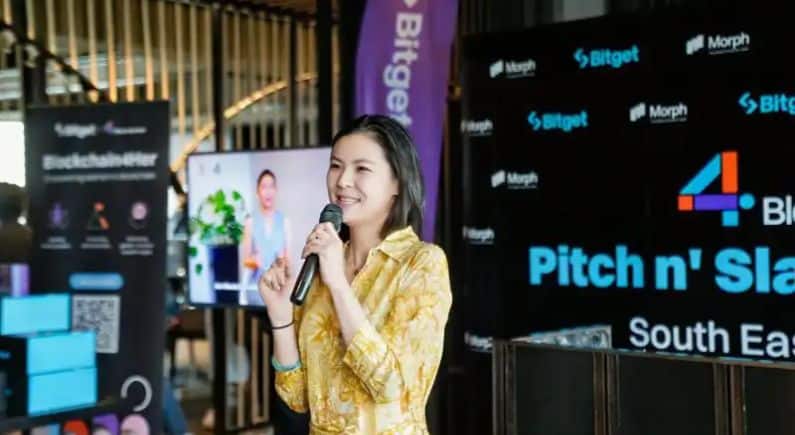
Bitget CEO Gracy Chen. (Source: Bitget)
Combining women’s advocacy with structured youth programmes has been most successful in play-to-earn hubs, where the majority of participants have earning experience but no core knowledge. The most successful strategy, according to Chen, combines youth programmes with women’s activism directly since it addresses the literacy issue from both perspectives rather than just checking a box. Women gain a platform to teach and lead, and younger communities get someone who actually understands their reality sitting across the table from them, explaining ownership, safety, and long-term thinking in a language that makes sense where they live.
The setting is extremely challenging for female educators who are trying to encourage responsible Web3 involvement. Chen succinctly explained the problem: hype spreads more quickly than knowledge.
“Speculative cycles, influencer-driven narratives, and short-term trading culture can make slow, fundamentals-based teaching feel less visible or less exciting,” she noted. Women in technical and financial spaces are also still frequently required to establish credibility in ways their male counterparts are not. Their expertise can be questioned more readily, and their authority in the space is not always assumed.
On what women leaders like MaryWave are doing on the ground, Chen described an approach less about broad messaging and more about disciplined learning environments.
“Her approach emphasises structure, market understanding, risk awareness, and long-term thinking, which is important for beginners and for communities that may have first encountered crypto through noise rather than education,” Chen said.
Chen concluded by making a point that went beyond the technical substance. The real contribution, she said, “is the creation of environments where people feel safe learning, making mistakes, and developing confidence over time.”