- Roadshow to Rome
- Exhibitors
- Agenda
- Speakers
- Media Partners
- News

The South Korean crypto landscape is transforming at a breakneck pace, and the latest message from the Bank of Korea (BoK) is clear: it is prepared to take the driver’s seat. In its recently released 2024 Payment and Settlement Report, the central bank underlined its commitment to proactively influence regulatory frameworks for the use of cryptocurrency, most specifically stablecoins.
South Korea has always had a complicated relationship with crypto. It is home to one of the most active crypto trading communities in the world, yet its regulators have often played catch-up with the rapid pace of technological change. From the 2017 ICO boom to the tightening of exchange regulations in 2021, it has been a bumpy ride.
In the Bank of Korea’s latest report, the central theme is evident: stability. The report discusses payment trends, regulatory issues, and most importantly, urges strong frameworks on crypto, particularly stablecoins. The central bank contends that to disregard stablecoins would be to invite monetary instability and financial risk—a bold turn for an institution usually assiduously risk-averse.
Stablecoins aim to combine the innovation of blockchain technology with the predictability of fiat currency, often pegged to stable assets like the US dollar or Korean won. Unlike more volatile cryptocurrencies like Bitcoin or Ethereum, the primary goal of stablecoins is price stability, making them potentially more suitable for everyday transactions and as a reliable store of value within the digital realm.
While they seem stable in theory, they rely on digital infrastructure that can fail. Hacks, algorithmic malfunctions, and mismanagement of reserves can lead to serious problems. The Bank of Korea cautions that these tokens are not foolproof and could act as Trojan horses—appearing stable on the surface while concealing systemic risks.
The virtual asset market of South Korea has grown dramatically, with its market capitalisation being over 100 trillion Won in 2024. This growth has been driven by a range of factors such as the greenlighting of spot Bitcoin and Ethereum Exchange Traded Funds (ETFs) in leading nations and the introduction of the EU’s Markets in Crypto Assets (MiCA) regulation.
In July 2024, South Korea enacted a landmark crypto law that introduced stricter KYC requirements, exchange oversight, and consumer protection mechanisms. But that was just the first phase. Now, the sequel is here: a second crypto law that focuses on stablecoins and provides operational clarity for crypto platforms.
The emphasis will be on offering straightforward directions regarding token listings, requiring transparent reporting obligations, setting guidelines on the reserve backing of stablecoins, and curbing money laundering and fraud. The aim is not to hold back growth but to drive out bad players and promote trust in digital finance.
Unlike in the past, where regulators reacted to crypto developments, the BoK is stepping up to co-create the rules of the game. They aim to make sure innovation does not come at the cost of stability. Expect the BoK to start flexing its muscles with policy drafts, public consultations, and inter-agency collaborations. By contributing to legislation early on, the central bank hopes to prevent financial chaos rather than clean it up later.
Let’s break it down: If more people start using stablecoins for everyday transactions, it could undermine the central bank’s control over the money supply. This is significant because tools like interest rate adjustments and liquidity injections would become less effective.
The European Union’s MiCA framework, the US SEC’s crackdown on crypto firms, and Singapore’s balanced approach all offer different flavours of regulation. South Korea seems to be carving out a path that sits somewhere in the middle—protective, but not prohibitive. With global political dynamics shifting post-Trump, especially in economic leadership and international collaboration, South Korea is leaning toward its regulatory sovereignty.
In fact, many crypto firms welcome the clarity. A defined framework can be a launchpad, not a roadblock. If the rules are fair and consistently applied, South Korea could emerge as a crypto regulation role model for the rest of the world.
Toulouse has officially become the first European city to accept payments for public transport in cryptocurrency. This innovative move, introduced by Tisséo, the city’s transit authority, enables passengers to pay for tickets with Bitcoin, Ethereum, and other cryptocurrencies. The introduction is part of a broader push to modernise transport payments and adopt digital innovation.
Passengers can buy tickets online using a specialised payment system that supports several cryptocurrencies. Payments are immediately converted into euros through a third-party intermediary, ensuring that Tisséo receives the exact fare amount without being subject to crypto market volatility.
The system now accommodates mainstream cryptocurrencies, such as Bitcoin (BTC), Ethereum (ETH), and other commonly used digital currencies. This move aligns with Toulouse’s digital transformation plan. As cryptocurrencies become increasingly popular in France, this step helps bring public transport into the modern era and serves a technologically advanced population.
A 2024 study found that nearly 20 percent of French citizens hold cryptocurrency, with projections indicating growth to 30 percent in the coming years. Tisséo’s move aligns with this increasing adoption.
Sacha Briand, Head of Finance at Tisséo, said, “It might be 20 or 30 percent in two to three years, so to stay on top of things, and in the interest of modernisation, we’re launching this payment method. Users will pay in cryptocurrency, which is converted into fiat currency, so we receive the amount in euros. Like the rechargeable ticket we’re launching in a few days, this is an initiative to diversify our payment methods.”
To purchase a ticket, visit the official Tisséo website or mobile app and select the ticket type, such as single ride or multi-pass. Choose cryptocurrency as the payment option, complete the transaction via a secure crypto wallet, and receive the ticket digitally.
By converting payments in cryptocurrencies immediately into euros, Tisséo eliminates the risk of market fluctuations. Moreover, sophisticated encryption techniques provide secure transactions. Cryptocurrency payments for public transport have various potential advantages. They allow faster and more efficient payments, enhance accessibility for foreign travellers, and decrease reliance on conventional banks.
Toulouse is at the forefront of crypto adoption for transportation. Other large cities have not yet adopted similar systems, but this project may be a precursor to future adoption.
In a highly anticipated speech at the White House, President Donald Trump announced his new strategy to boost the United States (US) economy, including new tariffs on imports from 50 countries, targeting both BRICS nations (Brazil, Russia, India, China, and South Africa) and the European Union (EU). However, cryptocurrency investors who were hoping for a mention of Bitcoin (BTC), blockchain, or digital assets were left in the dark.
The Trump’s address, called ‘Declaration of Economic Independence,’ had a heavy focus on new tariffs targeting imports from over 50 countries. These tariffs aim to reduce US dependence on foreign goods, particularly from BRICS nations and the European Union. The move is designed to protect American manufacturing jobs and combat what Trump perceives as unfair trade practices that have hurt the US economy over the years.
With zero mentions of crypto in the speech, the digital assets saw a swift and dramatic fall. The omission is significant, considering Trump’s previous campaign promises to make the US the ‘cryptocurrency capital’. Within minutes of Trump’s speech, Bitcoin (BTC), which had been hovering around $88,000, plunged by $3,000 to $85,000. This sharp drop in value occurred in just 10 minutes, sending ripples of panic through crypto traders. Ethereum (ETH) followed suit, sliding down to $1,845, while other major cryptocurrencies, including XRP, BNB, and Solana, saw similar declines.
However, Justin d’Anethan, Head of Sales at Liquifi, a token launch service company based in the US, believes the market move was not entirely because of Trump. He said, “Markets, meanwhile, reacted sharply—but it’s a mistake to attribute that purely to the lack of crypto commentary. The sell-off was already brewing. Risk-off behavior has been intensifying under pressure from rising geopolitical tensions, sticky inflation fears, and now, fears of retaliatory trade actions. These feed directly into a reallocation toward cash and short-duration assets.”
Trump’s speech focused on topics such as inflation control, energy independence, and revitalising US manufacturing. These are important areas of policy, especially for traditional industries that rely heavily on global trade. The omission of crypto, however, according to d’Anethan, “isn’t as telling as it might seem—it’s more a matter of priorities. With tariffs and trade taking center stage, this was a moment to rattle sabers on the global economic front, not to signal domestic tech agendas.”
However, d’Anethan believes that this may change if the silence persists. He said, “Could long-term behavior shift? Possibly, if silence becomes structural. But that’s not what we’re seeing. A more likely outcome is that crypto becomes a policy tool to deploy later—either as a competitiveness pitch or as a wedge against adversaries like China.”
The Federal Open Market Committee (FOMC) made a significant decision to maintain the benchmark federal funds rate between 4.25 percent and 4.50 percent while simultaneously decelerating its pace of quantitative tightening. This decision comes amidst ongoing economic growth, stable unemployment rates, and persistent inflation issues. Investors and economists are closely monitoring the effects of these policies on financial markets and the overall economy over the coming months.
In its first meeting since President Donald Trump returned to office, the Federal Reserve opted to maintain interest rates at their current levels. Additionally, the FOMC announced that starting in April, it will slow the reduction of its securities holdings by lowering the monthly redemption cap on Treasury securities from $25 billion to $5 billion. It will keep agency debt and mortgage-backed securities unchanged at $35 billion per month.
The U.S. Federal Reserve stated on Wednesday, “Recent indicators suggest that economic activity has continued to expand at a solid pace. The unemployment rate has stabilised at a low level in recent months, and labour market conditions remain solid. Inflation remains somewhat elevated. Uncertainty around the economic outlook has increased. The Committee is attentive to the risks to both sides of its dual mandate.”
The Federal Reserve’s statement emphasised several key economic indicators. The economy is still growing at a strong rate, and the unemployment rate is low and steady. However, inflation, although relatively high, continues to be an issue. Furthermore, there is greater uncertainty in the economic outlook due to global and domestic conditions.
The Fed’s action to delay the decline of its securities holdings is intended to avoid market turmoil. By limiting the Treasury securities redemption cap, the Fed is signalling a less aggressive stance on monetary tightening. This action will reduce some tension in financial markets and inject additional liquidity.
The FOMC has projected two rate cuts by the end of the year, leading to increased speculation about potential economic shifts. According to the CME FedWatch tool, there is currently an 18 percent (approx.) chance of a rate cut in May, with significantly higher odds for a reduction in June.
President Trump has repeatedly urged the Federal Reserve to reduce interest rates, claiming that high interest rates hinder economic growth. However, Fed Chairman Jerome Powell has adhered to a data-driven stance, resisting political pressure. The administration’s trade policies, especially tariffs on China, Canada, and Mexico, continue to influence inflation and economic growth.
While the Federal Reserve is being cautious about implementing forceful monetary stimulus, other global players are already taking decisive measures. China issued 300 billion yuan in special treasury bonds last week to stimulate its economy, and European central banks have begun loosening monetary policies to counter economic slowdowns.
Risk assets like cryptocurrencies saw renewed interest following the FOMC’s announcement. Bitcoin, Ethereum, and Solana all experienced notable price increases. Additionally, Ripple’s legal victory against the SEC provided further optimism in the crypto market.
The cryptocurrency community is abuzz with President Donald Trump’s World Liberty Financial (WLFI) cryptocurrency project, which has raised a further $250 million from its second token sale. The total amount raised now stands at an astronomical $550 million, representing a significant milestone for the development of the project.
WLFI is closely related to the Trump family and is touted as a revolutionary decentralised finance banking platform. The growing interest from high-profile investors and regulatory scrutiny, along with the necessary political connections, is making headlines in both the financial and political worlds.
World Liberty Financial aims to revolutionise the way individuals engage with digital currencies. Officially launched in October, just weeks before Trump’s election, WLFI was promoted as a next-generation DeFi platform. A report published during the launch of WLFI suggested that the Trump family may take home 75 percent of net revenue, raising eyebrows among investors and regulators alike.
The latest funding round saw a massive $250 million poured into WLFI, demonstrating investor confidence in the platform’s vision. The company sold $300 and $250 million worth of Ethereum, Bitcoin, Tron, Ondo, Sui, and other cryptocurrencies in two sets of token sales. The announcement by WLFI stated that more than 85,000 people completed Know Your Customer (KYC) verifications to participate in the sale, indicating widespread interest from across the crypto spectrum.
WLFI’s co-founder, Zach Witkoff, son of billionaire Steve Witkoff, stressed that the project is poised to transform DeFi and global finance. According to Witkoff, WLFI’s success reflects the deep understanding of crypto and finance among its supporters.
Witkoff stated, “This milestone proves that those who truly understand crypto and finance recognise what we’re building—and that WLFI is on track to supercharge DeFi as it transforms global finance in the coming years.”
Tron blockchain creator Justin Sun has significantly increased his holding in WLFI tokens to $75 million, showing faith in the long-term prospects of the project. David Sacks, Trump’s AI and crypto czar, reportedly sold more than $200 million in cryptocurrency holdings prior to taking up his position. His participation indicates a robust regulatory approach in the administration.
Witkoff further added, “The token sales are just the beginning. We’re gearing up to launch a wave of disruptive technology that will redefine the boundaries of what’s possible with digital assets.”
President Trump recently signed an executive order establishing a Strategic Bitcoin Reserve, reinforcing his administration’s pro-crypto stance. In a landmark decision, the SEC announced that meme tokens are not considered securities. A court filing in February revealed that Justin Sun and the SEC are in discussions to resolve Sun’s civil fraud case, adding regulatory uncertainty to his WLFI investment. With the Trump family deeply involved in WLFI’s financial structure, scrutiny from regulators is inevitable. Whether WLFI can navigate these challenges will determine its long-term success.
U.S. President Donald Trump has announced the establishment of a U.S. Crypto Strategic Reserve, which will include Bitcoin (BTC), Ethereum (ETH), XRP, Solana (SOL), and Cardano (ADA). This decision, unveiled on his social media site Truth Social, represents a dramatic change in the government’s policy towards cryptocurrency.
Trump’s remarks stressed his intent to make America the world leader in cryptocurrency. Initially, he mentioned only XRP, SOL, and ADA, but later indicated that Bitcoin (BTC) and Ethereum (ETH) would also be included in the reserve.
Trump’s post read, “A U.S. Crypto Reserve will elevate this critical industry after years of corrupt attacks by the Biden Administration, which is why my Executive Order on Digital Assets directed the Presidential Working Group to move forward on a Crypto Strategic Reserve that includes XRP, SOL, and ADA. I will make sure the U.S. is the Crypto Capital of the World. We are MAKING AMERICA GREAT AGAIN!”
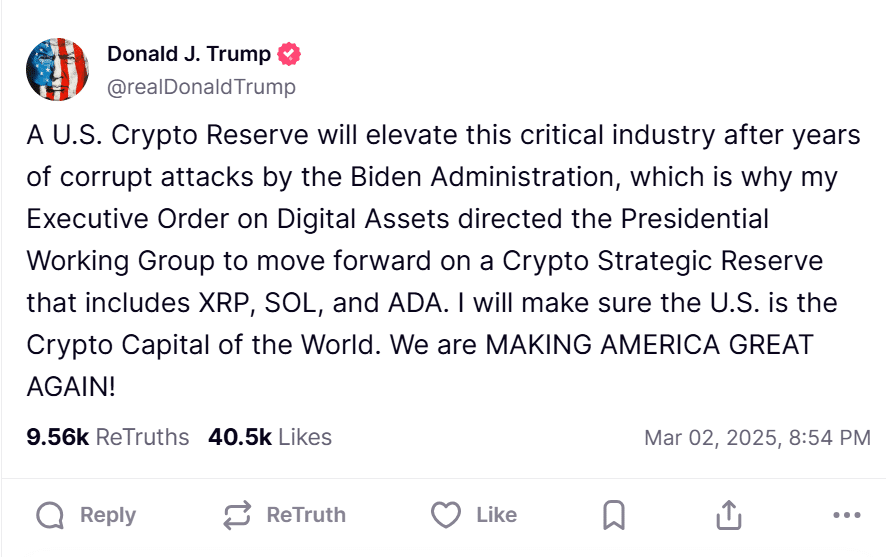
Trump made the announcements on Truth Social, his social media platform.
Following President Trump’s announcement, the prices of XRP, SOL, and ADA saw substantial increases. ADA’s price skyrocketed by over 63 percent within two hours of the announcement, while SOL rose by 23 percent and XRP by 32 percent. Bitcoin, the largest cryptocurrency by market value, climbed more than 11 percent to reach $94,164 on Sunday afternoon. Meanwhile, Ether, the second-largest cryptocurrency, increased by about 13 percent to $2,516.
Trump envisions the U.S. as the dominant player in the crypto space. He aims to reverse the “corrupt attacks” of the Biden administration and create a more crypto-friendly regulatory landscape. Trump has been discussing the concept of a crypto reserve since his 2024 campaign. An executive order signed earlier this year instructed a working group to examine the viability of such a reserve, paving the way for this announcement.
Senator Cynthia Lummis proposed a Bitcoin reserve to accumulate 1 million BTC over five years. While her bill stalled, Trump’s reserve plan seems to take a broader approach by including multiple cryptocurrencies.
Despite initial price surges, the crypto market has faced volatility, with major digital assets experiencing sharp declines. Analysts suggest that factors such as interest rate policies and regulatory clarity from Trump’s administration will dictate the market’s next moves. Although the strategic reserve would greatly contribute to the crypto sector, several issues persist. One of the main issues is market volatility, as cryptocurrency prices tend to be very volatile. Secondly, political pushback may ensue, as some politicians might oppose the concept of government-sponsored crypto holdings. Lastly, regulatory barriers need to be overcome, as implementing transparent and efficient policies will be vital to the success of the reserve.
“The allocation will likely be a rounding error compared to national reserves, gold holdings, and trade agreements. The bigger concern is the psychological effect—if the U.S. legitimises Bitcoin as a reserve asset, it could trigger a wave of unsophisticated retail investors piling in without understanding the volatility or diversification risks,” he added.
When asked about the market reaction in the short and long term, especially for smaller market cap coins like XRP, ADA, and Solana, d’Anethan noted that in the short term, the impact is already visible. ADA jumped 30-50 percent, driven by lower liquidity and the unexpected nature of the news. SOL and XRP are riding the same wave. It’s notable that these assets align with Bitwise’s top fund holdings, which crypto czar David Sacks—likely an influential voice in this policy shift—is directly involved with.
In the longer term, it still comes down to fundamentals. According to the crypto-expert, the real test for ADA, SOL, and XRP isn’t this announcement—it’s whether their ecosystems can build compelling, widely adopted solutions. However, d’Anethan also opined that this move clears a major psychological barrier. “Governments, sovereign wealth funds, and large institutional players now have a green light to allocate without fearing reputational risk. That’s a powerful shift,” he said.
Regarding measures investors should take to protect their investments and capitalise on potential opportunities, d’Anethan advised against succumbing to FOMO (Fear of Missing Out). If investors are only reacting now, chances are, the first wave of the trade has already played out, and the market is in a slight pullback.
That said, the long-term implications are undeniable. Having the U.S. government vouch for crypto as a strategic asset class is a seismic shift. Over time, this could drive fresh capital into the space, lifting not just BTC and ETH, but also altcoins that haven’t yet seen their moment, d’Anethan noted. He added that the key is disciplined positioning. “Investors should avoid chasing euphoric pumps and instead look at where institutional money might flow next. This is likely just the beginning of a broader reallocation into digital assets.”
When most people hear “blockchain,” they immediately think of Bitcoin. But blockchain technology extends far beyond cryptocurrency; it’s driving innovation across multiple industries, including entertainment, gaming, finance, and even healthcare. In a tech-forward nation like Australia, blockchain is rapidly changing the way people engage with digital services, attracting significant public and private investments and laying the foundation for a more transparent and secure digital ecosystem.
Blockchain is a decentralised and distributed ledger technology that records digital transactions securely and transparently. Since transactions on a blockchain don’t require a central authority or intermediary like a bank, they offer greater security, anonymity, and efficiency. This makes blockchain a game-changer in financial services, digital payments, and even entertainment platforms.
In Australia, blockchain is gaining traction across multiple industries, with gaming, finance, and retail among the top adopters. However, regulatory restrictions still apply, especially in the use of crypto for gaming transactions. If you’re considering using digital currencies for gaming, it’s wise to check reputable review platforms like CasinoBuddies, which lists not only the most recommended real-money online pokies casinos in Australia but also the top crypto casinos that accept digital currencies such as Bitcoin and Ethereum.
Beyond financial services, blockchain is also transforming supply chain management. Companies are using blockchain to track the movement of goods and verify authenticity, reducing fraud and improving efficiency. This is particularly important in industries such as food production and pharmaceuticals, where trust and transparency are paramount.
Beyond financial transactions, blockchain plays a crucial role in the development of Web3, ushering in a new era of decentralised applications. By integrating blockchain with Web3 technologies, businesses can build more secure, user-controlled platforms, allowing individuals to manage their digital identities and personal data without third-party interference.
A great example of this is in the gaming sector, where blockchain supports crypto-friendly online pokies. These platforms provide increased privacy, instant payments, and greater transparency. Blockchain’s algorithms also ensure game outcomes are completely random and provably fair, boosting trust and confidence among players.
Additionally, Web3 and blockchain technology are creating new opportunities in content creation and social media. Decentralised platforms allow creators to monetise their work directly without relying on traditional intermediaries like large streaming services or publishing houses. This shift gives artists, musicians, and writers more control over their intellectual property and revenue streams.
One of the most exciting applications of blockchain is tokenisation, the process of transforming real-world assets into digital tokens. This allows assets like real estate, art, and commodities to be traded more efficiently, reducing reliance on intermediaries and increasing liquidity and transparency.
A 2019 study revealed that small-to-medium-sized businesses in New South Wales and Victoria were among the first to explore tokenisation, viewing it as the next step in Australia’s evolving financial landscape. However, despite its potential benefits, regulatory challenges remain a significant hurdle. The Reserve Bank of Australia (RBA) is currently exploring the possibility of launching a central bank digital currency (CBDC) to facilitate tokenised banking transactions, which could help cut costs and enhance efficiency in the financial market.
Beyond financial assets, tokenisation is also making waves in the entertainment industry. Musicians and artists are experimenting with NFTs (non-fungible tokens) to sell exclusive content, concert tickets, and digital collectibles directly to fans. Similarly, sports franchises are leveraging tokenisation to offer unique fan experiences, including digital ownership of memorabilia and VIP access to events.
With cyber threats becoming more sophisticated, blockchain is emerging as a powerful tool for enhancing digital security. By decentralising data storage, blockchain reduces the risk of hacks and data breaches. In Australia, businesses and government agencies are exploring blockchain-based identity management systems to protect user data while ensuring seamless verification processes.
For example, blockchain can be used to create tamper-proof health records, allowing patients to control access to their medical history without relying on a centralised database. This technology has the potential to improve patient care and streamline medical processes while safeguarding sensitive information from cyber threats.
Blockchain is undeniably reshaping how Australians interact with digital services. From financial applications to gaming, tokenised assets, and security solutions, the opportunities are vast. However, regulatory compliance remains a major challenge that could impact the speed of widespread adoption.
Despite these obstacles, Australia’s digital economy is on an exciting trajectory. With continued innovation and investment, blockchain’s influence will only expand, paving the way for a more secure and decentralised digital future. As more industries recognise the benefits of blockchain, Australians can expect a wave of new digital services that prioritise security, efficiency, and transparency.
U.S. President Donald Trump and First Lady Melania Trump have entered the realm of digital assets by launching their respective meme coins, $TRUMP and $MELANIA. These tokens, launched in mid-January 2025, exhibit very high volatility, highly responsive to the unpredictable meme coin market. On 17 January 2025, just days before his inauguration, Donald Trump unveiled the $TRUMP meme coin. Initially met with scepticism due to the absence of a formal announcement, the coin’s legitimacy was later confirmed through Trump’s posts on social media platform X.
My NEW Official Trump Meme is HERE! It’s time to celebrate everything we stand for: WINNING! Join my very special Trump Community. GET YOUR $TRUMP NOW. Go to https://t.co/GX3ZxT5xyq — Have Fun! pic.twitter.com/flIKYyfBrC
— Donald J. Trump (@realDonaldTrump) January 18, 2025
The $TRUMP coin’s logo features a cartoon depiction of Trump raising his fist, commemorating his survival of an assassination attempt in July 2024. The project’s website emphasised that the coin was “not intended to be, or the subject of” an investment opportunity or security and was “not political and has nothing to do with” any political campaign, political office, or government agency. The terms prohibited buyers from participating in class-action lawsuits against the project and asserted indemnity against any claims.
Following its launch, $TRUMP’s price surged by over 300 percent overnight. Within two days, it became the 19th most valuable cryptocurrency globally, boasting a total trading value of nearly $13 billion, with each of the 200 million tokens valued at approximately $64 by the afternoon of 19 January. Reports indicated that Trump affiliates controlled an additional 800 million tokens, potentially significantly elevating Trump’s net worth.
Two days after $TRUMP coin launched, Melania Trump introduced her meme coin, $MELANIA. The Solana-based token quickly achieved a valuation of $12 billion within three hours of its launch. However, the construction and security measures of the project’s website have been criticised, which has led to questions about its legitimacy.
The Official Melania Meme is live!
You can buy $MELANIA now. https://t.co/8FXvlMBhVf
FUAfBo2jgks6gB4Z4LfZkqSZgzNucisEHqnNebaRxM1P pic.twitter.com/t2vYiahRn6
— MELANIA TRUMP (@MELANIATRUMP) January 19, 2025
The excitement surrounding both meme coins was short-lived. By 21 January 2025, the price of $TRUMP had declined by around 50 percent, falling from a high of $74 to about $38. Similarly, $MELANIA experienced a significant decrease, with its market capitalisation falling from $2 billion to $790 million.
As of 31 January 2025, $TRUMP is trading at approximately $0.745, reflecting a 0.11 percent decrease from the previous close, with an intraday high of $0.842 and a low of $0.742. Meanwhile, $MELANIA is priced at around $2.09, experiencing a 0.07 percent decline, with an intraday high of $2.30 and a low of $2.05.
These high-profile launches of meme coins have sparked public debate within cryptocurrency circles. This speculation, often likened to gambling, threatens the reputation and future value of the field. Some are considering the involvement of gaming commissions to regulate the volatility issues associated with the inherent lack of value of the underlying asset.
Moreover, as meme coin-based exchange-traded funds (ETFs) from asset managers gain momentum, there are apprehensions about creating “casino-type” speculation in the financial markets. The future of such digital assets will largely be dictated by the U.S. Securities and Exchange Commission’s response.
Speaking exclusively with AIBC World, Justin d’Anethan, Head of Sales at Liquifi, a token launch service company based in the US, shared his views on the profound positive and negative impacts of this phenomenon. He elaborated on the promising future of the market and helped us to understand the intricate dynamics at play.
AIBC: What are the positive and negative impacts of the $TRUMP meme coin, which we’ve seen in the past week?
Justin d’Anethan, Head of Sales at Liquifi: The old industry is split between positive and negative. On the positive side, I think there are three dynamics that are coming across. The first one is it’s very supportive for the crypto space that the US president and administration would be getting involved with crypto. There’s just a very good signal in terms of support from that point.
The second one is it gives a little bit more leeway, a little bit more room for activity from a legal perspective because you kind of assume that if you’re a company and you’re operating in crypto, as long as you’re not doing something too shady, if you’re just acting on it with best intentions, you shouldn’t.
Then the third part is it sends a signal to a lot of companies that are not involved in crypto, that they can now get involved in crypto. So, if you’re Apple or Microsoft or a small company or an NFT or media or gaming and you want to do something with crypto, go ahead and do it because it’s okay.
And the negative point that we have noticed that there was a liquidity event that happened with all the other coins. So essentially, the one you were talking about with the concentration, which is you have the Trump coin launching. And all the capital that was allocated and staying with. But that feels very negative for this. It’s right because of course, it’s cool that there’s volume and activity, but if we’re being honest with ourselves, like a meme coin is just a meme coin, right? It’s not building DeFi solutions or creating an ecosystem in which people can do a variety of stuff.
Another disappointing thing within all this is if you look at the total market cap of crypto, it hasn’t moved up by that much during the events. So essentially what that means is that the capital that was traded was crypto native guys and not necessarily people outside of crypto. They didn’t have the time because you needed a Solana wallet, you needed to go onto the right DEX, needed to be aware of the thing happening. And by the time you were aware, the Trump coin was already down quite a lot, and the Melania token was out and already down quite a lot and then the Baron token and kind of went cascading down that way.
AIBC: Do meme coins pose any concerns regarding financial stability and national security?
d’Anethan: Not at all. I think even though there’s a big speculative element to meme coins, I think people, even the average investor, are smart enough and knowledgeable enough to understand that it is very speculative, that it is very volatile, right? So, I don’t think anybody is under the illusion that if they buy a Trump Coin or a Melania Coin, that it is the same as the S&P 500 or investing in IBM, Microsoft, and Apple, right? So, I don’t think any of the large, sophisticated players will get involved in meme coins, or if they do, they’ll do it in a very smart way. And so, I don’t think it will, in fact, affect the stability of financial markets. I think it might hurt a lot of retail users, the ones that will be on the losing end of the trade.
AIBC: What are the key security and privacy concerns in the cryptocurrency space?
d’Anethan: I still think one of the core values of crypto is the privacy side of things, and so I think that relative to any other industry, especially if you’re thinking about Web2 and kind of centralised models, the privacy concerns should always be higher because you’re essentially trusting a large company that typically wants to monetise its user info. The only thing is a lot of hacks, and a lot of scams do happen in crypto because, of course, the whole responsibility of that privacy and safety is on the user side of things. If you’re doing everything right, you should never get hacked because the blockchain itself cannot get hacked.
I think as more and more people get involved, you will see more of those incidents. It won’t be a fault of the blockchain in terms of architecture. It would be a fault of the user, but just because of ignorance or inexperience. You cannot share private keys, you cannot interact with something that is not audited, you shouldn’t click on links that you don’t know, or interact with people that you don’t know online, people that reach out to you without you having to reach out to them first, and so on.
AIBC: How will meme coin culture impact the market in the coming year?
d’Anethan: I want to be optimistic here and I want to think that it’s going to onboard more users. Do you know what I mean? It’s like the NFT craze of the 2020-2021 bull market where, you know, you talk to your grandmother and she was trading an NFT and you’re like, huh, how did that happen, right? And it’s like if it gets cool enough and popular enough, it will get a lot of people to at least create a wallet, try some transactions, buy some Ethereum, buy some Solana, you know, do something to participate in that speculation.
Whenever you have a trend that’s very explosive, it goes on for a while, but you cannot sustain super big growth. You can do it for six months, you can do it for 12 months or 18 months, but at some point, people are like, you know, I didn’t make as much money as I thought. I made a lot of money, but now I’m not making as much money. And so, I should kind of cool down and take my money off the table. And so, you’re going to see some losers at the end of the trend and some winners maybe at the beginning, but yeah, that’s my perspective on it.
AIBC: What is your prediction for the Asian crypto market dynamics?
d’Anethan: I’m going to give you a positive and a negative view on the market because I think on the positive side, I think a lot of jurisdictions, a lot of countries, again, are going to try to catch up to the US and show that they’re active. You’ll have a lot of countries like maybe Korea or Japan or Thailand or Hong Kong or Singapore kind of supporting the crypto space because, again, they want to maintain relevance relative to the other countries. And that’s supportive for the crypto space. And there’s a lot of traders in Asia, right? A lot of the trading activity in India, but also in Korea and Japan and Southeast Asia is very big, so it’s a thing. And so, I think that will be positive.
I’m just talking about traditional markets in general. I think the theory is that Trump is going to keep or impose tariffs on the Asia side of things. He’s going to dampen enthusiasm. That’s on the market, but it still has an impact in terms of how much money people have in the region. And if they feel a bit more fearful, there’s less liquidity, there’s less certainty. It’s harder for them to get involved in speculative assets like new crypto projects, for example. And so, I’m positive for the crypto space. I think there’s still going to be a lot of traders.
AIBC: How do you see the crypto market evolving in the next 6–12 months?
d’Anethan: I’m not allowed to give any kind of financial advice, so I’m just sharing it from an opinion perspective. First, there are some dynamics that I think we will see unfold, which is essentially you’re going to see a lot more celebrities and companies getting involved in crypto, and that’s presumably going to be positive. It just means a lot more people are aware of those solutions and getting set up or involved with DeFi solutions. The other thing is I think a lot of asset managers, sovereign wealth funds, and governments are going to have to start looking at crypto. And it’s not a question of whether they like it or not. It’s just that if the US is doing it, and if you want to stay relevant, you need to have some kind of activity, some kind of, at least in opinion, we really don’t like it.
There is some kind of strategic reserve, like a strategic Bitcoin reserve as it’s been discussed for the US, but maybe other governments will follow suit. That will be just insane, basically. So, if the US does that, a lot of other countries will have to follow. And then there’s no more price target. It just can go up so much that you just don’t even know where to draw the line. AI coins are probably going to be very trendy. I’m not really confident myself if there’s actual value or substance behind those tokens, but I think it’s a narrative that people are going to pile into because 2025 AI is the thing, and if crypto becomes the thing, then some people are going to put two and two together and kind of do an AI crypto.
Over the past decade, online poker and cryptocurrency have both skyrocketed in popularity. This has created an interesting collision for players who wish to enjoy playing poker with the security, flexibility, and decentralised benefits offered by crypto.
In this comprehensive guide, we’re exploring the pros and cons of playing poker with cryptocurrencies. We’ll also examine a range of reliable and popular cryptocurrencies (beyond Bitcoin) used for buy-ins and dive deep into the aspects players should consider before funding poker games with cryptocurrency.
Crypto poker can be described as traditional online poker where players fund their buy-in or accounts using digital currencies as opposed to fiat money. This form of online poker became popular as cryptocurrencies like Bitcoin started gaining mainstream acceptance and adoption.
From this crypto integration into online gambling sites, players saw that crypto payments offered decentralised, fast, and relatively anonymous transactions. Due to this popularity, a number of online poker platforms have embraced crypto payment methods and allow users to buy into poker games using Ethereum, Litecoin, Bitcoin, and other altcoins.
These days, we also have a new breed of online casinos that can be played directly from the messaging app Telegram. Such platforms, like TG Casino, which has been voted the best Telegram casino, allow users to buy into poker and other live casino games using cryptocurrencies. Because of this, players can enjoy secure gambling, improved privacy, instant withdrawals, and rapid transaction times, all from the comfort of their smartphone, tablet, or laptop. These gaming options have already gained significant popularity among Telegram users, and the future growth of crypto will only make them more attractive for crypto players.
Online crypto poker offers distinct advantages, specifically for players who value control over their funds, anonymity, and international access. Here are some of the most-liked benefits of partaking in crypto poker:
Even though fees can vary by currency, crypto transactions are generally associated with lower fees than credit card transactions or bank transfers. Crypto options like Ripple and Litecoin have consistently low transaction fees, while Bitcoin can incur higher costs during peak times. This makes Ripple and Litecoin ideal for players who make consistent withdrawals and deposits.
Due to the decentralised nature of crypto, players benefit from almost instantaneous transactions across borders. This is particularly useful for international players who would otherwise experience delays with traditional banking transfers. Especially for international transactions, fiat withdrawals can take various business days to reflect. However, crypto transfers are typically processed anywhere from a couple of minutes to a few hours.
Due to regulatory concerns, banks in some countries might restrict transactions through online gambling sites. Using cryptocurrency offers a way to get around these limitations, as players can deposit and withdraw funds directly to and from poker platforms without needing to involve any banking institutions. Players in jurisdictions where traditional poker payment options are restricted might find using cryptocurrency particularly useful in these cases.
Crypto transactions offer a degree of anonymity and discretion, which many online poker players prefer. That’s because crypto transactions do not require any personal financial details from players, unlike traditional payment methods associated with credit card companies or banks. The privacy offered by crypto appeals to players concerned about identity theft and security. Other players prefer the convenience of keeping their gaming activities separate from their other financial dealings.
Some online poker platforms offer exclusive bonuses to players who make crypto deposits to attract more users. These rewards and bonuses might come in the form of free poker tournament entries, extra funds, or rakeback deals (fee rebates taken by the poker site). Sites offering these promotions help add value to the player experience. Additionally, these rewards can sometimes be more generous than deposit bonuses from standard payments.
Despite the many reasons for using crypto for online poker, you still want to know the potential downsides.
It’s common for many online poker platforms to accept Bitcoin. However, fewer platforms allow payments with a broad range of cryptocurrencies. This means that players who prefer using stablecoins or altcoins have limited options. Especially for well-established poker platforms, fiat remains the most popular option, even though the list of crypto-friendly poker sites is growing.
The prices associated with cryptocurrencies are famously volatile. By the time a player withdraws, they might find that their Ethereum or Bitcoin may be worth significantly less (or more) than when they made their initial deposit. Such risks are particularly concerning for players who keep their funds stored on poker sites for extended periods.
Players need to understand transaction confirmations, keys, and wallets when using cryptocurrency. This learning curve may be daunting for players who are new to crypto, just as novice poker players may know the rules but not necessarily in-depth strategies like the art of playing pocket kings or knowing when to bluff. Like using an incompatible network or sending funds to the wrong address, mistakes can lead to permanent loss of funds. Moreover, buying crypto may involve identification verification and fees and requires access to a reliable exchange.
Crypto is subject to scams and hacks if players don’t take the necessary precautions, even though these digital assets offer high levels of security. That’s why players need to use secure platforms and wallets, as these crypto transactions can’t be reversed. Stolen and lost funds can’t typically be recovered, which is unlike credit card transactions in some instances.
Bitcoin is the most accepted and widely used cryptocurrency. However, there are many other altcoins that are popular among poker sites for their unique set of advantages and characteristics. Here’s an in-depth look at some of the most popular crypto coins for poker buy-ins:
Bitcoin maintains its position of being the first and most widely accepted cryptocurrency, which is why it’s the most commonly accepted for online poker. This digital currency is well-liked for widely recognised, fast, and secure transactions. Nonetheless, some users might consider alternative options because of the coin’s slower processing times and higher transaction fees during high-traffic periods.
Pegged to the U.S. dollar, Tether is a stablecoin that offers the flexibility of crypto with the stability of fiat currencies. This is an attractive choice for those wanting to avoid market fluctuations during gameplay, as Tether’s value is less volatile than other cryptocurrencies.
Often labelled as the “silver to Bitcoin’s gold,” Litecoin provides lower transaction fees and faster block generation times. This makes it a practical option for online poker players. This digital asset is widely accepted by poker sites and is a great choice for players wanting a balance between transaction costs and speed.
Another popular option for online poker buy-ins is Ethereum, which is well-liked for its smart contract capabilities. The transaction speeds of ETH are faster than those of Bitcoin, while the Ethereum network also supports various tokens (ERC-20 tokens), which are also accepted on some sites. However, one downfall is that ETH is subject to “gas fees,” which significantly increase during network congestion.
Dogecoin is backed by an active community and is liked for its low transaction fees despite initially being created as a joke. DOGE’s acceptance into specific online poker platforms showcases its appeal to a subset of poker players even though the digital asset is less commonly accepted than ETH or BTC.
Thanks to low costs and rapidly fast transaction speeds, Ripple is an excellent option for players who want to prioritise transaction efficiency. Yet, the somewhat centralised nature of XRP has stirred up debate among crypto enthusiasts.
For those ready to dive into crypto poker, here’s a step-by-step guide to get you started:
You need a crypto wallet to store your cryptocurrencies. When picking a wallet, you can choose between software wallets (desktop, mobile, or online) or hardware wallets (physical store devices). Hardware wallets offer strong security, while software wallets are liked for their added convenience.
Once you’ve set up a wallet, you can go ahead and purchase cryptocurrency on a reliable crypto exchange. Most of these exchanges accept various payment methods, such as credit cards, bank transfers, and even PayPal.
Pick an online poker platform that’s reputable and accepts cryptocurrency. Before deciding on this platform, consider factors like available games, security, user reviews, and withdrawal policies.
After selecting an online poker site, you want to navigate to the platform’s deposit section and choose your preferred cryptocurrency. From here, follow the site’s instructions to fund your account. It’s important to double-check the wallet address to avoid making any errors.
Now that you have funds in your account, you’re ready to join online poker tables and start participating in games. If you’re dealing with a volatile crypto coin, remember to monitor market conditions and practice bankroll management.
Players have several other reliable payment methods for poker buy-ins besides cryptocurrency. Depending on the player’s priorities for convenience, privacy, and speed, each payment method comes with its own set of pros and cons.
Providing a middle-ground solution, e-wallets allow for fast deposits and withdrawals without sharing bank details with the poker platform. Nonetheless, some e-wallets don’t support gambling transactions in various jurisdictions, and transaction fees can vary depending on which e-wallets are accepted.
Typically limited by regional restrictions and incurring fees, debit and credit cards are still one of the most widely accepted payment methods and offer standard transaction speeds. Even though credit or debit card deposits are quick, withdrawals might not be available through this payment method on some poker platforms.
Bank and wire transfers are the most traditional payment methods and are known for being reliable and secure. However, bank or wire transfer transactions are often slow, with withdrawals generally taking up to several working days. Additionally, bank transfers typically incur higher fees, a drawback for frequent online poker players.
A more anonymous method of depositing funds into online poker platforms is through vouchers or prepaid cards. However, such payment methods are limited to deposits only. You can’t typically facilitate withdrawals to prepaid cards. That’s why players require a secondary method if they want to cash out.
Using crypto offers many benefits when playing online poker. However, it also requires players to adopt a responsible and cautious approach. From managing the risks associated with crypto to picking a secure platform or using poker spreadsheets to track your spending, these tips will help players protect their assets and have an enjoyable playing experience.
Your chosen poker platform and wallet can either make or break your playing experience. That’s why you want to pick secure sites that will keep your funds safe. Here’s what to consider:
Acting as the gateway to player funds, cryptocurrency relies on securely storing private keys. That’s why protecting these keys is crucial, and you can do so by:
Between the time you win and cash out, the value of player funds can be significantly impacted by crypto’s volatile price swings. To minimise these risks, you can:
Even though online crypto poker can be convenient and exciting, it’s important to approach playing with the same responsibility as any form of gambling. You can do this by:
The inclusion of cryptocurrency in online poker has opened up new possibilities for players and offered a flexible way to engage in the game. With benefits like faster transactions, improved privacy, easier access across borders, and lower fees, playing poker with crypto is an attractive opportunity for many players who want more control over their online gaming experience.
With that being said, it remains crucial for players to recognise potential drawbacks of using crypto in online poker, especially the security risks associated with digital currency, volatility of crypto assets, and limited availability of crypto poker platforms.
In the end, choosing to play poker with crypto comes down to a player’s comfort with digital assets and preferences. By understanding these pros and cons, staying informed about market trends, and choosing to play on secure platforms, players can empower themselves to partake in rewarding online poker experiences that are improved by the flexibility of cryptocurrency.
Kazakhstan has been making headlines for its stringent approach to regulating cryptocurrencies. By shutting down over 3,500 illegal exchanges, the country is setting an example for the global crypto community. The latest effort by the Kazakh regulator, AFM RK, underscores its commitment to digital asset legislation.
Cryptocurrency use in Kazakhstan has been on the rise, mirroring a global trend. To protect consumers and maintain financial stability, the government has established a comprehensive framework to monitor, supervise, and regulate digital asset activities.
The AFM RK’s recent announcement highlighted the scale of the crackdown. The National Security Committee and the Ministry of Culture and Information collaborated with AFM RK to dismantle illegal exchanges and curb their use in criminal activities, thereby safeguarding the financial system’s integrity.
Kazakh authorities have shut down over 3,500 illegal cryptocurrency exchanges. These platforms, operating without proper licensing and violating the country’s strict digital asset laws, are now banned. This move reduces the risk of financial fraud and money laundering.
In 2024, authorities intensified their efforts by dismantling 36 illegal crypto exchanges with a combined turnover exceeding US$113 million. Assets worth 4.8 million USDT were also frozen and confiscated. Notably, in 2023, Kazakh authorities blocked access to Coinbase for violating the country’s digital asset laws.
The crackdown also uncovered two major cryptocurrency pyramid schemes. Authorities successfully returned 545,000 USDT to victims and froze an additional 120,000 USDT held by the schemes. This recovery effort underscores the government’s commitment to protecting its citizens.
“AFM continues to work with international partners to enhance control over crypto transactions and combat their use for criminal purposes. Amendments to the legislation have also been developed, introducing liability for providers of digital assets in cases of money laundering violations. Checks on cryptocurrency transactions in financial institutions have been strengthened,” stated the regulatory announcement (translated from Russian).
Kazakhstan’s regulatory bodies are working with international partners to enhance control over cryptocurrency transactions. This collaboration aims to prevent the use of virtual assets for criminal purposes, reflecting a broader global initiative.
The regulatory announcement concluded, “AFM will continue to improve tools for effectively monitoring financial transactions to combat criminal schemes involving virtual assets.”
Despite the crackdown on illegal operations, major global crypto exchanges like Bybit and Binance have expanded their presence in Kazakhstan. There are 21 licensed digital asset service providers in the country, including well-known platforms like Binance, Bybit, ATAIX Eurasia, and Biteeu. These companies have obtained full regulatory licenses and demonstrate their dedication to following regulations and working closely with local authorities.
The National Bank of Kazakhstan has launched a pilot programme to explore the digital tenge, a central bank digital currency (CBDC). This initiative aims to modernise financial transactions and enhance processes such as VAT reimbursements through digital fiat.
Currently, crypto exchanges are restricted to operating within the Astana International Financial Centre (AIFC), a trade and financial zone located in Astana. This environment requires a delicate balance between control and innovation for digital asset providers.
Russian authorities have announced that ten regions will halt cryptocurrency mining for six years. The move, starting from January 1, 2025, comes as the country struggles with energy shortages and as part of the country’s strategic financial plans.
The restrictions, lasting till March 15, 2031, is sure to have ripple effects across the crypto world, especially for miners in regions heavily reliant on mining operations. The ban is directed to regions with high energy consumption and demand. The affected regions are Dagestan, Chechnya, and the Donetsk and Lugansk People‘s Republics.
Regions such as Irkutsk and Zabaikalsky will also have specific restrictions during the winter season when electricity demand is at its peak.
The ban comes as Russia struggles with an ongoing energy shortage. This comes as the country usually has high energy demand, especially in colder months. This leads to the country finding it increasingly difficult to manage its power resources effectively, with crypto mining being a significant contributor to this strain due to high consumption.
The has given rise to regional pricing disparities in the country, with some regions having lower electricity prices while others face much higher costs. This has been backed by insights from energy sector experts like Sergey Kolobanov.
Therefore, the government aims to balance energy consumption, address regional pricing disparities, and ensure that the nation’s energy resources are allocated more efficiently. Economic inequalities and inefficiencies are especially prevalent in areas where crypto mining is concentrated.
Vladimir Klimanov, a regional policy specialist, has endorsed the idea of adopting a unified pricing structure across the country. He believes this could reduce the financial strain on certain regions and make energy distribution more sustainable.
While Russia has long allowed cryptocurrency mining, recent changes in the regulatory environment require mining activities to be registered with the Federal Tax Service (FTS). However, small-scale miners, those consuming less than 6000 kWh per month, are exempt from paying for electricity.
The move towards regulation is expected to stabilise the sector and address concerns about unregulated mining activities that cause the already existing energy shortages to exacerbate.
At the same time as the mining ban was announced, Russia’s government has been engaging in discussions about the potential for a Bitcoin Strategic Reserve. This concept proposes that Bitcoin could serve as a safeguard against economic instability.
Bitcoin’s decentralised nature presents it as an attractive alternative to traditional foreign exchange reserves amid inflation and foreign restrictions weighing heavily on Russian economy.
The Bitcoin Strategic Reserve is part of a broader strategy to bolster Russia’s financial stability through the use of digital currencies. With the global economy facing increasing inflation, Russia is looking at ways to diversify its reserves. By adopting Bitcoin, the country could potentially reduce its reliance on traditional financial systems, which are susceptible to international sanctions and political pressures.
Russia has also introduced new laws to regulate the taxation of cryptocurrencies. President Vladimir Putin signed the new law in November 2024, which officially recognise digital assets as property, placing them under legal scrutiny.
By placing them under legal scrutiny, it also makes them subject to taxation, a move that will help regulate and monetise the growing digital asset market.
The introduction of a crypto tax law aligns with Russia’s push toward a more structured and regulated financial landscape. By categorizing digital assets as property, the government hopes to ensure that the cryptocurrency sector contributes to the country’s economy while maintaining transparency and accountability.
Crypto.com has introduced an innovative product that merges sports and cryptocurrency, unveiling its first-ever sports event trading platform exclusively for U.S. users via its application. This platform enables participants to trade predictions on sports event outcomes, with the inaugural offering centred on the upcoming Super Bowl. Users can predict which team will clinch the NFL championship in the app, with various teams listed alongside their probabilities, enabling straightforward selection.
This new platform’s launch, strategically timed ahead of the holiday season, aims to attract an audience and build momentum during a period of heightened consumer engagement. Operating under the oversight of the Commodity Futures Trading Commission (CFTC), Crypto.com adheres to stringent regulatory requirements, ensuring a compliant trading environment for its users, such as UpDown Options and Strike Options.
🏈 Predicting the outcome of The Big Game just got a lot more interesting
Turn correct predictions into profit with Sports Event Trading, now available across the US 🇺🇸
🏆 US$100 payment for each correct event contract you own
✔️ Simple Yes/No decision
🔒 CFTC-regulated… pic.twitter.com/gUaHyycOnf— Crypto.com (@cryptocom) December 23, 2024
Crypto.com co-founder and CEO Kris Marszalek said, “Sports event trading offers an entirely new platform for U.S. users to engage nationwide at Crypto.com and in the Crypto.com app. This unique financial product allows users to trade their prediction on the outcome of a sports event. It’s a fundamentally new concept for sports, and we’re thrilled to be the first regulated platform in the U.S. to offer it to our users.”
Gaming industry analyst Chris Grove published a post highlighting its significance, suggesting it should capture the attention of stakeholders in the U.S. regulated online betting market. Grove posted, “This news should be rocketing through the inbox or chat app of every analyst, every C-suite, every investor, and every stakeholder with an interest in the U.S. regulated online betting market.”
PlayerProps.ai Founder and CEO Trevis Waters stated, “All 50 states are crazy. Just not sure if that’s a ‘crazy good’ or a ‘crazy bad’ yet.”
ClutchBet’s technology expert David Belovitch hinted at the possibility of regulatory backlash. He added, “They can call it what they like but it is sports betting. Rogue cowboy stuff.”
Crypto betting hasn’t gained much traction in the U.S. sports betting scene, making Crypto.com’s offering quite unique. Like sweepstakes casinos, which are still hotly debated, this new development is expected to spark further discussions about the legality and classification of online gaming activities.
The company’s new project comes amid efforts to make crypto a more attractive payment method for consumers as the sector hits record highs, with bitcoin, the most popular cryptocurrency, topping $108,000 last week. As crypto adoption grows, remaining abreast of regulatory changes is also something that could be vital for consumers and merchants.