- Roadshow to Rome
- Exhibitors
- Agenda
- Speakers
- Media Partners
- News

The United Kingdom has introduced the Property (Digital Assets etc) Act, which formally classifies cryptocurrencies, stablecoins and tokenised instruments as a new category of personal property.
As reported by media outlets, lawmakers say the reform aims to protect consumers, reduce legal uncertainty, and support the UK’s ambition to become a global hub for digital assets. By placing digital tokens in a clearly defined property class, courts and lawyers no longer need to rely on patchwork case law when handling disputes over wallets, private keys or token transfers.
The statute builds on guidance from the Law Commission of England and Wales, which found that traditional property categories, physical goods or intangible rights, did not adequately capture the nature of digital assets. Now, judges can recognise crypto tokens as distinct property, enabling stronger remedies in cases of hacks, fraud or misappropriation.
The new framework provides stronger legal grounds for proving ownership of cryptocurrencies and tokenised assets, improved pathways for recovering stolen or lost digital tokens through proprietary remedies, simpler contract structures for custody, collateral and tokenised real-world assets, as well as greater legal certainty for banks, asset managers and custodians planning digital asset services.
Courts can now treat wallets and on-chain records as legally recognised property interests, making it easier to include crypto holdings in insolvency processes, estate planning, and commercial disputes.
Regulators also view the Act as part of the UK’s broader digital asset strategy. Ongoing consultations by HM Treasury and the FCA aim to bring crypto markets, stablecoins and related services into the existing financial rulebook, combining innovation with strict oversight.
The new policy coincides with Reform UK securing a record-breaking £9 million donation from cryptocurrency investor and aviation entrepreneur Christopher Harborne, setting a new benchmark for political funding in Britain. As reported by the BBC, Fresh Electoral Commission data confirms it is the largest single donation ever made by a living individual to a UK political party, giving Reform a significant financial edge ahead of local elections in May.
Christopher Harborne, who resides in Thailand despite being a British citizen, has long been a prominent political donor. He previously contributed millions to the Conservative Party under Boris Johnson and to the Brexit Party, Reform UK’s predecessor, during 2019–2020.
His latest donation surpasses the previous record of £8 million, made by supermarket magnate Lord David Sainsbury to the Liberal Democrats in 2019. Another family member, Lord John Sainsbury, posthumously left £10 million to the Conservatives in 2022.
Harborne has extensive interests in private aviation, with companies such as AML Global and Sherriff Group operating in aircraft services and logistics.
Between July and September, Reform UK reported more than £10.2 million in total donations, according to Electoral Commission filings, more than double the Conservative Party’s £4.6 million. Labour followed at £2.1 million, with the Liberal Democrats reporting £1 million.
Combined with its strong polling performance since spring, Reform UK enters 2025 as one of the country’s best-funded political forces, bolstered by both financial momentum and shifting attitudes towards the digital economy, an area closely tied to Harborne’s investment interests.
In May, the UK government unveiled draft legislation aimed at tightening the reins on cryptocurrency operations within its borders. The move signalled the country’s closer cooperation with the United States instead of following the European Union’s approach to digital assets.
UK Finance Minister Rachel Reeves announced legislation that will extend current financial regulations to crypto companies within the country by this year’s end. The proposed rules will bring crypto exchanges, dealers, and agents under the purview of financial regulators.
To put this in context, according to recent government data, 12 percent of British adults now own or have previously owned cryptocurrencies like Bitcoin or Ethereum, triple the figure from 2021.
Japan is reportedly preparing a sweeping overhaul of its cryptocurrency regulatory framework, with the Financial Services Agency (FSA) advancing plans that would require exchanges to hold substantial liability reserves to protect users from hacks, insolvencies, and technical failures. According to Crypto News Australia, the proposed legislation, expected to be submitted to parliament in 2026, would mark one of the most significant regulatory shifts since Japan first introduced its crypto exchange licencing system after the Mt. Gox collapse.
Under current rules, Japanese exchanges can avoid reserve obligations by storing customer funds in offline cold wallets. The FSA now intends to remove this exemption, forcing platforms to maintain financial reserves—mirroring the requirements imposed on traditional securities firms, which must hold between US$12.7 million and US$255 million depending on trading activity.
To ease operational burdens, the framework may allow exchanges to purchase insurance instead of maintaining full cash reserves. The legislation would also establish clear procedures for returning customer assets during insolvency, granting administrators stronger intervention powers.
The change follows a number of widely reported cyberattacks that revealed weaknesses in the industry. North Korean hackers stole 4,502 BTC (about US$305 million) from DMM Bitcoin in 2024. Bybit lost US$1.46 billion in one of the biggest breaches in cryptocurrency history in February 2025. Systemic dangers were also highlighted by smaller occurrences, such as the US$21 million theft from SBI Crypto in 2025.
The FSA says liability reserves are designed to ensure user losses are fully compensated—akin to traditional bank protection models.
The liability reserve proposal is part of a wider regulatory overhaul the FSA is drafting. Last week, the Asahi Shimbun reported that the agency is preparing to classify cryptocurrencies as “financial products” under the Financial Instruments and Exchange Act—a move that would significantly increase compliance obligations for exchanges, institutions, and traders.
If accepted, digital assets would be handled similarly to securities, with more precise regulations governing disclosures, trading behaviour, and investor protection.
The FSA intends to mandate that exchanges release comprehensive information about each of the 105 authorised tokens, such as the blockchain’s technical details, volatility and risk metrics, and whether the token has a known issuer.
The goal is to boost transparency and help traders make informed decisions with standardised information across all listed assets.
The FSA also intends to apply insider trading laws to crypto markets, an unprecedented step in Japan. The rules would prohibit trading based on non-public information such as upcoming token listings or delistings, issuer financial distress, and major network upgrades or vulnerabilities
The aim is to reduce market manipulation and price swings caused by information asymmetry.
Another key proposal that was proposed a few days ago involves changing how crypto profits are taxed. The FSA is exploring a flat 20 percent tax rate, aligning crypto taxation with stocks.
Currently, gains are treated as miscellaneous income, with rates climbing to as high as 55 percent for top earners. The new structure would simplify filings and reduce tax burdens, particularly for active traders.
Japan is also reviewing rules that currently prohibit banks from holding digital assets. If restrictions are lifted, banks could offer:
This would accelerate institutional adoption and expand consumer access.
Major banks, including MUFG, Sumitomo Mitsui, and Mizuho, are already running stablecoin pilots to test operational and legal feasibility.
Meanwhile, the Japan Exchange Group (JPX) is preparing stricter listing rules for companies involved in crypto-related activities. The measures focus on preventing backdoor listings, regulating major corporate transformations tied to crypto and limiting fundraising heavily dependent on digital asset purchases At least three listed companies have paused digital asset acquisition plans following regulator warnings.
Japan’s approach prioritises strengthening oversight of the 105 tokens already approved, rather than expanding into thousands of global alternatives—aiming to create a more reliable and structured market.
Japan remains one of Asia’s most influential regulators in digital asset governance. Following the Mt. Gox collapse in 2014 and Coincheck’s 2018 hack, the country established stringent licensing and custody rules that set regional standards.
Other Asian markets are now tightening their frameworks:
– South Korea implemented the Virtual Asset Users Protection Act.
– Singapore strengthened conduct requirements under amendments to the Payment Services Act.
– Hong Kong introduced a licencing system allowing regulated retail crypto trading.
Swiss crypto-focused AMINA Bank AG has become the first international bank to receive approval from Hong Kong’s Securities and Futures Commission (SFC) to offer institutional crypto trading and custody services, marking a major milestone in the city’s push to attract global digital-asset firms.
The SFC granted AMINA a “Type 1 licence uplift,” enabling its Hong Kong entity to provide trading and custody for 13 cryptocurrencies, including Bitcoin, Ether, USDC, Tether, and leading DeFi tokens. At a time when compliance on-ramps are still scarce due to Hong Kong’s stringent regulatory framework, the permission grants institutions access to bank-grade cryptocurrency infrastructure.
AMINA’s licence arrives during a significant expansion of the region’s crypto market, as reported by Crypto News. The bank reported a 233 percent increase in trading volumes on Hong Kong platforms in the first half of 2025 compared to the previous year, underscoring renewed institutional appetite following the city’s regulatory overhaul.
Michael Benz, AMINA’s Hong Kong head, said the enhanced licence positions the bank to branch out into private funds, structured products, derivatives, and tokenised real-world assets, which he expects to drive the next wave of institutional demand.
The clearance supports Hong Kong’s plan to separate itself apart from uncontrolled markets by creating an institution-friendly, closely monitored digital asset ecosystem. Since 2022, the city has implemented stablecoin regulations, authorised its first Solana ETF before the US, and established an exchange licensing system.
Local players such as HashKey and Tiger Brokers have already obtained approvals, but AMINA is the first foreign bank to secure the uplift needed to serve institutional crypto clients.
Regulators have signaled continued openness to responsible innovation, even while tightening certain self-custody requirements to curb cybersecurity risks.
The approval of AMINA coincides with Hong Kong’s preparations for a significant revision of the regulations governing cryptocurrency trading. By enabling approved exchanges to connect with international order books, the SFC intends to abolish the city’s historically isolated trading paradigm and bring digital asset markets into line with conventional finance.
SFC Chief Executive Julia Leung announced the shift during Hong Kong Fintech Week, framing it as a key step in boosting liquidity and reinforcing the city’s role as a regional crypto hub.
Alongside this change, Hong Kong is finalising licensing frameworks for crypto brokers, custodians, and stablecoin issuers, potentially opening more pathways for global firms such as Binance or Coinbase to enter the market.
Meanwhile, in June, stablecoins gained sudden prominence within China’s financial and technology sectors. Hong Kong’s financial sector is also experiencing a shift as major institutions respond to the city’s new stablecoin framework. Among these, the Hong Kong branch of Standard Chartered has partnered with Web3 company Animoca Brands to develop a stablecoin backed by the Hong Kong dollar. Anchorpoint Financial Limited, a joint venture intended to function within Hong Kong’s changing regulatory environment, was established as a result of this cooperation.
With institutions increasingly seeking compliant digital-asset exposure, AMINA’s arrival offers Hong Kong fresh momentum in its effort to cement itself as a global centre for regulated crypto finance.
Japan’s Financial Services Agency (FSA) is preparing to update its cryptocurrency regulations. The agency is drafting a proposal to classify digital assets as “financial products” under the Financial Instruments and Exchange Act, as reported by the Asahi Shimbun. If implemented, the plan would subject cryptocurrencies to more stringent legal and compliance frameworks, which would affect financial institutions, traders, and exchanges nationwide.
The FSA is proposing to classify cryptocurrencies as financial instruments under the Financial Instruments and Exchange Act. The move would subject digital assets to stricter regulatory oversight and provide clearer rules for institutional and investor participation.
The FSA plans to require crypto exchanges to publish detailed disclosures for all 105 approved tokens. Exchanges would need to provide information on whether a token has an identifiable issuer, technical details of its blockchain, and volatility and risk metrics. The aim is to improve transparency and help traders make informed decisions by ensuring every listed cryptocurrency includes clear, standardised data.
For the first time, the FSA intends to apply insider trading laws to cryptocurrencies. The proposed regulations would forbid trading on the basis of non-public information, such as impending listings or delistings, issuer financial problems, or significant network modifications. In addition to addressing price fluctuations caused by information breaches and asymmetry in the cryptocurrency industry, the policy seeks to reduce market manipulation.
The FSA has proposed changing how crypto gains are taxed by introducing a flat 20 percent rate, similar to stock taxation. Currently, profits are treated as miscellaneous income, with rates reaching up to 55 percent for high earners. The new model aims to simplify taxation and reduce the burden on traders.
Additionally, Japan is considering removing regulations that prohibit banks from storing cryptocurrency. Banks are currently prohibited from holding digital assets because of concerns about risk and volatility. Banks might offer cryptocurrency trading services, custody solutions, and retain Bitcoin and other tokens if the regulations change. Retail clients would have easier access to digital assets as a result.
The Japan Exchange Group (JPX) is planning stricter listing rules for companies involved in crypto-related activities. Proposed measures target backdoor listings and major corporate transformations linked to digital assets. Regulators have also warned firms that fundraising could face limits if it relies heavily on crypto purchases. At least three listed companies have paused plans to acquire digital assets after these concerns.
The overhaul aims to improve transparency through clearer disclosures, insider trading safeguards, and tax clarity. Japan is focusing on stronger oversight of the 105 tokens already listed rather than adding thousands of global alternatives. This approach is intended to create a more structured and reliable market.
Japan is reinforcing its position as a key regulator in Asia’s crypto market. After the Mt. Gox collapse in 2014 and the Coincheck hack in 2018, the country introduced licensing for exchanges and strict custody rules.
Other Asian markets are following suit. The Virtual Asset Users Protection Act was put into place in South Korea to deal with reserve management and insider trading. Singapore is tightening its requirements for company conduct by improving its Payment Services Act. Hong Kong has adopted a different strategy, permitting retail cryptocurrency trading under a licensing system designed to attract international exchanges.
The Madras High Court has declared that cryptocurrencies are “property” under Indian law, giving their holders the same legal protections as those of owners of material or monetary goods.
Local media has reported that the judgment, delivered by Justice N. Anand Venkatesh in Rhutikumari v. Zanmai Labs Pvt. Ltd and Ors., marks the first time an Indian court has extended property rights to crypto assets, offering long-awaited clarity in a country where digital ownership remains largely unregulated.
“There can be no doubt that cryptocurrency is a property,” Justice Venkatesh wrote. “It is not a tangible property, nor is it a currency. However, it is a property capable of being enjoyed and possessed in a beneficial form, and capable of being held in trust.”
The decision is the outcome of a petition submitted by Rhutikumari, a Chennai-based investor who bought 3,532.30 XRP tokens for ₹1.98 lakh ($2,375) in January 2024 through WazirX, the biggest cryptocurrency exchange in India run by Zanmai Labs Pvt. Ltd.
In July 2024, WazirX suffered a $230 million cyberattack, leading the platform to freeze all user withdrawals. The investor sought legal protection to stop WazirX from dispersing her holdings while the company was undergoing restructuring in Singapore, claiming that her XRP currencies were different from the stolen Ethereum-based tokens.
Zanmai Labs and its directors contested her claim, asserting that the Singapore-based parent company Zettai Pte Ltd had jurisdiction and that all users were required to share losses under a Singapore court order.
Justice Venkatesh rejected this argument, ruling that the Madras High Court had jurisdiction since the transactions were made in India through an Indian bank account.
“In the present case, it is the first respondent [Zanmai Labs], which got registered as a reporting entity and is authorised to handle cryptocurrency in India. Neither Zettai nor Binance is registered as a reporting entity in India,” the judgment noted.
The Court determined that cryptocurrencies fit the legal criteria of property since they are recognisable, transportable, and solely controlled by private keys. Justice Venkatesh also referenced Section 2(47A) of the Income Tax Act, 1961, which classifies crypto as a “virtual digital asset” rather than a speculative transaction.
Relying on earlier Supreme Court precedents—including Ahmed G.H. Ariff v. Commissioner of Wealth Tax (1970) and Jilubhai Nanbhai Khachar v. State of Gujarat (1995)—the Court reaffirmed that property encompasses “every possible interest which a person can acquire, hold, and enjoy.”
The verdict is anticipated to have major implications for the country’s digital asset legislation, investor protection, and cryptocurrency sector. The High Court’s recognition of cryptocurrency as property has established a legal basis for investors to pursue compensation in situations involving cross-border restructuring, mismanagement, or hacking. It also strengthens the jurisdictional authority of Indian courts over domestic crypto disputes, even when foreign entities are involved.
Legal experts say the decision brings India in line with global standards where digital assets are treated as property, not speculative instruments. It could also prompt lawmakers and regulators—such as the Reserve Bank of India (RBI) and the Finance Ministry—to fast-track comprehensive crypto legislation.
Justice Venkatesh concluded that Web3 and crypto businesses must adhere to corporate governance norms, including segregated client funds, independent audits, and robust KYC and AML compliance.
“Courts now play a key role in defining rights, responsibilities, and trust in the digital economy,” he stated.
In related news, India is moving closer to introducing a central bank-backed digital currency (CBDC), designed to simplify transactions, reduce paper use, and offer faster, traceable payments built on blockchain technology. According to several media reports, Piyush Goyal, the minister of commerce, has announced that India will soon introduce a digital currency that is insured by the Reserve Bank of India (RBI).
In separate news, according to the sixth Chainalysis Global Crypto Adoption Index, India ranked first in cryptocurrency adoption for 2025. The United States comes in second, indicating a rise in activity in both nations. The research shows, market trends are being influenced by institutional investment and grassroots usage. India leads in all measured categories, including retail and institutional flows. The US rise is linked to higher institutional involvement following the approval of spot bitcoin ETFs. Pakistan, Vietnam, and Brazil complete the top five
India is moving closer to introducing a central bank-backed digital currency (CBDC), designed to simplify transactions, reduce paper use, and offer faster, traceable payments built on blockchain technology
According to several media reports, Piyush Goyal, the minister of commerce, has announced that India will soon introduce a digital currency that is insured by the Reserve Bank of India (RBI).
“We will be coming out with a digital currency backed by the RBI guarantee. It will be like normal currency—somewhat like the stablecoins that the USA has announced,” Goyal said during a recent roundtable in Qatar.
He added that the new system will not only speed up transactions and cut paper usage but also ensure traceability through blockchain, making it easier to track and prevent illegal activities. The remarks follow Finance Minister Nirmala Sitharaman’s comments that stablecoins are rapidly transforming global finance and that countries must adapt or risk being left behind.
According to Goyal, the proposed digital currency will coexist with India’s CBDC, known as the e-rupee. The RBI launched its first CBDC pilot for wholesale transactions in November 2022, involving nine major banks including State Bank of India, HDFC Bank, ICICI Bank, and HSBC. A retail version followed in December 2022, allowing consumers to use a digital wallet via participating banks.
As of 2025, India counts over seven million CBDC users, with the RBI focusing on real-world use cases rather than a full-scale rollout. RBI Deputy Governor T. Rabi Sankar said the goal is to create programmable CBDC applications that allow users to set custom conditions for spending.
“A user should be able to attach a program to the CBDC and then use it without needing to understand the technology,” Sankar explained during the Global Fintech Fest 2025. He added that cross-border payments remain the key long-term application for CBDCs.
The RBI is now preparing a pilot project on deposit tokenisation, leveraging the wholesale version of its CBDC as a foundational layer. According to Reuters, the central bank is collaborating with select lenders to test this innovation.
RBI Chief General Manager Suvendu Pati explained: “Risks in asset tokenisation are manageable and can be addressed through regulatory guardrails.”
Tokenisation converts financial assets such as deposits, bonds, or equities into digital formats recorded on blockchain, enhancing security and transaction speed while lowering costs.
The RBI’s January 2025 Payment System Report also revealed significant progress in card tokenisation, with over 910 million tokens created by December 2024 and more than 3.2 billion transactions processed since its launch.
While India is embracing blockchain-based financial systems, it continues to discourage decentralised cryptocurrency trading. Goyal reiterated that India’s approach is to regulate, not ban, crypto assets, but also to ensure they remain outside the definition of legal tender.
“There’s no ban on cryptocurrency, but we tax it heavily. We don’t encourage it because there’s no sovereign backing,” Goyal said. “You can use it at your own risk and cost—the government neither encourages nor discourages, it only taxes.”
India levies a GST of 18 percent on trades, a 1 percent TDS on transactions over ₹10,000 ($112), and a 30 percent flat tax on cryptocurrency gains. A number of smaller businesses are anticipated to close or merge in 2025 as a result of the consolidation of Indian cryptocurrency exchanges brought about by regulatory pressure and the absence of official legislation pertaining to digital assets.
In separate news, according to the sixth Chainalysis Global Crypto Adoption Index, India ranked first in cryptocurrency adoption for 2025. The United States comes in second, indicating a rise in activity in both nations. The research shows, market trends are being influenced by institutional investment and grassroots usage. India leads in all measured categories, including retail and institutional flows. The US rise is linked to higher institutional involvement following the approval of spot bitcoin ETFs. Pakistan, Vietnam, and Brazil complete the top five.
Meanwhile, India’s cryptocurrency market has expanded rapidly, leading to increased attention from tax authorities. In August, the Income Tax Department issued over 44,000 notices to individuals who failed to report Virtual Digital Asset (VDA) transactions in their income tax returns. This forms part of a broader initiative to ensure compliance and bring crypto-related earnings within the tax framework.
Bitcoin fell 8.4 percent to $104,782 following heightened tensions in the US-China trade conflict. The decline came after US President Donald Trump announced a 100 percent tariff on Chinese tech exports and new export restrictions on key software. The announcement triggered a sharp reaction across global financial markets, leading to significant losses in cryptocurrency value.
Bitcoin had a precipitous plunge following the announcement of higher tariffs, which led to a general market slump. With notable losses in key assets like Ethereum, BNB, and XRP, the cryptocurrency industry saw a value decline of almost $19 billion.
Trump called China’s export restrictions on rare earths excessively harsh in his statement on Truth Social. He responded by tightening export restrictions on vital software and levying 100 percent tariffs on Chinese tech exports. Global market financial instability increased as a result of the announcement.
Coinglass reported that 1.6 million traders were liquidated within 24 hours, with over $7 billion in positions sold in less than an hour. The rapid sell-off intensified market losses. Exchanges such as Binance experienced high liquidation volumes, and analysts estimate total liquidations could surpass $30 billion.
In less than an hour, Bitcoin fell from about $113,000 to $102,000 before levelling off at about $104,782. This was the sharpest drop since 2020. Selling pressure persisted even if the $102,000 support level momentarily held. Price volatility has usually resulted from such steep declines.
Ethereum declined 5.8 percent to $3,637, BNB dropped 6.6 percent to $1,094.09, and XRP fell 22.85 percent to $2.33, reducing its market capitalisation by over $140 billion. Tether decreased slightly by 0.1 percent, indicating cautious investor sentiment across the crypto market.
Cryptocurrencies, being relatively new and decentralised, are highly responsive to geopolitical developments. Events like trade disputes, tariff changes, and political instability often lead to investor uncertainty and widespread selling.
The recent tariff measures are part of ongoing trade disputes between the US and China. Rare earth minerals, essential for electronics and clean energy, are now central to the conflict. The new tariffs reflect the growing link between geopolitical decisions and financial markets.
The S&P 500 declined over 2 percent as investors moved towards safer assets like bonds and the US dollar. The policy shift in Washington triggered volatility across global financial markets.
Edul Patel of Mudrex noted that despite the correction, sentiment remains optimistic, citing past October recoveries averaging 21%. Brian Strugats from Multicoin Capital cautioned that counterparty risks could lead to broader financial instability.
Patel said, “The crypto market is reacting strongly to Trump’s announcement of a 100 percent tariff on China, with a total market cap standing at $3.74 trillion. Bitcoin briefly tested $102,000 levels before recovering to the $113,000 range. Historically, October corrections (as seen between 2017 and 2022) have often been followed by relief rallies of up to 21 percent. Despite the short-term selling pressure, overall sentiment remains bullish.”
Some analysts view the current decline as a potential entry point, contingent on Bitcoin holding key support levels. Others warn that if financial stress spreads, the downturn could persist.
Investors from institutions are keeping an eye on possible capital movements from gold to cryptocurrency. In the event of short-term market turbulence, anticipated approvals of US spot altcoin ETFs could provide liquidity and aid in market stabilisation. In order to control risk, investors are concentrating on structured approaches like dollar-cost averaging. During times of market volatility, careful position sizing and strict risk management are essential.
In the past, October has seen corrections in Bitcoin followed by periods of rebound. Investors had opportunities during these bounces, which averaged about 21 percent between 2017 and 2022. Global political issues are having an increasing impact on cryptocurrency markets. Decisions by major economies can trigger widespread market reactions, highlighting crypto’s growing integration with global financial systems.
North Korean hackers have stolen more than $2 billion worth of cryptocurrency so far in 2025, their most profitable year on record, according to a new report by blockchain analytics firm Elliptic.
The thefts, which researchers say now make up around 13 percent of North Korea’s total gross domestic product (GDP), highlight a growing shift in strategy by regime-linked hacking groups such as Lazarus Group. Rather than focusing exclusively on cryptocurrency exchanges, hackers are increasingly targeting high-net-worth crypto holders, many of whom lack the robust cybersecurity measures used by large organisations.
“Other thefts are likely unreported and remain unknown as attributing cyber thefts to North Korea is not an exact science,” Dr. Tom Robinson, Chief Scientist at Elliptic was quoted as saying by BBC. “We are aware of many other thefts that share some of the hallmarks of North Korea-linked activity but lack sufficient evidence to be definitively attributed.”
The report warns that private investors, often holding millions in personal wallets, have become lucrative and vulnerable marks for North Korean hackers. Attacks on individuals are also less likely to be disclosed, meaning the actual figure could be even higher than Elliptic’s $2 billion estimate.
According to Elliptic, 2025’s cyber theft spree has already eclipsed North Korea’s previous record of $1.35 billion in 2022, bringing the total cumulative stolen crypto to over $6 billion since the country’s cybercrime operations began.
The single largest attack this year came in February, when hackers stole $1.4 billion from the crypto exchange Dubai-based cryptocurrency exchange ByBit. The heist was pulled off by North Korean group hackers. Other incidents include a $14 million theft from nine WOO X users in July and a $1.2 million breach at Seedify. Elliptic also confirmed that several unnamed organisations and individuals lost tens or even hundreds of millions in separate attacks. The largest individual theft so far this year amounted to $100 million.
Western intelligence agencies believe that the proceeds from these cyber heists are being funneled into North Korea’s nuclear weapons and missile development programs, helping the regime sidestep international sanctions.
Elliptic and other blockchain analytics companies like Chainalysis have been instrumental in tracking the stolen funds, using blockchain forensics to trace the flow of Bitcoin, Ethereum, and other digital assets through the public ledger.
Despite mounting evidence, North Korea has consistently denied any involvement in cyberattacks. The country’s UK embassy did not respond to requests for comment.
In addition to its prolific hacking campaigns, the North Korean regime is also accused of running a fake IT worker network to earn hard currency abroad. This is to further bypass global sanctions and boosting its covert income streams.
The UN estimates that North Korea’s GDP in 2024 was $15.17 billion, meaning that the regime’s cryptocurrency thefts, estimated at $2 billion in 2025 alone, could represent a significant share of its national revenue.
As the sophistication of North Korean cybercrime operations grows, experts warn that crypto investors must strengthen their own defenses, especially those holding large digital asset portfolios outside of institutional protection.
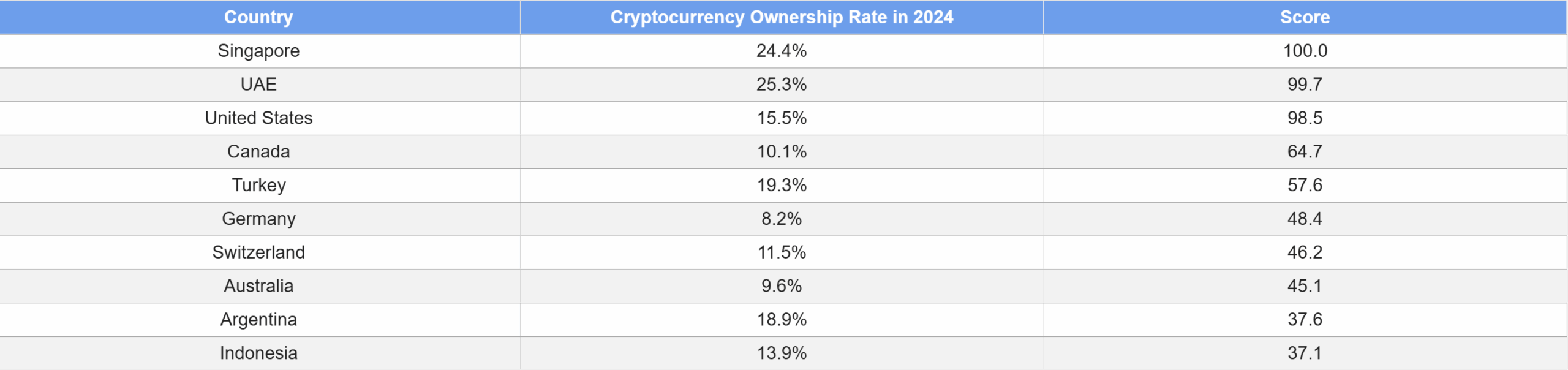
Cryptocurrency is a part of digital finance, used in transactions and institutional investments. A report by ApeX Protocol lists Singapore and the United Arab Emirates (UAE) as the leading countries in cryptocurrency activity. The data reflects adoption levels and the role of digital assets in their financial systems and societies.
With a composite score of 100, Singapore is the country with the highest adoption of cryptocurrencies worldwide, as reported by several media outlets. The percentage of residents with digital assets rose from 11 percent to 24.4 percent between 2021 and 2022. With almost 2,000 searches per 100,000 individuals, the nation also has the highest number of online searches pertaining to cryptocurrencies.
The Monetary Authority of Singapore (MAS) regulates exchanges and digital payment providers. The regulatory structure is intended to safeguard consumers while fostering innovation. The fact that cryptocurrency is utilised in a number of industries, such as retail and financial services, suggests that it is present in daily transactions.
The United Arab Emirates ranks just behind Singapore in cryptocurrency engagement, with a composite score of 99.7. Approximately 25.3 percent of the population owns digital assets, the highest recorded rate globally. Since 2019, ownership has increased by 210 percent, peaking in 2022 before stabilising.
Dubai hosts exchanges, industry events, and blockchain-related organisations. Regulatory structures such as the Virtual Assets Regulatory Authority (VARA) provide operational guidelines for businesses. The UAE offers tax arrangements, designated business zones, and policies that support blockchain-related activities.
Summary of ApeX’s report. Source ApeX
The United States ranks third globally in cryptocurrency engagement, with a composite score of 98.5, primarily due to its infrastructure. It has over 30,000 cryptocurrency ATMs, significantly more than any other country.
Since 2019, usage has increased by 220 percent, although ownership rates remain comparatively lower. Developments such as spot Bitcoin ETFs and institutional involvement have contributed to broader market participation. Retail investors have also played a role in increasing the use of cryptocurrency in financial activities.
Canada ranks fourth in global cryptocurrency engagement, with a composite score of 64.7. Since 2019, adoption has increased by 225 percent, the highest growth rate among the countries listed. There are approximately 3,500 cryptocurrency ATMs across the country, contributing to widespread access. Ownership stands at 10.1 percent, showing gradual growth compared to other leading nations.
Turkey ranks fifth in global cryptocurrency engagement, with a composite score of 57.6. Approximately 20 percent of the population owns digital assets. Online search activity related to cryptocurrency is high, with around 1,000 searches per 100,000 people. Economic factors, including currency inflation, have contributed to increased interest in digital assets.
Germany is known for having clear financial regulations, and Switzerland has banks that accept digital assets. Blockchain technology is incorporated into Australia’s digital infrastructure, and in Argentina, bitcoin adoption has increased in response to inflation. Adoption among younger users is increasing in Indonesia.
According to the ApeX Protocol study, four indicators were used to assess global trends: ownership rates, ATM availability, adoption growth since 2019, and search activity. The UAE and Turkey lead in ownership, while the United States has the most extensive ATM network. Canada recorded the highest growth in adoption, followed by the US and the UAE. Singapore ranks highest in search volume, with Turkey and Indonesia also showing significant online interest.
In contrast to the ApeX rankings, the Chainalysis Adoption Index offers a distinct perspective. For three years running, India has led the world in the adoption of cryptocurrencies, mostly because of its large retail user base. Thanks to regulatory changes and a rise in ETF activity, the US has risen to second place. With considerable development in nations like Vietnam and Pakistan, the Asia-Pacific region leads in transaction volume. Singapore stands out for its strong institutional interest and progressive regulatory environment, further solidifying its role as a regional crypto hub.
US President Donald Trump-backed World Liberty Financial (WLFI) has announced plans to roll out a debit card that integrates with Apple Pay. The move is aimed at facilitating seamless retail transactions for USD1, the decentralised finance (DeFi) project’s native stablecoin. Additionally, it will also expand the project’s reach into mainstream payment solutions.
The announcement was made by WLFI co-founder Zak Folkman during Korea Blockchain Week 2025 in Seoul. Folkman described the debit card as a key part of WLFI’s retail application, which will launch in the near future.
“It allows users to be able to attach their USD1 and their World Liberty Financial app right into their Apple Pay. Not today, but it’s coming very soon,” Folkman told the audience.
The WLFI debit card will be complemented by the project’s upcoming retail application. As quoted by media, Folkman said the app will operate as a cross between “Venmo and Robinhood,” combining trading capabilities with Web2-style peer-to-peer payments. The WLFI platform will provide investment tools and accessibility through a single interface.
By targeting everyday retail use cases alongside crypto-native functions, WLFI is positioning itself as a bridge between traditional finance and decentralised finance.
Folkman also used the stage to dismiss speculation that World Liberty Financial might build its own blockchain. Instead, he stressed that the project will remain chain-agnostic, focusing on interoperability and broad adoption.
“We will never put out a World Liberty Financial chain. It’s literally the opposite of our entire mentality. We believe our job is not to roll out chains or exchanges, but to be completely agnostic when it comes to chains, technology, and distribution platforms,” he said.
WLFI’s native cryptocurrency has been under pressure since its launch on 1 September 2025. The token, which has hovered around $0.20, is trading 35 percent down from its debut.
Market analysts have highlighted several key levels for WLFI. Popular crypto analyst CryptoBusy noted that the token slipped below its ascending trendline, signalling weakening momentum. Accumulation zones have been identified at $0.2088, $0.1973, and $0.1855, while a breakout above $0.2399 on strong volume could flip WLFI back into a bullish structure.
Earlier this month, WLFI burned 47 million tokens in an effort to stabilise its market performance, but selling pressure has persisted.
Folkman acknowledged the volatility, stating that WLFI will remain exposed to market fluctuations. However, he emphasised confidence in long-term growth as the project expands its ecosystem of products.
In separate news, World Liberty Financial has also signed a memorandum of understanding (MoU) with South Korean exchange Bithumb. The collaboration is expected to strengthen WLFI’s presence in the Asian market, where crypto adoption continues to accelerate.
With its debit card, retail app, and Apple Pay integration in the pipeline, WLFI is betting on mainstream usability to drive adoption of its USD1 stablecoin and associated ecosystem.
In March, WLFI raised a further $250 million from its second token sale. The total amount raised stood at $550 million. WLFI is closely related to the Trump family and is touted as a revolutionary decentralised finance banking platform. The company sold $300 and $250 million worth of Ethereum, Bitcoin, Tron, Ondo, Sui, and other cryptocurrencies in two sets of token sales. The announcement by WLFI stated that more than 85,000 people completed Know Your Customer (KYC) verifications to participate in the sale, indicating widespread interest from across the crypto spectrum.
Standard Chartered’s venture capital arm, SC Ventures, is reportedly preparing to launch a $250 million digital asset investment fund in 2026. According to a report by Bloomberg, the fund will focus on digital assets within the financial services industry. SC Ventures Operating Partner Gautam Jain confirmed that the fund will be backed by Middle Eastern investors and will target global opportunities across the sector.
The initiative reflects the rising appetite among corporate and institutional investors to gain structured exposure to digital assets. In recent years, several corporate treasury firms have adopted long-term accumulation strategies, suggesting broader institutional inflows may accelerate in the coming years.
SC Ventures has not yet disclosed which specific cryptocurrencies or blockchain-based assets will form part of the fund. Requests for comment on the fund’s crypto allocations were not immediately answered.
Beyond the digital asset initiative, SC Ventures is also preparing to roll out a $100 million Africa-focused investment fund. Jain noted that the firm is considering its first venture debt fund as well, though it remains unclear whether these additional vehicles will have a crypto or fintech emphasis.
The new funds are part of SC Ventures’ strategy to diversify its portfolio into emerging markets and digital infrastructure. This will help position Standard Chartered as an active player in both fintech innovation and frontier investment landscapes.
The announcement comes against a backdrop of market pressure on digital asset treasuries (DATs). Standard Chartered recently raised concerns about the declining market net asset value (mNAV) of DAT firms—a key metric comparing enterprise value to cryptocurrency holdings.
Several prominent treasury firms have slipped below the critical 1.0 mNAV threshold, indicating difficulties in issuing new shares and sustaining crypto accumulation.
“The recent collapse in DAT mNAVs will likely drive differentiation and market consolidation,” Standard Chartered said in a recent note. The bank added that stronger firms with access to low-cost capital and staking yields would be better positioned, naming industry leaders such as Strategy and Bitmine as examples.
The $250 million SC Ventures fund adds to a series of institutional announcements expanding exposure to cryptocurrencies beyond Bitcoin. On the same day, Nasdaq-listed Helius Medical Technologies revealed plans to establish a $500 million corporate treasury reserve using Solana (SOL) as its primary reserve asset, with a commitment to scale holdings significantly over the next 12 to 24 months.
In August, the Hong Kong branch of Standard Chartered partnered with Web3 company Animoca Brands to develop a stablecoin backed by the Hong Kong dollar. This collaboration has led to the formation of Anchorpoint Financial Limited, a joint venture designed to operate within Hong Kong’s evolving regulatory landscape.
Anchorpoint Financial formally submitted its application for a stablecoin licence to the Hong Kong Monetary Authority on 1 August. This move coincided with the launch of Hong Kong’s new stablecoin framework, following a six-month transition period.
The introduction of the new regulations brought unforeseen challenges. The rules proved to be more stringent than many market participants had anticipated, resulting in a noticeable market reaction. Shares of some Hong Kong-based companies associated with stablecoin concepts fell by up to 20 per cent in early August. Industry analysts viewed this as a necessary correction, helping to distinguish serious operators from speculative ventures.
India ranks first in cryptocurrency adoption for 2025, according to the sixth Chainalysis Global Crypto Adoption Index. The United States comes in second, indicating a rise in activity in both nations. The research shows, market trends are being influenced by institutional investment and grassroots usage. India leads in all measured categories, including retail and institutional flows. The US rise is linked to higher institutional involvement following the approval of spot bitcoin ETFs. Pakistan, Vietnam, and Brazil complete the top five.
The Chainalysis Global Crypto Adoption Index looks at the use of cryptocurrencies by people, businesses, and governments around the world. The sixth volume in the series, published in 2025, focuses on adoption trends as of right now. The index for this year shows shifts in how nations view and utilise digital assets. It covers a range of activities, from routine transactions to large-scale institutional investments, showing that cryptocurrency use is becoming more widespread.
India leads the index overall and ranks highest in retail adoption, DeFi usage, and institutional activity, a first since the index began. This reflects growth at both individual and institutional levels.
Several key factors drive India’s top ranking in global crypto adoption. The country has a large, young population that is comfortable with technology, supported by widespread access to smartphones and internet connectivity. Its rapidly growing start-up ecosystem fosters innovation, while a cultural openness to new financial tools encourages experimentation with digital assets. Together, these elements have created a strong foundation for both retail and institutional crypto activity.
Following the SEC’s approval of spot Bitcoin ETFs, financial firms became more active in the US in 2025, increasing institutional involvement. As a result of the entry of firms like Vanguard, Fidelity, and BlackRock, the United States rose to the second position in the global rankings of cryptocurrency adoption.
India, the United States, Pakistan, Vietnam, and Brazil make up the top five countries in cryptocurrency adoption. The presence of emerging markets reflects how digital assets are being used to address gaps in traditional financial systems.
Countries like Pakistan, Vietnam, and Brazil face challenges such as currency instability, limited banking access, and high remittance volumes. Cryptocurrencies offer an alternative that is faster, lower-cost, and more accessible.
On-chain transaction volume in the Asia-Pacific region reached $2.36 trillion this year, marking a 69 percent increase compared to the previous year, outpacing all other areas. India contributed significantly to this volume, supported by an active developer base and rising institutional involvement, placing it at the forefront of crypto activity in the region.
Countries such as Brazil, Argentina, and Colombia are utilising stablecoins to manage inflation and gain access to the US dollar. In Sub-Saharan Africa, cryptocurrency is being used for cross-border money transfers, offering a lower-cost alternative to traditional remittance services.
North America and Europe recorded $2.2 trillion and $2.6 trillion in on-chain transaction volume, respectively. Although APAC and LATAM are growing at a faster rate, these regions maintain the highest overall activity, driven by institutional participation and clearer regulatory frameworks. Investment from hedge funds, pension plans, and corporate treasuries continues to grow, contributing to sustained volume in both regions.
Stablecoins like USD Coin (USDC) and Tether (USDT) are essential to the global adoption of cryptocurrencies. By providing price stability tied to fiat currencies while preserving the flexibility of digital assets, they enable high monthly transaction volumes. Their extensive use indicates a need for stable value in areas with unstable currencies or restricted access to banks.
Additionally, new stablecoins like EURC and PYUSD are becoming more popular. Circle’s EURC is governed by Europe’s MiCA standards, whereas PayPal’s PYUSD has grown quickly, going from $783 million to $3.95 billion in circulation in a matter of months. These additions point to a growing stablecoin sector with more corporate participation and regulatory monitoring.
The main gateway to cryptocurrency for fiat money is still Bitcoin. More than twice as much money was invested in it as in other cryptocurrency assets, totalling $4.6 trillion between July 2024 and June 2025. With $4.2 trillion in fiat-to-crypto transactions, the US dominated the world thanks to well-established infrastructure and widespread use.
Crypto adoption is becoming less concentrated in the US, with more countries participating actively. With appropriate policies and infrastructure, India could become a leading force in the global Web3 landscape.