


Global cryptocurrency adoption reached a major milestone in 2025, with the number of digital asset holders rising to 741 million, according to Crypto.com’s latest Crypto Market Sizing Report. The 12.4 percent increase from the previous year signals crypto’s transition from a niche technology to a firmly established part of mainstream finance, driven by clearer US regulations and growing institutional interest.
A new milestone for global adoption
Global crypto adoption reached a new peak in 2025, with 741 million people worldwide owning digital assets, up from 659 million the year before, a 12.4 percent increase. Numerous factors contributed to the surge, including political developments such as US President Donald Trump‘s executive order in March 2025 establishing a Strategic Bitcoin Reserve, which provided digital assets with a more formal policy framework. Later, states such as Texas, Arizona, and New Hampshire revealed their own plans for digital reserves, indicating that the government was paying closer attention.
Throughout 2025, there were noticeable fluctuations in the use of cryptocurrencies, influenced by corporate and political events. Owing to expectations of a pro-crypto US government, January saw a 3.4 percent increase, with Ethereum recording an 8.9 percent gain.
Adoption increased once again in March as a result of the Strategic Bitcoin Reserve’s announcement, which brought digital assets back into the spotlight. A further rise of 1.9 percent in September was attributed to businesses integrating digital assets into their treasury plans, reflecting an increase in institutional engagement.
Bitcoin’s path to a strategic national asset
With a global ownership increase of 8.3 percent to 365 million units, or almost half of all cryptocurrency users, Bitcoin maintained its dominant position in 2025. The United States’ announcement of plans for a Strategic Bitcoin Reserve, which would have integrated the asset into a broader national strategy rather than viewing it as merely a speculative investment, marked a significant policy move for the year. The action suggested greater government participation in the industry, as did growing state-level discussions about creating digital reserves.
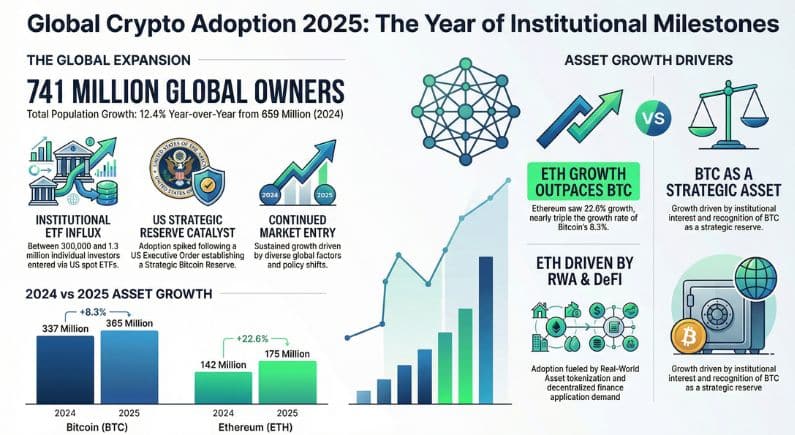
Crypto Market Sizing Report 2025 (Source Crypto.com)
Ethereum’s remarkable surge
With a 22.6 percent increase in global ownership to 175 million users, or about a quarter of all cryptocurrency holders, Ethereum experienced significant growth in 2025. The fact that Ethereum remains a key platform for decentralised finance, smart contracts, NFTs, and other tokenisation initiatives helped to drive this increase. Furthermore, a number of businesses integrated Ethereum into their Digital Asset Treasury plans; in September 2025, there was a noticeable rise in these corporate allocations.
In 2025, Ethereum introduced two major network upgrades that contributed to its continued development. The Pectra upgrade, released in May 2025, enhanced validator performance and made the network more efficient for users. Later in the year, the Fusaka upgrade focused on expanding scalability to support growing demand from tokenisation and other applications. These technical improvements helped strengthen confidence among developers and institutions, leading to increased activity and investment across the Ethereum ecosystem.
Spot ETFs open floodgates
Both institutional and individual investors can now acquire digital assets through standard brokerage accounts without the need for wallets or private keys thanks to the US government’s approval of spot crypto ETFs. According to estimates, between 300,000 and 1.3 million new investors entered the market by July 2025, with Bitcoin ETFs holding approximately $11.8 billion and Ethereum ETFs holding approximately $42.3 million.
Approximately $4.5 billion was managed by banks, advisers, and brokerage firms in these products, indicating a shift away from treating cryptocurrency as a purely speculative asset and towards incorporating it into broader portfolio strategies.
Portfolio diversification trends
More crypto users today are spreading their investments across different assets, with over 43 percent of Bitcoin holders also owning Ethereum. Many investors also rely on several platforms—an average of 3.36 exchanges—to balance risk and reduce costs. At the same time, around 42 percent of users choose neither Bitcoin nor Ethereum, instead exploring a variety of alternative digital assets built for specific use cases. These trends show a maturing market where diversification and broader participation have become the norm.
Cryptocurrency is also becoming more integrated into everyday financial life. Digital assets now appear in political discussions, financial planning, and corporate strategy, while digital wallets are becoming more common alongside traditional bank accounts. The industry is continuing to evolve from a specialised alternative to a well-established component of the financial system as institutions become more involved, reflecting how the function and significance of digital assets are continually changing.
Thinking beyond the ordinary? AIBC Eurasia in Dubai and Ras Al Khaimah from 8–11 February 2027, brings together 14,000 leaders shaping the future of frontier technology, crypto and AI