
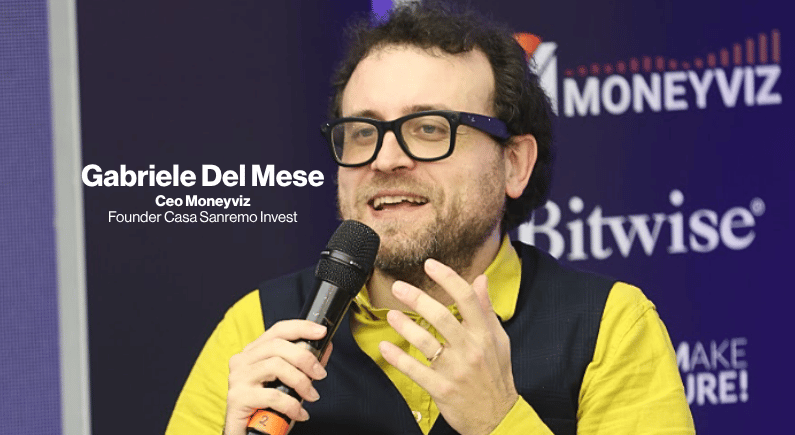
The founder of Moneyviz and coordinator of Casa Sanremo Invest tells AIBC News why AI, blockchain and digital finance cannot be separated from education, trust and the ability to recognise credible operators and to distinguish between credible operators and misleading promises.
Digital finance has multiplied the number of tools, platforms, content formats, and access points available to users. Today, people can open an online account in minutes, invest by using a smartphone, follow financial creators on social media, buy digital assets, or ask an artificial intelligence system to explain markets, crypto, and blockchain. But the issue is not simply having more tools. It is understanding what those tools actually are. For Gabriele Del Mese, founder and coordinator of Moneyviz and Casa Sanremo Invest, true financial innovation today does not lie in creating yet another platform or digital product. The priority is different: helping people find their way through them.
Asked whether innovation means building new financial tools or making existing ones easier to understand, Del Mese is direct: “It is definitely about helping people understand them.” Much of what surrounds blockchain and crypto, he adds, “is rarely truly original”, but rather takes functions already present in traditional finance and performs them “more efficiently, more securely, and more quickly”. It is an important point because it narrows the perceived distance between traditional and digital finance. Many tools are presented as a radical break with the past, when what often changes is the way how they are executed, distributed, verified, and accessed. Technology changes language and infrastructure. It does not always change the underlying needs: investing, protecting wealth, assessing risk, and deciding who to trust.
That is why, according to Del Mese, the first task is cultural. “Digitalisation, literacy, vocabulary, and language are the fundamental aspects,” he explains. The aim is not to turn every saver into a technician, but to give people enough tools to avoid moving in the dark.
Moneyviz was created around this need: reducing the distance between complex financial tools and a non-specialist audience. The point is not to promise simplicity where there is none. It is to select what actually matters. Del Mese speaks of “a problem of noise” and the need to “distinguish the signal from the noise”. It is an effective way to describe today’s market. There is a lot of information, perhaps too much. Between social media content, platforms, influencers, newsletters, communities, gurus, and self-styled experts, the risk is not only that people do not know enough. It is that they believe they know because they are exposed to a constant stream of messages every day. Awareness, however, does not come from the volume of content. It comes from the quality of the information a person can retain, understand, and use.
Gabriele Del Mese uses a simple comparison: you can drive a car without knowing every detail of the engine. But you need to know enough to avoid damaging it, recognise when something is wrong, and speak to the person who needs to repair it. The same applies to digital finance. Not everyone needs to know the technical workings of a smart contract or the architecture of a blockchain. But anyone using these tools needs to know enough to avoid exposing themselves carelessly. “We can use it and know enough to avoid scams, because unfortunately they do exist,” he says. This is the dividing line. Making digital finance more accessible does not mean pretending that everything is easy. It means providing the minimum tools needed to recognise risks, warning signs, unauthorised operators, unrealistic promises, and oversimplified content.
Artificial intelligence is becoming an increasingly common part of digital finance conversation. It can explain concepts, summarise documents, simulate scenarios, answer complex questions, and help people without technical knowledge understand tools that once felt out of reach. Del Mese, however, urges caution. He does not question the usefulness of AI, but rather the way people may use it. Asked whether artificial intelligence could become a kind of personal financial educator, his answer is careful: “I have some doubts about that.” The reason is clear: “Artificial intelligence is a bit like our mirror.”
The image captures a real risk. If someone questions AI from a position they have already formed, or frames the question in a leading way, they may receive an answer that reinforces their point of view rather than challenges it. Del Mese explains this with a deliberately provocative example: AI can end up confirming our biases and telling us, “Yes, great idea, you can invest everything in bitcoin; actually, why not invest your severance pay in bitcoin.” The issue is not only the answer itself. It is the trust the user may place in that answer because it appears structured, quick, and confident.
In finance, an incorrect confirmation can have real consequences. A poorly framed question can produce an unsuitable answer. An unsuitable answer can strengthen an already fragile decision. That is why Del Mese insists on the role of the user: artificial intelligence “is extraordinary and should be used”, but “with the right awareness”. Technology can help people become better informed. It cannot replace critical thinking. This matters even more when savings, personal goals, risk appetite, and time horizons are at stake.
If AI raises questions about bias and user responsibility, blockchain takes the discussion onto another ground: transparency, traceability, and trust. Del Mese does not present blockchain as an automatic solution to the problems of digital finance. His reading is more practical. Transparency, he explains, is often underestimated because its value becomes clear mainly when something goes wrong. “We often take transparency a little for granted,” he says. It is a bit like insurance: people remember its usefulness when it prevents financial loss following an accident.
In the case of digital financial tools, transparency can play a preventive role. “It is a deterrent,” Del Mese explains, because it forces those issuing financial instruments “to do things properly and communicate them properly”. It is not enough to claim transparency. Certain information must be verifiable, allowing users, professionals, and observers to verify it.
This is where journalism also comes in. Del Mese notes that transparency can help “journalists and industry professionals to check and read between the lines”. It is a relevant point: in a sector often defined by scandals or oversimplifications, more verifiable data and processes can help distinguish credible operators from fragile projects and opaque initiatives. He calls it “the power of having collective eyes” on financial instruments. It is a phrase that captures the value of blockchain beyond the usual crypto narrative: not only tokens and speculation, but also the possibility of distributed scrutiny, at least where the technology is applied consistently.
Moneyviz is also linked to Casa Sanremo Invest, a project that brings finance, investment, and innovation into a context far removed from the sector’s technical events. The choice is not accidental. Del Mese says the idea came from the desire to reach a different audience. Many crypto and fintech events, however useful, mainly speak to people who already know that world. Sanremo represents the opposite: “There is no place in Italy more national-popular than Sanremo’s Festival of music.”
The aim is not to turn finance into entertainment. It is to bring complex subjects into a place where they can meet people who would not normally attend conferences on blockchain, regulation, or digital investments.
The focus, Del Mese explains, is the intersection between technology and regulation. Anyone who wants to invest or use new tools needs to know at least the basics of both. They do not need to become legal experts, but knowing where to verify whether an intermediary is authorised can make a real difference. “You need to be able to distinguish a scam from fluff and from a legitimate project operator,” he says. Sometimes, he adds, a single piece of information acquired in a few minutes, can prevent serious financial damage. This is where financial education, content, and communication come together. It is not enough simply to simplify; you have to simplify effectively.
Finance often uses technical, distant, and sometimes discouraging language. Digital finance adds further layers: blockchain, wallets, tokens, smart contracts, exchanges, DeFi, AI, and regulation. The risk is that the public either gives up trying to understand or relies on those who promise shortcuts.
For Del Mese, the task of education and communication is to “reduce complexity without trivialising it”. It is a sentence that could apply to the whole fintech sector. Making a concept accessible does not mean emptying it of meaning. It means finding examples, metaphors, and pathways that help people understand enough to make more informed decisions.
This also applies to the line between useful education and dangerous oversimplification. Del Mese warns against the idea that investing is simple just because it can now be done with one click. Access does not mean suitability. “It is not necessarily true that everyone should invest without first going through a process of awareness,” he warns. What may be a good investment for one person may not be suitable for another. Goals, risk appetite, age, assets and time horizon all differ. There is no universal solution. The greatest risk is generalisation.
In a market crowded with financial influencers, platforms, gurus, and easy promises, credibility is not built through visibility alone. Del Mese ties it into two words: “seriousness and consistency”. For those who organise events, produce content, or build communities, this also means carefully selecting partners, companies, and professionals. Anyone who takes the stage receives, in some way, an endorsement. If that person or company is not credible, the damage affects not only the organisation but also the audience that placed its trust in that context.
This responsibility carries a particular weight in digital finance. The public often lacks sufficient tools to assess each speaker or operator independently. It relies on the reputation of those who select, invite, publish, moderate, and explain. Trust, then, is not an abstract word. It is the result of editorial, commercial, and professional choices repeated over time.
AI and blockchain will continue to change digital finance. Artificial intelligence may make explanations, analysis, and scenarios more accessible. Blockchain may make certain information and processes more verifiable. Platforms will continue to simplify access to financial tools. But the point Del Mese makes comes before all of this: understanding.
Without literacy, AI risks becoming an elegant confirmation of mistaken beliefs. Without transparency, blockchain remains a word used more for selling than for verifying. Without awareness, digital finance can appear accessible in form while remaining dangerous in substance.