In contemporary finance, almost every new product or service is described as innovative. The term is applied to digital platforms, investment instruments, artificial intelligence applications, and new market infrastructures. What is far harder to determine is when that label reflects genuine change and when it is little more than storytelling.
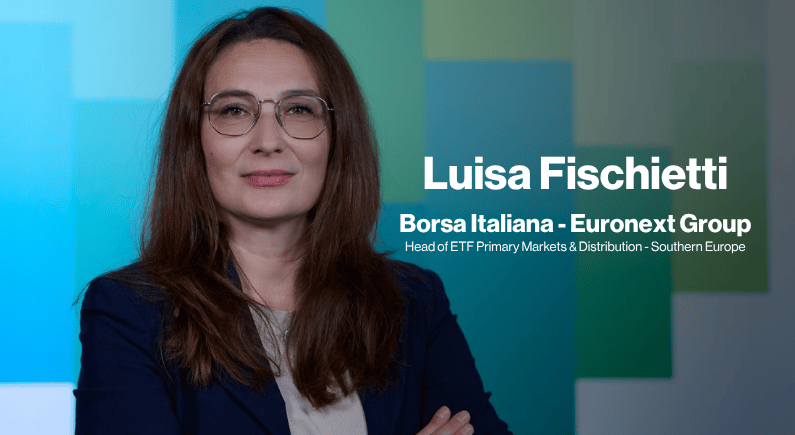
For Luisa Fischietti, Head of ETF Primary Market & Distribution Southern Europe at Euronext, novelty alone is not the decisive factor. Genuine innovation is what makes processes more efficient, reduces costs, and strengthens investor protection. “What truly changes finance is anything that makes processes more efficient, while always safeguarding investors, and also helps to reduce costs,” she explains in an interview with AIBC.
From a market perspective, innovation does not necessarily mean creating increasingly complex products. On the contrary, it can involve making something that was once difficult to access simpler, more transparent, and easier to trade.
Exchange-traded funds are among the clearest examples of an innovation that has become a structural part of the financial markets. The first ETFs were listed on Borsa Italiana on 30 September 2002. Today, they are traded on ETFplus, the regulated electronic market dedicated to ETFs, structured ETFs, actively managed ETFs, ETCs, and ETNs.
Their strength lies in combining the characteristics of an investment fund with the ability to buy and sell units on a stock exchange throughout the trading session, through an authorised intermediary. “ETFs are funds listed on a stock exchange,” Fischietti explains. “They allow investors to gain exposure to a market or package a strategy within an instrument that is transparent, liquid, tradable, and accessible.”
Liquidity in instruments listed on ETFplus is supported by market makers, which are subject to obligations governing the quantities displayed and the maximum spread between bid and ask prices. At least one market maker is required when an instrument is listed and throughout the entire period in which it remains admitted to trading.
The transformation brought about by ETFs therefore extends beyond the financial product itself. It also concerns the way investors can access it, monitor its price, and trade it within a regulated infrastructure.
In recent years, the spread of investment apps has fuelled the narrative that finance has finally been democratised. For Fischietti, however, accessibility did not begin with mobile applications. “The democratisation of investment has always been at the heart of financial markets,” she says. Stock exchanges are accessible to investors through brokers and intermediaries that participate in their respective trading platforms.
Technology has undoubtedly changed the user experience by reducing transaction times and by simplifying many processes. Generational change has also increased demand for digital services and tools that can be used on smartphones. Operational simplicity, however, does not automatically solve the problem of financial knowledge. “Accessibility must always be accompanied by financial education. The fact that investing has become quick and easy does not mean that people know how to plan their investments or manage their savings properly.”
The technical distance separating individuals from the markets has narrowed, but the risk of making decisions without defined objectives, a suitable time horizon or a sustainable level of risk remains. “Speed must not be confused with objectives or returns.”
Digital platforms provide real-time prices, charts, and immediate access to a volume of information that was once largely reserved for professionals. Yet the availability of data does not automatically result in better understanding. “We are all moving very quickly, but how often does that speed genuinely translate into awareness? Speed is not the same as awareness,” Fischietti says.
Her first piece of advice to anyone approaching investing is to pause, read, and understand the characteristics of the instrument under consideration. One of the essential documents is the KID, or Key Information Document, required under the European regulatory framework for packaged retail and insurance-based investment products, known as PRIIPs.
The KID provides a concise description of the product’s characteristics, risk and return profile, potential losses, performance scenarios, and costs. European legislation requires manufacturers or distributors of the relevant products to make this information available to retail investors. “People need to read and inform themselves,” Fischietti stresses. “Easy access should not be confused with a disciplined approach to investing.”
Artificial intelligence is also entering the financial markets, from data processing to risk management. Fischietti nevertheless remains cautious about the predictive claims often associated with AI. Its most immediate value lies in the ability to analyse large volumes of historical data and relate them to macroeconomic and geopolitical factors.
“I am not talking about predictive data, because for me that remains a partly unknown world. AI can, however, help us reassess many years of data, process it and make it more readily available.” Technology can accelerate analysis, but it cannot replace judgement. Examining an instrument’s historical performance and behaviour during different market conditions remains part of the process that should precede an investment decision.
The same principle applies to thematic ETFs linked to technology, artificial intelligence, sustainability, or other emerging trends. The availability of a listed product does not automatically mean that its investment theme represents a structural shift. “Before we can describe something as a structural change, we need to wait until it genuinely becomes an established driver of investment rather than remaining just a trend,” Fischietti observes.
Digital transformation is not confined to financial products. It also affects the architecture through which instruments are traded and settled. According to Fischietti, the transition towards infrastructure based on distributed ledger technology will take time, because the market microstructure of traditional systems and that of DLT-based platforms follow different models.
The European Union’s DLT Pilot Regime, applicable since 23 March 2023, recognises three types of infrastructure: DLT multilateral trading facilities, DLT settlement systems, and systems combining both trading and settlement.
Functions traditionally assigned to separate infrastructures could therefore be integrated or reorganised. This will not, however, amount to an immediate replacement of traditional markets. “For a certain period, these two market microstructures will necessarily have to communicate and remain interoperable,” Fischietti explains.
Convergence is already visible in the relationship between digital assets and regulated markets. On 9 February 2026, Euronext launched a professional segment on ETFplus dedicated to listed instruments linked to cryptocurrencies. Access is restricted to professional clients. The instruments are traded in euros, cleared by Euronext Clearing and settled through Euronext Securities Milan. Euronext uses the broader term crypto ETPs, while the instruments admitted to the Italian market are classified as ETNs.
For Fischietti, this does not represent a complete merger between decentralised finance and traditional markets. “It is a bridge, a handshake, almost a passing of the baton.”
Investors do not purchase the underlying cryptocurrency directly. Instead, they acquire a financial instrument whose performance is linked to the digital asset. The exposure is therefore brought within a regulated infrastructure and accompanied by traditional trading and post-trade processes. “We wanted to create a bridge towards these digital instruments by bringing them into traditional finance and offering access to institutional and professional investors who choose to include them in their portfolios.”
To compete with the United States, Europe must ultimately reduce the fragmentation of its markets. In March 2025, the European Commission broadened the Capital Markets Union agenda through the Savings and Investments Union, a strategy designed to connect European savings more effectively with productive investment and improve companies’ access to capital. “We need a common approach at European level,” Fischietti says. “Market integration will be one of the keys to the future.”
Technology can make infrastructure faster and more efficient. Success, however, will depend on the ability to turn innovation into services that people genuinely use. “The future of finance will be determined by the use cases that people embrace, the models that investors adopt, and their efficiency,” Fischietti concludes. “Perhaps it will depend partly on technology, but it will certainly depend on trust.”