

Across Asia, open futures positions tied to precious metals on centralised exchanges reached $1.98 billion in May 2026, according to CoinGecko, an independent cryptocurrency data aggregator. It added that 36.2 per cent of total open interest in traditional-finance assets traded on these platforms.
This trend of growth in gold trading sits at the centre of The Cross Asset Shift, a report published by Blockworks Research examining how crypto-native traders in Asia are increasingly using crypto exchange accounts to gain exposure to gold, US equities and forex alongside digital assets. In an exclusive interview with AIBC News, Vugar Usi Zade, Chief Executive Officer of crypto exchange MEXC, addressed the numbers behind that shift.
Gold’s open interest numbers look strong, but Zade set a high bar for calling the broader trend structural. Demand would need to hold up outside periods of high volatility, he said, and be confirmed by independent data across multiple exchanges and multiple asset classes.
Zade stated, “If activity disappears as soon as volatility falls or leverage becomes less attractive, then the market is still being driven mainly by speculation.”
He pointed to gold as the strongest early evidence so far, noting that precious metals open interest stayed near $1.69 billion at the end of June even as initial volatility eased. But he was clear that gold alone doesn’t settle the real test, in his words, is whether equities and commodities begin to show the same persistence.
Zade added, “If users keep trading these products under different market conditions and across multiple venues, then the demand is much harder to explain as a temporary trade.”
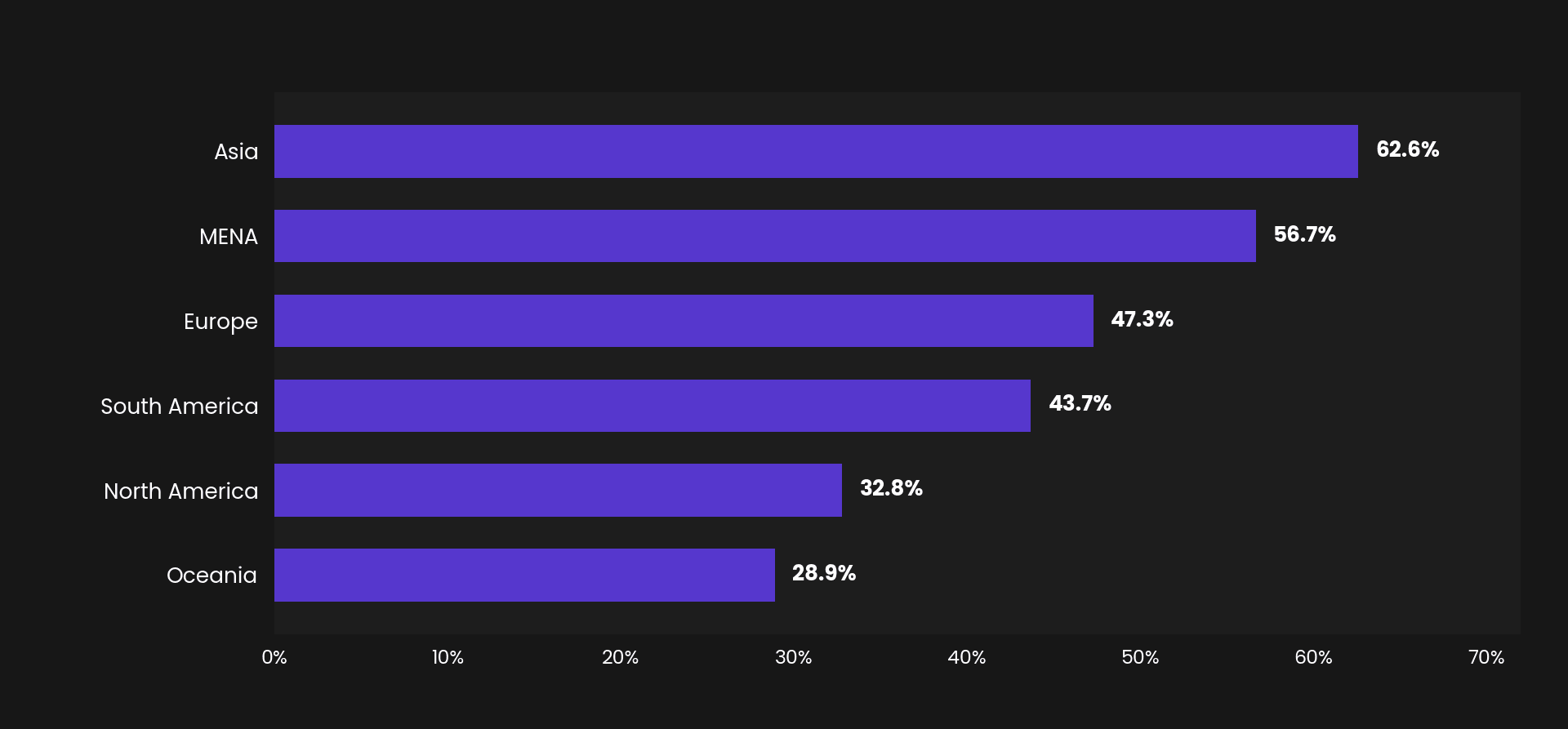
Precious metal trading on CEX’s by region (Source: MEXC Global User Behavior Report 2026)
CoinGecko’s June 2026 TradFi trading analysis shows that precious-metals trading on centralised exchanges remains concentrated among a small number of platforms. Across the six exchanges tracked, monthly trading volumes ranged from approximately $57 billion to $85 billion during April and May 2026.
MEXC’s own data, cited in the Blockworks report, stated: the average number of daily users trading stock futures increased by 386 per cent quarter-on-quarter in Q2 2026, while average daily trading volume surged by 3,308 per cent. Southeast Asia emerged as the fastest-growing region, with stock-futures trading volume soaring 6,648 per cent and average daily users rising 399 per cent during the same period.
User growth was clearly a significant contributor to the increase, but it does not fully explain the scale of volume expansion, Zade said. “We are seeing not only more users entering the market, but also existing participants trading these products with greater frequency and intensity.”
The evidence of 24/7 trading’s double edge came independent of any exchange’s marketing. When the US struck Iran over the weekend of 28 February 2026, West Texas Intermediate (WTI) crude jumped as much as 15 per cent on the decentralised venue Hyperliquid while traditional brokerage clients had no way to react until markets reopened, as per Blockworks’ report.
Discussing risk allocation when a centralised exchange offers price exposure to a market that is technically closed, Zade said the risk is distributed rather than eliminated.
Zade clarified, “A 24/7 product has to account for that in its pricing and leverage limits. If those controls are too loose, users end up taking on more risk at a time when market makers have fewer options to hedge their exposure.”
According to a survey conducted for the Blockworks report, the leading concerns among Asian respondents were lack of product knowledge (51.2 per cent), market volatility (43.8 per cent), regulatory uncertainty (37.2 per cent) and liquidity issues (36.3 per cent).
Zade named regulatory clarity as the biggest systemic risk, arguing that liquidity and user education are solvable with time, while inconsistent rules across jurisdictions discourage firms from committing capital in the first place.
Zade stressed, “If firms do not know how that exposure will be treated, they will hesitate to commit significant capital to it.”
Hyperliquid’s reported volumes show how fast decentralised venues have moved into this space: $70.8 billion in stock perpetual volume in July 2026, plus $27.3 billion in index volume and $16.2 billion in commodities, together 51 per cent of its total monthly volume.
Zade called that competitive pressure “healthy,” saying it forces centralised exchanges to look harder at where they’re moving too slowly. However, he is frank about the downside: if we launch a contract prematurely, i.e. when liquidity is not sufficient yet or where regulators have not yet got clarity on the risks associated with the product, we will obtain some products that become available before regulatory requirements are in force.
According to aggregated data from Blockworks, real-world assets (RWAs), forex and tokenised stocks now account for more than 12 per cent of monthly futures volume across centralised exchanges. Their share of spot volume remains below 2 per cent.
Spot trading in these categories has declined sharply, falling from more than $30 billion in October 2025 to approximately $9.5 billion in July 2026. Over the same period, futures volume expanded to nearly $400 billion, according to The Cross Asset Shift report.
Zade acknowledged this directly, saying the users are clearly trading RWA, forex, and tokenised-stock futures in significant volumes, but futures activity alone does not necessarily indicate demand beyond leveraged speculation.