
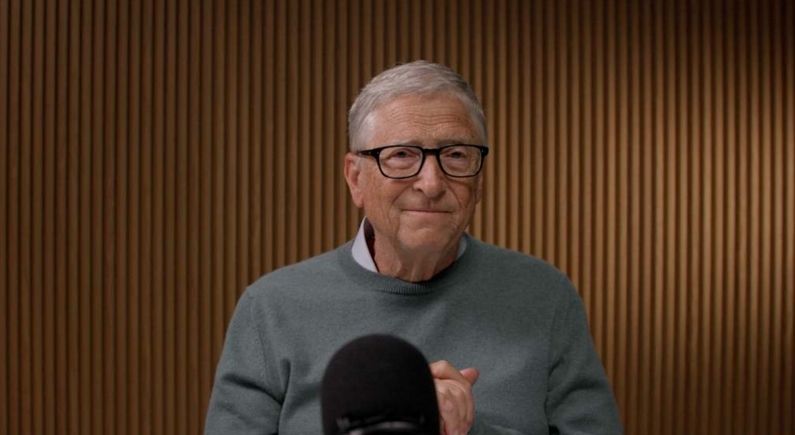
Microsoft co-founder Bill Gates has warned that the rapid transition into the artificial intelligence (AI) era could trigger widespread economic and social disruption unless governments begin preparing now.
In a blog post, Gates said AI could transform industries, employment and everyday life at a pace unlike previous technological shifts. He argued that policymakers, businesses and communities need to work together to ensure the technology improves lives rather than deepening inequality.
“AI will either be the greatest equaliser ever invented, or the worst source of injustice,” Gates wrote.
He said the world is not adequately preparing for the changes ahead, despite AI’s rapid development and growing ability to perform tasks that traditionally require human cognition.
Gates said previous technological transitions cannot fully explain what is coming because AI can spread quickly, operate on devices people already use and interact through natural language. Unlike the shift from agricultural work to office employment, which unfolded over several generations, he said AI could affect multiple sectors within a decade.
Law, customer service, medicine, software and manufacturing are among the industries that could see rapid changes. Entry- and mid-level positions could face particular pressure as companies adopt AI to reduce costs.
Gates also expects robotics to add to the disruption, with “smart” robots potentially competing with workers in areas such as construction and hospitality by the end of the decade.
He warned that young workers could be particularly exposed as companies reduce entry-level opportunities.
“The biggest shift for workers will happen when AI provides nearly error-free work,” Gates wrote. At that point, he said, companies could have strong economic incentives to allow AI systems to operate with limited human oversight.
Gates identified three major risks from the transition: job losses, increased capacity for harmful activity, and potential damage to children’s development and human relationships.
AI could make fraud, disinformation, deepfakes and cyberattacks easier to carry out, he said. The technology could also increase risks to hospitals, financial institutions, power grids and other critical infrastructure.
He also raised concerns about AI-assisted bioterrorism and the possibility that increasingly autonomous systems could eventually behave in ways their developers did not intend.
“AI models could begin to act against our interests, and we could lose control,” Gates wrote.
The impact on children is another concern. Gates said AI companions could become addictive because they are always available and designed to interact in ways users find comfortable. He also warned that excessive reliance on AI in education could weaken critical thinking, particularly as people face increasingly sophisticated deepfakes and misinformation.
View this post on Instagram
Despite his concerns, Gates said the potential benefits of AI are equally important. He expects AI to accelerate scientific research, improve healthcare, support farmers in low-income countries and make government services easier to access.
In healthcare, AI could help doctors identify emergencies, analyse medical information and support patients between appointments. Gates cited Viz.ai, which analyses scans to detect strokes and other emergencies and is being used in nearly 2,000 US hospitals.
Agriculture could see rapid gains in developing economies, he said, as AI provides farmers with better information about weather, seeds, crop diseases, livestock and soil.
“AI can be a boon for education as well,” Gates wrote, arguing that carefully designed systems could give teachers more time for individual students while helping learners develop understanding rather than simply providing answers.
Gates’ call for deliberate AI governance aligns with principles set out by UNESCO’s 2021 Recommendation on the Ethics of Artificial Intelligence.
UNESCO’s framework calls for AI to respect human rights and human dignity, while promoting transparency, fairness, environmental sustainability and human oversight. It also advocates multi-stakeholder governance involving governments, businesses, researchers and civil society.
Gates similarly argues that AI policy cannot be left to technology companies alone. He wants governments to develop national and international frameworks covering employment, education, public health, taxation, energy, elections and national security.
One proposal is to establish areas of work that remain reserved for people even as AI and robotics advance.
Gates calls this concept “Human Reserved”, arguing that some roles should remain human because of their social value or because replacing workers would cause excessive disruption. He pointed to caregiving as an example, recalling the professionals who cared for his father during his illness.
“Something in the care they gave my dad was irreplaceably human,” he wrote. “No robot could or should have done it.”
Gates also renewed his support for taxing AI and robots. He said such taxes could slow the shift away from human labour while generating funds for retraining and stronger social safety nets.
Gates said governments should establish institutions capable of addressing AI across sectors rather than treating each issue separately. He also called for international cooperation, arguing that AI risks such as cyberattacks, autonomous weapons and technology supply chains cross national borders.
“We do not have the luxury of moving slowly,” Gates wrote, urging countries to begin building institutions and shared norms before disruption reaches crisis levels.
“This unprecedented technology demands an unprecedented global response,” Gates wrote. “If we get it right, the payoff for humanity will be phenomenal, and the world will be a more equitable place.”