Artificial intelligence is transforming faster than governments can regulate it, raising new questions about accountability, financial infrastructure, and public trust.
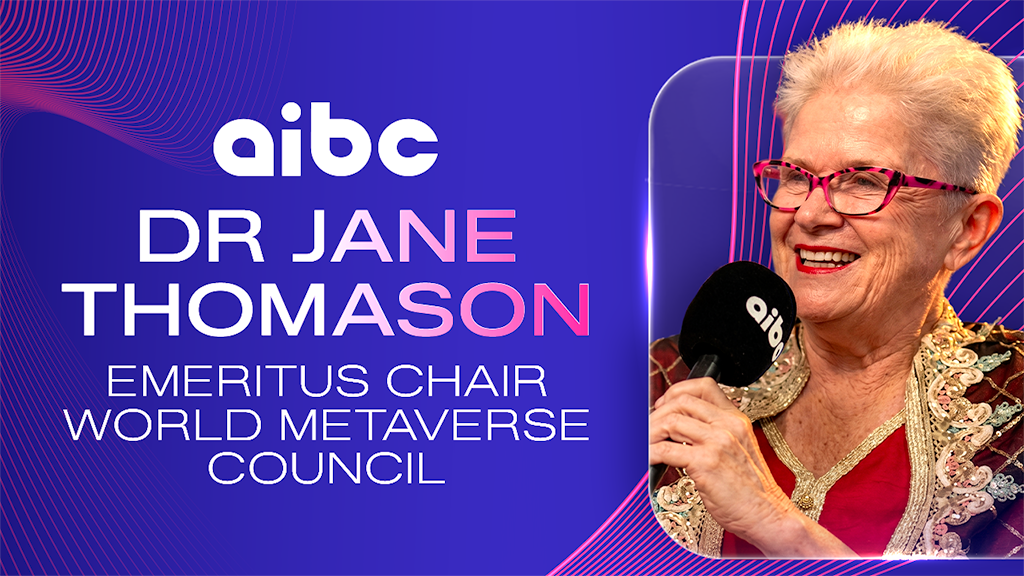
In an exclusive interview at AIBC Asia 2026, Dr Jane Thomason, Emeritus Chair of the World Metaverse Council, said the rise of autonomous AI agents and blockchain-based financial systems is forcing policymakers to rethink how governance itself is designed and enforced.
“I think the biggest issue that we’ve got at the moment is that AI’s moving so fast,” Thomason said. “AI agents are now independently transacting, and it’s impossible for traditional banks to be able to manage that 24-hour, seven-day-a-week, really rapid transformation.”
Her comments come as governments, regulators and international organisations grapple with the growing influence of AI. A February article published by the United Nations Foundation described 2026 as a pivotal year for AI governance.
While no country has fully solved the challenge of AI governance, Thomason believes some jurisdictions are moving faster than others. “For sure, leading in Asia is Singapore. They’ve really leaned in. They’ve now started working on agentic AI. They’ve got regulations that are more advanced than any other economy in Asia.”
She also highlighted the United Arab Emirates (UAE) as a government that has embraced emerging technologies through proactive policymaking.
Beyond Asia, Thomason pointed to recent work by the British Commonwealth Secretariat, which has developed model legislation for digital assets and stablecoins. “What it provides is a template that countries can use if they wish to, and this is particularly important for smaller jurisdictions that can’t afford to develop their own regulations.”
The importance of shared frameworks mirrors one of the central conclusions of the UN Foundation’s analysis of the Global Digital Compact. The report argues that global cooperation is essential to avoid fragmented AI governance regimes that could create conflicting standards and uneven protections.
According to Thomason, governments risk focusing on the wrong target when designing regulatory frameworks. “You shouldn’t be regulating the technology,” she said. “You should be regulating what the technology does and the outcome and protecting consumers or preventing money laundering or whatever it is that your objective is.”
The approach reflects broader discussions at the United Nations, where member states continue to debate how to balance innovation, consumer protection, human rights, and economic development.
The UN Foundation article noted that countries entered negotiations around the Global Digital Compact with different assumptions about AI governance. Some favoured lighter regulation to support innovation, while others pushed for stronger safeguards. The result was a growing recognition that governance frameworks must focus on practical outcomes rather than ideological divides.
For Thomason, the next stage of governance extends beyond policy papers and legislation. “We’ve moved beyond the time of policies and regulation because everything’s moving onto platforms,” she said. “Unless governance is encoded on the platform, it will not be done.”
She believes societies are entering a new phase where governance mechanisms must be embedded directly into digital infrastructure. “We’re moving into this era of codified societies, and we have to codify governance.”
The idea aligns with one of the key lessons highlighted by the UN Foundation: that future governance will depend not only on principles and regulation but also on interoperability, standards and implementation mechanisms capable of operating across different jurisdictions and technologies.