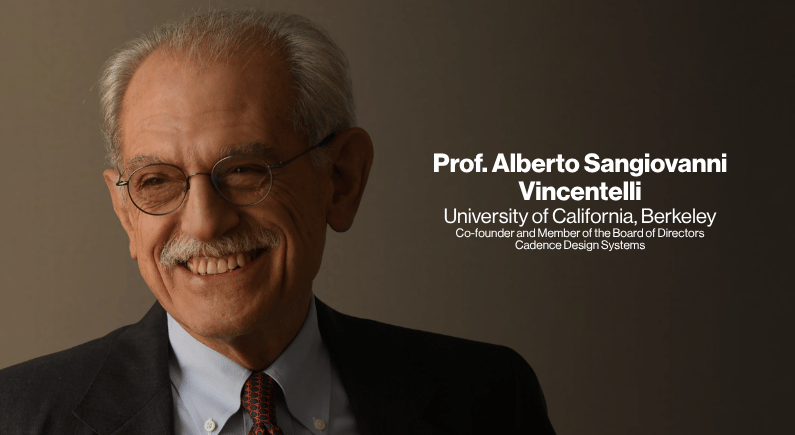
The Berkeley professor explains why a scientific discovery only leads to industrial impact when market, technology, capital, and external conditions align. The Cadence case shows that some insights may wait as long as forty years before becoming reality.
Asked what it really takes to turn a scientific discovery into industrial impact, Alberto Sangiovanni Vincentelli does not reach for a textbook formula on innovation. He does not begin with patents, capital, venture capital, universities, or technology transfer. He answers with a single word: “Luck.” He then clarifies what he means. Not luck as blind chance, nor as a stroke of fortune replacing talent, research, or hard work. Luck as a rare alignment of conditions. An idea may be brilliant, even revolutionary, but if it arrives too early, it risks remaining still. Not because it is wrong, but because the world around it is not yet ready to receive it.
“You may have an explosive idea,” explains the professor at the University of California, Berkeley, “but if the surrounding conditions are not ready to make it happen, that idea will remain locked away somewhere.” That is where what he calls luck comes into play: the moment when, through an almost magical combination, “the stars align” and an intuition can finally become an industry, a product, a company, a market.
To explain this, Sangiovanni Vincentelli turns to a concrete personal example: the original business plan for Cadence, one of the companies associated with his entrepreneurial and scientific experience. He still keeps that document. It contained ideas that were not implemented at the time, and that, forty years later, are only now becoming current. The point is decisive: a vision does not always fail because it is weak. Sometimes, quite simply, it arrives before its time. Seen in this way, innovation is not a straight line. It is a more irregular process, made of attempts, waiting, sudden accelerations, and external conditions that mature slowly. A discovery can remain beneath the surface for years, even decades, before finding the context that turns it into real impact. The difference is not made by the idea alone. The soil makes it.
There is another important passage in Sangiovanni Vincentelli’s vision: the relationship between research and enterprise. Asked whether a great researcher today must also learn to be an entrepreneur, the professor takes the question back. A researcher, he says, already possesses some of the entrepreneur’s characteristics. “What is an entrepreneur? Someone who sees the conditions and sets out to exploit them,” he observes. But the same happens in science: a researcher identifies an open problem, gathers the available tools, knowledge, and resources, and tries to solve it. Whether that problem is a theorem, a physical phenomenon, or the creation of a company, the mental mechanism is not so different.
It is an interesting way of narrowing the distance, often perceived as enormous, between the laboratory and the market. Research is not an abstract exercise detached from reality. And enterprise, when it truly emerges from a strong intuition, is not merely commercial execution. Both begin with an open question and with the ability to see a possibility where others still see a limit. The most difficult step remains the one that follows: turning that possibility into something the system can recognise, use and support. That is where individual talent meets context. That is where science can become industry, but only if it finds around it an environment capable of absorbing it.
When Sangiovanni Vincentelli speaks about Silicon Valley, he describes it neither as a magical place nor as a recipe that can be replicated automatically. He describes it as an ecosystem. More precisely, as a set of surrounding conditions that make innovation more likely to emerge. To explain the point, he uses an unusual and highly effective metaphor: the white truffle. “You cannot cultivate it,” he says, “but you can create the conditions for it to grow.” As in the forests of Piedmont, it is not enough to plant something and expect a result. You need the right soil, the right humidity, and the right environment. You need a combination of factors that does not guarantee the outcome but makes it possible.
Silicon Valley works in the same way. It does not eliminate the uncertainty of innovation, but it makes it more fertile. Universities, companies, capital, talent, freedom of thought, a culture of risk, and the constant circulation of people create a field in which ideas are more likely to germinate. Sangiovanni Vincentelli speaks of serendipity, that form of positive chance that brings people, insights, and opportunities together. But even serendipity needs places in which to happen. If the conditions are missing, the idea does not emerge or does not grow. If the field is dry, even the best seeds remain underground.
It is a less rhetorical and more profound vision of innovation. It is not enough to invoke it. It is not enough to fund it once. It is not enough to create a slogan. An environment must be built in which it can actually happen.
The comparison with Europe takes the professor onto more critical ground. The formula according to which Europe invents, and the United States turns everything into business does not hold up, in Sangiovanni Vincentelli’s view. “No, it isn’t true,” he replies firmly. According to the professor, the issue is more complex. Ideas can be born anywhere. They do not come only from universities, and they do not belong to a fixed geography. They emerge from the system: from laboratories, companies, spin-offs, groups of people, internal disagreements, and intuitions that develop inside or outside the traditional spaces of research.
In his reading, Europe’s problem is not only commercial. It is cultural, industrial, and environmental. Europe has good universities and strong expertise, but it does not always possess the concentration of talent and freedom of thought that characterise certain major American hubs. In Silicon Valley, at Stanford and Berkeley, but also in other centres such as Harvard and Princeton, there is a density of knowledge and ambition that produces continuous collisions between ideas.
Sangiovanni Vincentelli insists on one aspect in particular. What is needed is the freedom to take the plunge, even at the risk of saying or doing something that may look like an “atrocious nonsense” but may also break a paradigm. It is a culture of risk that, in Europe, appears more fragmented and less systemic. Then there is the role of companies. To have an impact on society, he explains, there must be companies capable of understanding that a certain innovation may prove useful. In his case, he says, he initially had no intention of founding a company. It was the market that pulled him, telling him that his work had value and could be used. In Europe, by contrast, he often sees large companies focused mainly on survival rather than on the willingness to push beyond the existing paradigm.
To explain the difference between incremental and radical innovation, Sangiovanni Vincentelli uses Tesla as a case study. Europe, he recalls, had one of its great industrial strengths in the automobile. It produced some of the best cars in the world. But it kept refining an existing model. Tesla, by contrast, changed the paradigm. Not because it simply made an electric car. The electric motor, the professor notes, was something everyone already knew how to build. The breakthrough was different: Tesla reinvented the automobile as an electronic object dressed as a car.
It is a powerful definition because it captures the transformation precisely. True innovation does not always mean making what already exists better. Sometimes it means changing the very way in which a product is conceived. In the case of the car, it is no longer only mechanics, engine and bodywork, but also software, electronics, data, updates, and user experience. That is why, at one point, Tesla came to be worth more than the sum of many large traditional car companies, despite selling fewer vehicles. The market was rewarding not only the number of cars produced but also the breaking of a paradigm.
Here, too, the central theme returns: the idea must coincide with the right moment. An electric motor is not enough. What is needed is a technological, industrial, and cultural ecosystem willing to rethink the entire object.
Artificial intelligence offers another perfect example of this logic. Today it is often described as a sudden revolution, but Sangiovanni Vincentelli reminds us that its roots are far older.
The debate around machines capable of reasoning runs through the twentieth century. Alan Turing was already raising fundamental questions in the post-war years about the relationship between man and machine. The Turing test was born precisely from the attempt to understand when a machine could be perceived as intelligent. Neural networks and perceptrons date back to the 1950s. In this case, too, the idea is not enough. The right time is needed. The ground must be ready.
The reflection ends with a very concrete piece of advice for young people, start-ups, and new companies: move. Circulate. Do not remain fixed in the same place. For Sangiovanni Vincentelli, mobility is a decisive condition for innovation. The Erasmus programme, he says, was one of the best ideas ever conceived for European universities precisely because it encouraged exchange, cross-pollination, and openness. Those who always remain in the same place risk seeing the same field, the same possibilities, the same limits.
The professor also recalls his own personal experience. Had he stayed in Milan, he says, he probably would not have founded companies of enormous value. The person would have been the same, but the field would not have been. And it is the field, the ecosystem, that allows certain plants to grow. It is perhaps the simplest yet most difficult lesson to accept: talent matters, but it is not enough. What matters is the place where that talent is put to the test, the people one meets, the companies that listen, the capital that supports it, and the freedom one is granted. Luck, then, is not merely a gust of wind. It is the moment when a well-prepared person encounters a receptive environment.
Sangiovanni Vincentelli’s lesson is that innovation is measured not only by the strength of an idea, but also by the quality of the ground that receives it. Talent is needed, of course. So are research, capital, companies, universities, and vision. But the right moment is needed too: that fragile alignment in which the market understands, technology supports, people move, and the ecosystem leaves room for risk.
That is where luck ceases to be a matter of chance and becomes a system. And that is where a discovery can leave the laboratory, become a business, and sometimes truly change the world.