Several years ago, launching a business meant finding an office space, staff, and even millions in funding. But today, the builder economy has rewritten these rules. With just a laptop and an internet connection, entrepreneurs are creating apps, festivals, and fan platforms that reach millions worldwide.
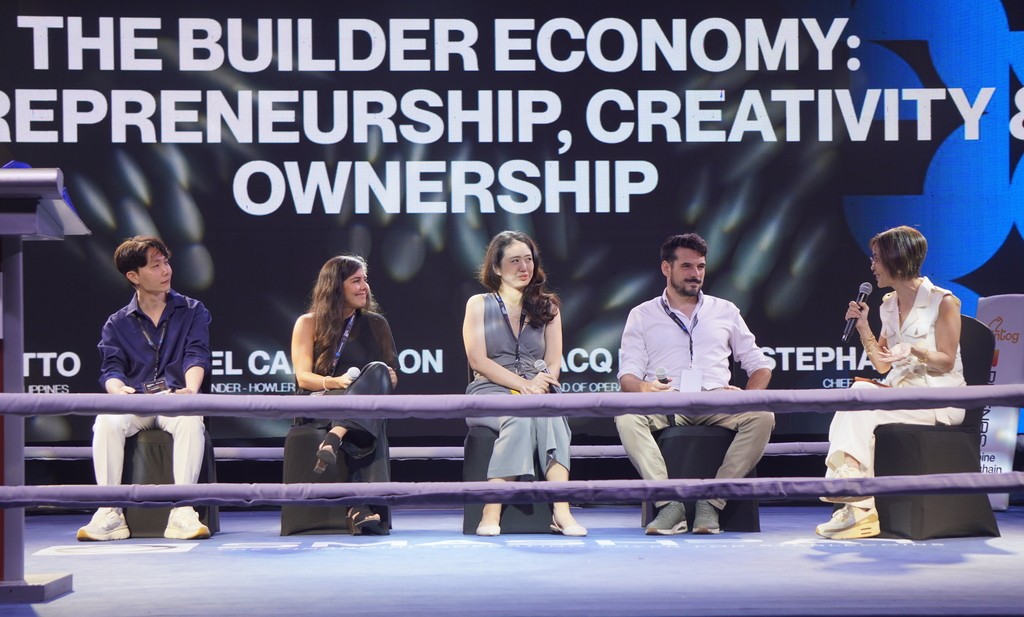
At the fifth edition of Philippine Blockchain Week, the panel “The Builder Economy: Entrepreneurship, Creativity & Ownership” brought together innovators to explore this new era: one where creativity, community, and ownership converge to reshape how businesses are born and scaled.
Moderated by Janelle Barretto, President and Co-founder of Philippine Blockchain Week, the discussion featured Jacq Lim, Fractional Business Process Automation Operator at Nas.io, Daniel Carrasson, Founder of Howlers Manila Festival, Minjae Lee, Founder/CEO of MyStarPick, and Stephanie Carolina, CGO at PangeaPath. Together, they unpacked how technology empowers individuals to build faster, cheaper, and more meaningfully than ever before.
The panelists agreed: the builder economy marks a decisive shift away from traditional gatekeepers. As Carolina observed, “It’s a world where anybody can turn any idea into reality… you don’t have to deal with the traditional gatekeepers that made things slow.”
Lim emphasised how ownership is moving from institutions to individuals: “The speed at which we can build has been accelerated by 10x, 20x. You no longer need millions of dollars of capital to make an idea a reality.”
Community has risen as the main core of sustainable growth, whether it is digital or physical. Carrasson explained how Howlers Festival thrives on belonging: “Community is a big part of our festival. People feel at home. It’s their own place.”
Lee also mirrored this sentiment, highlighting that his blockchain-powered fan voting platform was born out of controversies in K-pop competitions: “Community comes first, before the product. Fans stop being numbers on a screen and start being real stakeholders.”
While technology accelerates building, it also introduces new challenges. Carolina warned: “It’s no longer who has the best product, but who has the right distribution.”
Panelists further discussed the role of AI. Barretto discussed how AI has transformed customer support from repetitive tasks into revenue-driven conversations. Lee also noted that: “AI creates, and blockchain verifies. AI helps us grow, and blockchain ensures transparency.”
Creativity and human connection continue to be important as we look towards the future. Lim argued that schools should teach AI rather than ban it, while Carolina cautioned against losing critical thinking: “AI is here whether we want it or not. The skill is how you leverage it while staying human.”
In a lightning round, panelists identified common mistakes. For Lee, it is about building the product before the community, while Carolina pointed out taking too much money too early. Additionally, Lim said about hiring “yes people” instead of challengers. Lastly, Carrasson mentioned micromanaging instead of empowering teams.
Asked to imagine the builder economy five years from now, panelists provided various types of visions. For Carrasson, it is about festivals becoming global, with entrepreneurs owning more of the market. Lim was hopeful about thousands of Filipinos building beyond national borders. Meanwhile, Carolina spoke of a generation of first-time owners who are empowered by technology. Finally, Lee shared about fans becoming co-owners of the stars they support.
The panel underscored a simple truth: while technology evolves rapidly, the builder economy is ultimately about people, their creativity, their communities, and their ownership. As Barretto closed, “People don’t fall in love with technology, they fall in love with people.”
(Source: Philippine Statistics Authority/ Facebook)