

As artificial intelligence (AI) levels the technological playing field across industries, a growing number of executives argue that the deciding factor in competitive advantage is no longer which company has the best platform, but which one can make and act on decisions the fastest.
The observations came during a conference in Warsaw, where an industry founder argued that the real tech race is no longer won by technology. The speed of decision-making and execution wins it.
For the last couple of decades, having a robust technology platform gave a company competitive advantage for many years ahead, but the equation is no longer the same. With AI tools easily available nowadays, the cost of creating technology has become significantly lower.
According to the 2025 analytical article “Leading and Strategizing in the Age of AI,” published by California Management Review, competitive advantage is shifting toward factors including data quality, algorithm design, and the ability to integrate insights faster than competitors.
Speaking at the inaugural SOFTSWISS Tech Race Summit 2026, SOFTSWISS founder Ivan Montik argued that competitors can close a technical gap almost as quickly as it opens. He framed this as a mindset borrowed, unexpexctedly, from strategy and role-playing video games: the instinct to constantly accumulate experience and reinvest it, rather than sit on accumulated advantage.
Montik stated, “Sometimes you can fail with this decision, but it’s better to fail rather than not to do it, or to postpone it.”
Montik outlined four principles he said should guide companies operating in an AI-driven market. His first recommendation was for companies to target growth significantly ahead of their industries rather than simply keeping pace with competitors.
The second principle is to break large departments into units of three to five people, each with a single person clearly accountable for delivery. “Speed is built into the organisation,” the Montik said.
The idea is consistent with earlier management research on decision-making. Bain & Company researchers Marcia W. Blenko, Michael C. Mankins and Paul Rogers found in their book “Decide & Deliver” that decision-making effectiveness declines as groups grow larger. For every person added beyond seven members, decision effectiveness drops by about 10 per cent. Once a decision-making group reaches 17 or more people, its ability to make decisions and establish clear ownership effectively falls to zero.
The third rule Montik shared is that leaders should make the exercise engaging rather than purely administrative. “It’s a very important skill to make these key result objectives in a fun way, so that everybody in the company has fun.”
The final rule “never sacrifice resilience for speed,” Montil said. While businesses need to move quickly to take advantage of AI and new technologies, they must also ensure strong cybersecurity measures are built into products from the start. He argued that as AI makes it easier and faster to develop new tools, it also makes it easier for cybercriminals to launch attacks. As a result, security should be a core part of product development rather than something added just before launch.
According to the World Economic Forum’s Global Cybersecurity Outlook 2026, 87 per cent of the executives identified risks associated with AI as one of the quickest emerging cybersecurity threats.
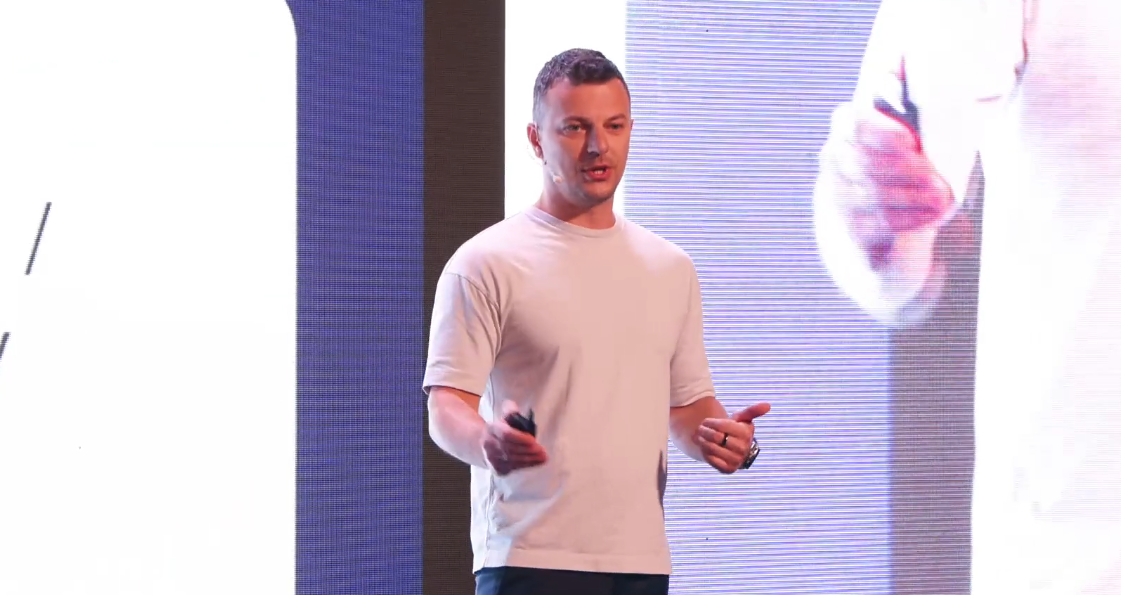
SOFTSWISS founder Ivan Montik delivering his keynote speech at the SOFTSWISS Tech Race Summit 2026 in Warsaw, Poland.
Montik established the fourth rule during an expensive crisis of his own. He co-founded the cryptocurrency payments business CoinsPaid, which suffered a serious intrusion in July 2023 that resulted in hackers stealing almost $37.3 million from its hot wallets.
The hack was subsequently linked by the organisation to the Lazarus Group, a cybercrime group backed by North Korea. The FBI confirmed the attribution in August 2023.
According to the founder, that incident forced a company-wide overhaul: security considerations were built directly into every stage of development, not just the technology function, but also financial and HR processes.
Montik stated, “We always check from the security points, weakness points, how this feature, how this upgrade, will influence our security.” He added that the shift later helped the company withstand a subsequent, AI-enabled intrusion attempt that exploited a different vulnerability.
Montik highlighted restructuring his chief technology officer role in order to formalise AI usage. He said generative AI tools had initially been adopted “randomly, no specific strategy, no specific structure”, before the company split its chief technology officer role in two: one executive retained responsibility for core technology, security and innovation. In contrast, a newly created chief AI officer (CAIO) role was tasked with driving AI integration across every business unit.
Many companies are now recruiting CAIOs to manage their AI policies and programming. According to an Avasant report published in 2026, almost one-fourth of Fortune 500 companies have now hired CAIOs while some other companies have also created a separate responsible AI role in order to enhance monitoring.