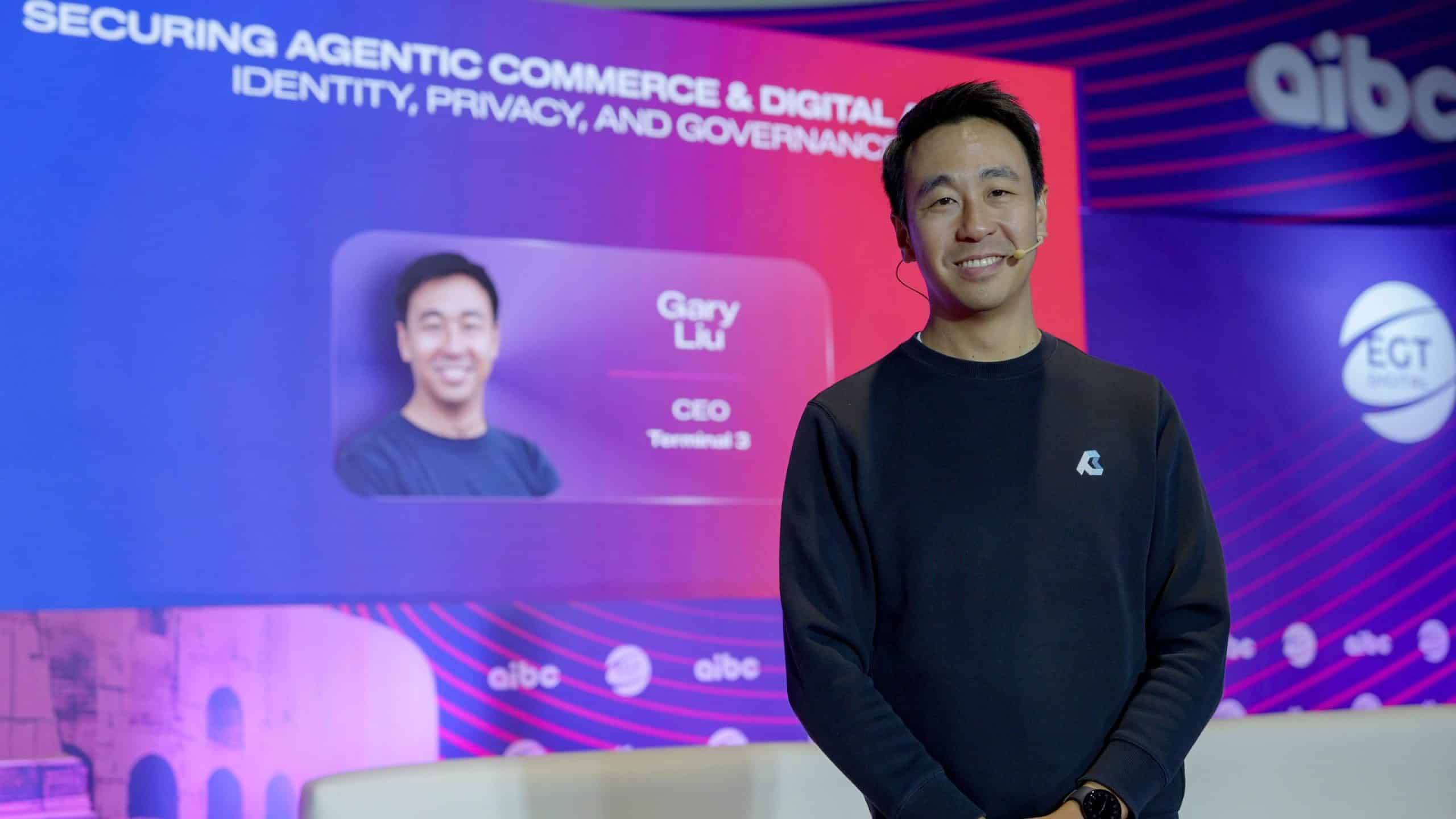
AIBC Asia 2026 opened its first day of conference at the SMX Convention Center in Manila, the Philippines, with a sharp focus on one of the industry’s most urgent questions: how AI agents, digital assets, privacy and governance will connect as autonomous commerce moves closer to real world adoption. During the keynote, “Securing Agentic Commerce & Digital Assets: Identity, Privacy, and Governance,” Gary Liu, Co Founder and CEO of Terminal 3, outlined why the next phase of AI powered transactions will demand new security architecture, regulated digital assets and stronger identity systems.
Speaking to delegates, Liu framed agentic commerce as a major use case for regulated stablecoins and on chain settlement. He argued that AI agents are no longer simple knowledge tools, but autonomous actors increasingly capable of carrying out economic activity on behalf of individuals and enterprises.
“In just three short years, we have seen AI agents go from being knowledge tools to now fully autonomous actors and participants in the global economy,” Liu said.
The keynote placed particular attention on scale. Liu pointed to forecasts suggesting that autonomous agent to agent transactions could reach nearly USD 5 trillion annually by 2030. He also highlighted the speed required to support this new market, noting that future payment rails may need to handle transaction volumes far beyond today’s infrastructure.
Traditional rails, he said, are too slow and costly for a world where agents may need to interact, negotiate and settle payments in real time. “AI agents and true agentic scale is not going to be possible without blockchain,” Liu told the audience, adding that stablecoins offer faster settlement, lower transaction costs and a framework already suited to high volume digital activity.
While Liu presented blockchain and stablecoins as a practical foundation for agentic transactions, he also warned that transparency, irreversibility and speed introduce serious risks. Public blockchains allow wallet activity to be visible, while instant settlement means mistaken or fraudulent payments cannot easily be reversed.
This becomes more urgent when AI agents are involved. Liu explained that most internet security systems were designed around human behaviour, using patterns built from decades of human activity online. AI agents, by contrast, behave differently, learn quickly and may bypass systems once they detect how those systems operate.
“Identity, privacy and governance are non negotiables for the future of an agentic economy,” he said.
Liu identified four areas that regulators, policymakers and businesses must address: trust, authorisation, data privacy and governance. Trust requires verifiable credentials so systems can confirm which AI agent is acting. Authorisation requires limits on what an agent is allowed to do, especially when financial decisions involve large sums. Data privacy requires stronger safeguards over what information agents can access. Governance requires audit trails that regulators can trust.
He also questioned whether current approaches to software based security can keep pace with autonomous agents. “Software is not enough,” Liu said, pointing to the need for hardware guardrails and confidential compute infrastructure that can secure agent activity from the point of launch.
Terminal 3, he said, has been developing cryptographic infrastructure aimed at these challenges, including tools for AI agent identity, payments, audit logs and policy enforcement. Liu also referenced the company’s work on verifiable credentials and secure data systems, which he said have already supported millions of users.
The keynote set a serious tone for AIBC Asia 2026, placing security, privacy and governance at the centre of discussions around AI and digital assets. As the summit continues in Manila, delegates can explore further sessions across the agenda, with more conversations expected on regulation, enterprise adoption, blockchain infrastructure and the future of intelligent commerce.