
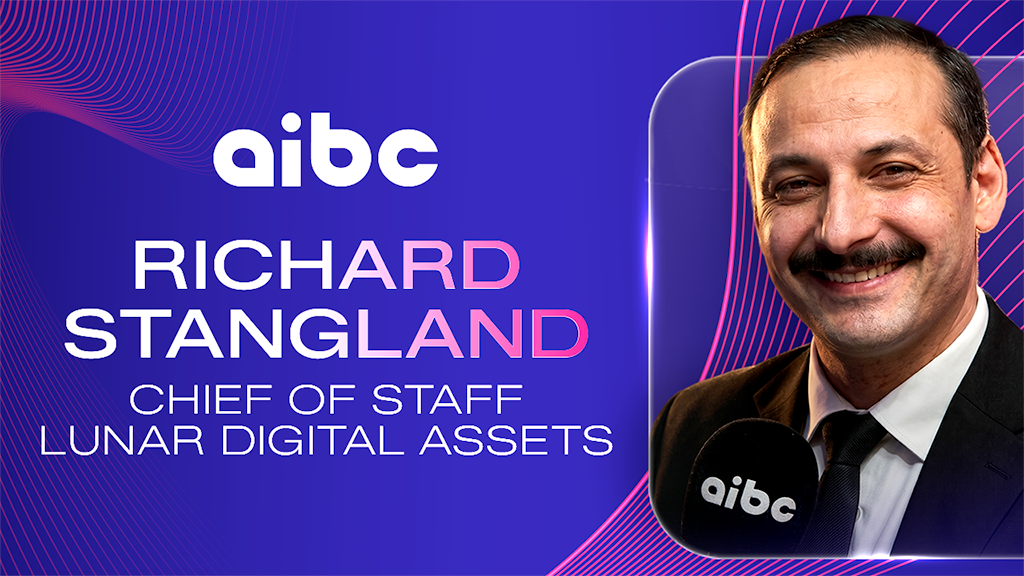
Richard Stangland, Chief of Staff at Lunar Digital Assets and a veteran of multiple Web3 project launches, spoke to AIBC in Manila about the mistakes that continue to plague blockchain start-ups, the relationship between regulation and speculation, and what makes Asia-Pacific stand apart as a trading hub.
Amid the buzz of the AIBC event in Manila, Richard Stangland addressed a subject he knows well: the mistakes blockchain start-ups continue to make, years into the industry’s evolution. Stangland has worked across multiple Web3 projects through various stages, from launch to scale, giving him a vantage point few others share on what actually separates a project that survives from one that doesn’t.
Asked how important branding, storytelling, and community building are compared with the emphasis often placed on technology, Stangland answered without hesitation.
“Understanding the purpose of a project and telling that story is extremely critical for any project, any founder that’s a startup in general,” he said, making clear from the outset where his priorities lie when judging a project.
Stangland was blunt when discussing the most common stumbles in blockchain’s early stages. “I think some of the biggest mistakes are focusing on the wrong things,” he said, before noting that a large share of founders launch with an idea before they have something that actually works.
He also pointed to a persistent mismatch between product and market, a failure he has watched repeat itself across numerous projects over the years. “A lot of times, there’s a lot of projects and a lot of founders who have an idea. However, that idea doesn’t necessarily solve a solution,” he said, flagging what he sees as a structural disconnect running through much of the ecosystem. That idea, he added, doesn’t always address a genuine problem. He identified another recurring pattern among new projects: the habit of chasing issues that, on closer inspection, are not problems at all.
Asked about regulation, Stangland looked to the past for context. “Crypto, Bitcoin, Web3, blockchain, has thrived in that environment,” he recalled, referring to the years when the sector operated with barely any regulatory framework, and noting that cross-border payments, free of the friction traditional finance carries, were much of the original point.
That early absence of rules, in his telling, was part of what allowed the sector to take off. But the landscape shifted, and with it came a dynamic he described as a chain reaction. “Now that we have regulation, there’s been a lot of friction, and that friction has caused a lot of constriction within our industry today,” he explained. He argued that increased regulatory pressure created further market constraints, which in turn encouraged additional regulatory scrutiny and speculative activity.
Towards the end of the interview, the conversation turned to Asia-Pacific’s place in the global blockchain landscape. Stangland’s definition was unambiguous: “Asia has always been a trader’s market,” he said, singling out the region’s strength in both centralised and decentralised exchanges, alongside an active user base.
It was one of his shortest answers, but also his clearest assessment of what distinguishes the region within the global crypto ecosystem. As attention turns from Manila to the next AIBC gathering in Rome, Stangland’s assessment offers a reminder that Asia-Pacific remains one of the most active and influential regions in the global blockchain market.