In the wake of corruption scandals that eroded public confidence and jeopardised foreign aid, Philippine leaders and business groups have launched the Integrity Chain, a blockchain-powered initiative designed to restore transparency and accountability in public projects.
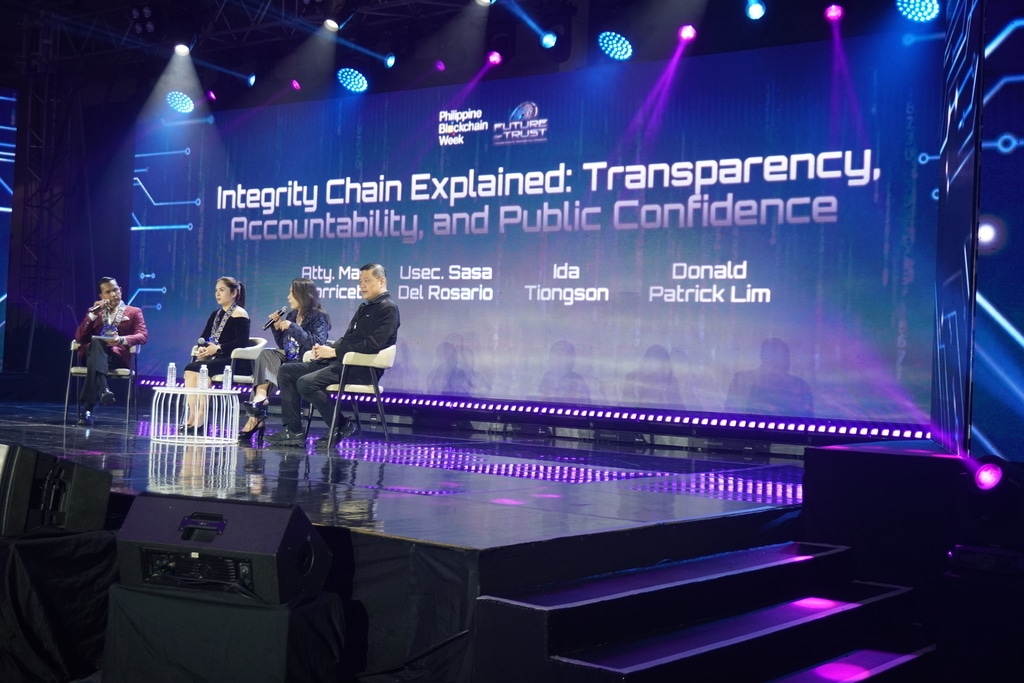
At the fifth Philippine Blockchain Week, government officials, business leaders, and civil society groups converged on 19 June to discuss this bold experiment in governance in a panel entitled, “Integrity Chain Explain: Transparency, Accountability, and Public Confidence.” Moderated by Atty. Mark S. Gorriceta, Chairman of Go Digital Philippines, the Integrity Chain aims to strengthen oversight, ensure proper use of funds, and rebuild trust in institutions.
The Integrity Chain was initiated last September 2025, when the Department of Public Works and Highways (DPWH) searched for solutions in the middle of a flood control scandal. Within days, 57 organisations, which include business chambers, civil society groups, and academic institutions, pledged support. By February 2026, the system went live, enabling conveners to review project documents, track funds, and verify progress through satellite imagery.
“This is not symbolic participation but real vigilance,” said Dr. Donald Lim, Chairman of Blockchain Council of the Philippines and one of the panelists. “Blockchain allows us to monitor foreign-assisted projects in real time, ensuring aid is used properly and transparently.”
The Department of Budget and Management (DBM) has embedded blockchain technology into its financial systems to combat the use of fraudulent documents. “We wanted courts to recognise blockchain’s immutability as proof in legal proceedings,” explained Usec. Maria Francesca “Sada” del Rosario, Chief Information Officer, Philippines Department of Business and Management, noting that this innovation strengthens accountability in public fund use.
In the meantime, the Department of Information and Communications Technology (DICT) is developing a nationwide rollout through its e-government structure. By producing a public dashboard, DICT enables citizens and organisations to check projects in real time. Together, DBM and DICT anchor the Integrity Chain in formal processes, bridging policy reform with technological innovation.
Legislative reforms can take years to be enacted, whereas the Integrity Chain moves ahead faster thanks to the private-sector leadership. Business groups, NGOs, and academic institutions stepped in as conveners, now acting as evaluators. They review documents, monitor progress, and provide an added layer of civic oversight. “Even if many leaders didn’t fully understand blockchain, they understood the urgency of corruption scandals,” Dr. Lim said. “Their intent to help the country was enough to get the ball rolling.”
Panelist Ida Tiongson, Vice-President of Blockchain Council of the Philippines, likened the process to renovating a house: “You check if the contractor is building correctly before releasing funds. Evaluators ensure transparency in the same way.” This partnership highlights a broader principle: governance is not the responsibility of government alone. By offering expertise and civic commitment, the private sector helps build a culture of shared accountability.
According to the panelists, the value of the Integrity Chain rests in its accessibility to ordinary citizens. For barangay officials, students, and taxpayers, it offers a simpler way to verify that public funds are used properly. In education, examples already exist. Schools, for instance, have incorporated transcripts and certificates on blockchain to ensure authenticity and eradicate bureaucratic delays. Meanwhile, in public works, evaluators can confirm project progress through documents and satellite images.
“Investors look for systems that curb corruption,” Tiongson added. “By putting trust in documents and curbing fraud, blockchain strengthens confidence in the Philippine economy.” Ultimately, the Integrity Chain empowers citizens to become active participants in governance. “Educated citizens make nations great. Active citizens stabilise democracy,” Dr. Lim emphasised. “We cannot just complain while the ship sinks. We must act together.”
With its pilot phase nearing completion, the Integrity Chain is poised for broader integration. DICT will ensure interoperability across agencies, giving citizens access to a public dashboard that tracks project progress and fund usage in real time.
Panelists noted that the next stage is cultural as much as technical. “Any new technology requires small wins, proof of concept, and civic commitment,” Dr. Lim said. Future enhancements may include artificial intelligence tools to assess construction costs and completion rates, enabling faster, more precise monitoring. Legislative efforts such as the proposed Cadena Bill aim to institutionalise blockchain in budget automation, complementing Integrity Chain’s private-sector leadership.
The Integrity Chain is a crucial step for the country in combating corruption, as it blends technology with civic participation to restore public confidence. By integrating blockchain into government systems and enabling evaluators, it indicates that transparency is not just a promise but a process.
But sustainability will be the true test. Agencies need to continue digitising records, while business groups demand sustained vigilance, and citizens should demand accountability. As Tiongson noted, “Blockchain in governance is not about technology alone. It’s about curbing corruption, attracting investment, and giving Filipinos confidence that public funds are used for the public good.”
The Integrity Chain could transform governance into a system in which trust is built into every transaction if it is scaled at the national level and streamlined through legislative reform, sharing responsibility across government, business, and society.
(Source: Bam Aquino/Facebook)