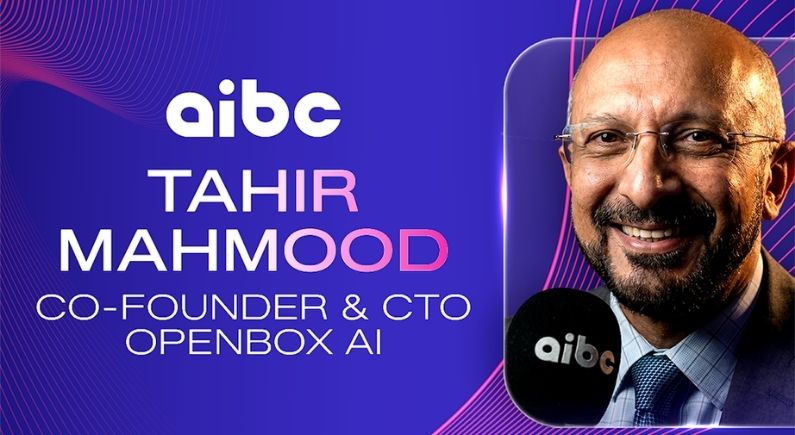
As enterprises race to move artificial intelligence projects from experimentation to deployment, governance has become the industry’s most pressing challenge, according to Tahir Mahmood, Co-Founder and CTO of Openbox AI. In an exclusive interview during AIBC Asia 2026 in Manila, Mahmood said businesses are entering a new phase of AI adoption where oversight, security and accountability can no longer be treated as secondary concerns.
“We’re getting to the stage where people have built a lot of proof of concepts, and now they’re looking at productionising, which is how do we take AI to the next level?” Mahmood said.
His comments align with findings from Deloitte’s State of AI in the Enterprise 2026 report, which found that only 25 per cent of organisations have successfully moved at least 40 per cent of their AI experiments into production, although 54 per cent expect to reach that milestone within the next six months. According to Deloitte, many companies remain stuck in a “proof-of-concept trap” because production deployments require far greater investment in infrastructure, compliance and security than pilot projects.
Mahmood said many organisations have already demonstrated AI’s value but are now asking a more difficult question.
Mahmood believes the rise of agentic AI systems will make governance even more important. Unlike chatbots that rely on human users to validate outputs, agentic systems can independently interact with tools, make decisions and perform tasks across multiple systems.
“A chatbot is just talking to the LLM directly, and you as a human get an answer,” he explained. “An agent is like the body of the brain. The brain is the LLM, and the agent is the body: arms, legs, eyes. It reaches out to tools. It communicates with other agents.”
The challenge, Mahmood said, is that AI models remain probabilistic rather than deterministic. “It has no sense of knowing what is right or wrong because the model is probabilistic. So that is the cause of governance.”
Deloitte’s research highlights a similar concern. While 74 per cent of organisations plan to deploy agentic AI within the next two years, only 21 per cent currently have mature governance frameworks to manage autonomous AI systems.
According to Mahmood, enterprises increasingly recognise the value of AI agents operating independently, but they also want assurances that those systems remain aligned with business objectives.
Security risks continue to rank among the biggest obstacles to wider AI deployment. Deloitte found that data privacy and security remain the leading concern for organisations, cited by 73 per cent of respondents. Legal, intellectual property and regulatory risks followed at 50 per cent.
Mahmood said many of these concerns can be addressed through proper governance mechanisms. “There are known things that AI can do that will go off, and you need to protect against this,” he said.
He pointed to the work of the Open Worldwide Application Security Project (OWASP), which has identified major AI-specific security vulnerabilities, including prompt injection attacks.
Mahmood said regulators worldwide are still determining how best to oversee the technology. “The EU has always been the first adopter of regulation,” he said, pointing to the European Union’s AI Act as one of the first comprehensive AI regulatory frameworks.
He estimated that more than 30 countries are implementing policies similar to the EU AI Act. “What I’ve noticed is that governments are all searching and trying to find out where they should land themselves.”
Despite the attention surrounding artificial intelligence, Mahmood believes adoption remains less advanced than many people assume. He said perceptions are often shaped by developments in technology hubs such as Silicon Valley rather than the realities facing most businesses and consumers.
Deloitte’s findings support this view. While access to enterprise AI tools has expanded rapidly and now reaches nearly 60 per cent of workers, fewer than 60 per cent of those employees actively use AI in their daily work. Meanwhile, 84 per cent of companies have yet to redesign jobs around AI capabilities.
Mahmood expects adoption to accelerate as younger generations grow alongside AI technologies.