Artificial intelligence has moved past the early excitement. After months, perhaps years, in which companies, start-ups, and major corporations have experimented with chatbots, generative models, and new automation tools, the market has entered a more selective season. It is no longer enough to say that a company is “doing AI”. It is no longer enough to launch a pilot project or introduce a virtual assistant into a single business process. Businesses are now demanding measurable results, return on investment, cost control, data security, and infrastructure capable of supporting large-scale adoption.
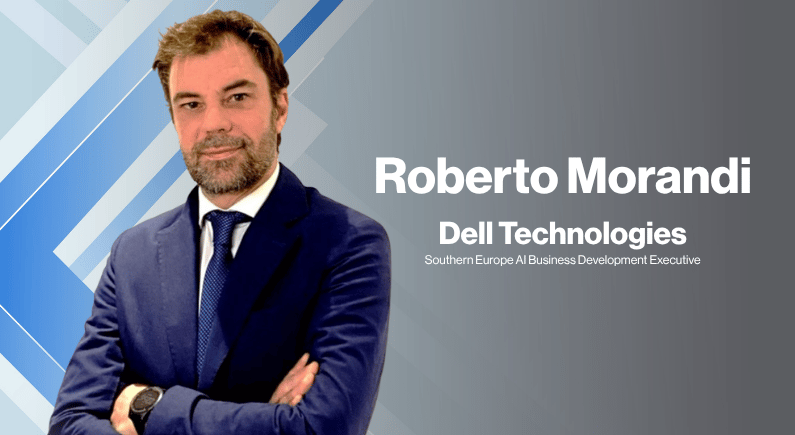
This is at the heart of the view expressed by Roberto Morandi, the Southern Europe AI Business Development Executive at Dell Technologies, whom AIBC interviewed during We Make Future.
For Morandi, speaking about “real” AI means, first and foremost, moving beyond the fragmented approach that characterized the first wave of adoption. “It means moving away from what has so far been an approach based on pilot projects, unconnected to one another, perhaps managed differently, using different platforms and different tools, towards a consistent, reusable platform approach that can support and govern multiple AI initiatives,” he explains.
Many companies began their artificial intelligence journey through isolated initiatives: one use case in customer service, one in personal productivity, one in data analysis, another in automated content generation. It was a useful phase because it allowed businesses to understand the technology’s potential and test its initial applications. But, according to Morandi, it is not enough to generate lasting value.
The next phase requires a paradigm shift. AI must become an enterprise platform, not a collection of experiments. A common model is needed, one capable of making data, software, infrastructure, and expertise reusable. The goal is to “repeat the processes learned each time”, making every new implementation easier and creating “an infrastructure and solutions” capable of progressively increasing the return on investment.
In this view, artificial intelligence is no longer simply a technology to be tested, but an industrial capability to be built. Every project must contribute to the next one, every use case must strengthen the company’s ecosystem, and every investment must become part of a broader strategy.
The real dividing line, however, remains the business outcome. Asked where the boundary lies between companies that are genuinely innovating with AI and those that are simply following a trend, Morandi answers with a clear criterion: “The boundary is where the company focuses on the business results it wants to achieve, rather than on a stylistic or technological exercise.”
It is a statement that captures one of the main risks of the current artificial intelligence season. AI can become a powerful lever for transformation, but it can also be reduced to an image exercise, presentation language or experimentation with no real impact. To avoid this risk, a clear guiding principle is needed: return on investment.
“When the guiding star of artificial intelligence implementation is the business result you want to achieve, namely return on investment, then you move from hype to AI for real,” Morandi adds. This is where the topic becomes particularly relevant to the ecosystem covered by AIBC, in which artificial intelligence, fintech, blockchain, digital assets, and digital infrastructure are increasingly intertwined. The technological complexity of a project does not measure innovation, but by its ability to generate value: reducing inefficiencies, improving processes, increasing productivity, protecting data, accelerating decisions, and opening up new business opportunities.
In the global debate on artificial intelligence, the gap between Europe, the United States, and China remains one of the most widely discussed issues. Morandi acknowledges the gap, including from an economic perspective, but urges against reading the European model solely as a limitation.
“It would be easy to answer that, probably also from an economic point of view, there is a difference between Europe, the United States, and China,” he observes. The difference, however, is not only about investment. It is also about regulation, governance, and the way innovation is situated within a framework of responsibility.
“We have much more significant legislation, I would even say fortunately, from a certain point of view,” Morandi says. This makes adoption “potentially more measured, with stronger requirements for governance, transparency and control”, but also “rightly much more controlled” and “much more governed”.
For Morandi, this is not necessarily a hindrance. If AI is to become a technology that benefits companies and society, it must be governed. “That is how it must be if it is to become something that genuinely benefits the company and the wider community,” he stresses. Global competition, therefore, will not be a race for speed alone. It will also be a race for trust. In regulated sectors, from finance to healthcare, from public administration to advanced manufacturing, compliance, transparency, and security may become decisive factors.
In the public narrative around AI, attention often focuses on visible applications: chatbots, virtual assistants, generative tools, and easy-to-use interfaces. But behind every response produced by an artificial intelligence system, there is a complex machine made up of hardware, servers, data centres, cloud, storage, networks, cybersecurity, computing capacity, and data management.
“Behind every artificial intelligence there is an infrastructure,” Morandi recalls. And this infrastructure, in his view, can no longer be perceived as an invisible, almost “ghost-like” element behind a graphical interface. The new paradigm is different: infrastructure must be “something I can govern, that I can secure, that can become a differentiating factor for me”.
It is one of the most important passages in the interview. Artificial intelligence is not immaterial. It is a deeply physical technology, built on computing capacity, data centres, cloud architectures, energy, and information protection systems. The more AI enters companies’ core processes, the more central issues such as data sovereignty, compliance, and intellectual property become.
“Data sovereignty and the protection of intellectual property will increasingly become a fundamental issue for companies,” Morandi says. The question is not only which model to use, but also where the data is located, who controls it, how it is handled, and on which infrastructure it is processed.
Linked to this dimension is another issue that is weighing increasingly heavily on corporate strategies: the cost of artificial intelligence. Morandi refers to tokenomics, meaning the economics of AI token consumption and generation, including the costs, efficiency, and business value associated with AI workloads.
“Recently, there has been a lot of talk about tokenomics: in other words, how much artificial intelligence costs. Many consumption-based AI services are priced according to token usage, making usage patterns an important element of cost governance,” he observes.
The price of an individual token may fall, but this does not necessarily mean that AI will become cheaper. With the arrival of AI agents, the number of tokens exchanged can grow significantly. “The token itself is a unit of measurement that is decreasing in price,” Morandi explains, but “with agents and all the developments that are coming, the number of tokens has grown by a huge multiple.”
The risk is that the perceived cost of AI may appear to be under control, while actual usage becomes difficult to predict. “The cost we see as the price, as the interface of artificial intelligence, seems contained,” he warns, “but in reality, the big risk is not being able to govern it correctly and therefore risking that increased agent activity can make consumption and costs more difficult to predict.”
For a company, the challenge is concrete. It may know the unit cost of a token but not how many tokens a given interaction will use. With AI agents, that uncertainty grows. “How many they’ll use is difficult to predict precisely,” Morandi says. That’s why “building a budget in advance is very complicated,” and why usage modeling, quotas, and guardrails matter.
This is where the issue of private cloud and on-premises solutions comes back into play. In certain enterprise scenarios, these architectures can offer greater cost predictability than models based exclusively on consumption.
“It’s different in a private cloud infrastructure, where costs are tied largely to maintenance and the platform you run,” Morandi explains. “Customer-controlled infrastructure can give you a more predictable cost profile for steady, well-utilized workloads, though the economics still vary by workload, configuration, and utilization.”
This is not about rigidly opposing public cloud and private infrastructure, but about assessing each case individually. For workloads linked to inference and fine-tuning, Morandi notes that several studies are beginning to show how the total cost of ownership of on-premises solutions can become advantageous as resource utilization increases. Control of infrastructure, therefore, is not only a matter of security or data sovereignty. It is also an economic issue. For companies bringing AI to scale, predicting, and governing costs will become a strategic variable.
With the spread of AI agents, the issue of governance over automated decisions is also growing. The debate often refers to human-in-the-loop, meaning the human being included in the decision-making cycle. Morandi, however, proposes a stronger concept: “human on the loop”.
“There is a lot of talk about human in the loop when it comes to agents: a human being who must be inside this decision-making loop, managed by the agents,” he explains. “I believe we need to think a little more about human on the loop.”
The difference is substantial. The human being must not merely be present in the process but must govern it. Humans must define the boundaries, control the agents, and establish rules and responsibilities. “The human being must be the fundamental governing entity of these agents,” Morandi says.
At the same time, he makes clear that oversight should not be uniform across every decision. High-risk, regulated, ethical, or safety-critical decisions require stronger human oversight, and some should not be fully delegated at all. The broader principle remains consistent: agentic AI should be governed by human judgment, clear accountability, and a human-centered approach.
It is a position that avoids both blind enthusiasm for total automation and fear of indiscriminate replacement. The challenge is not to block AI, but to build appropriate control models.
This is where the shift from hype to real AI will be decided: not in the promise of a technology capable of doing everything, but in companies’ ability to turn it into a scalable, secure, sustainable system focused on return on investment.