The Middle East and North Africa have long been among the world’s most discussed yet poorly understood business frontiers. For global B2B enterprises eyeing its oil-rich corridors and increasingly diversifying economy, the opportunity is great, but so are the risks of going in blind.
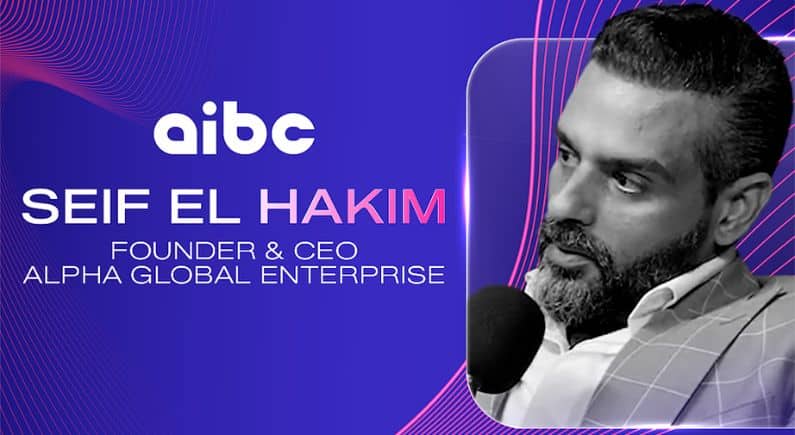
Seif El Hakim, Founder and CEO of Alpha Global Enterprise, spoke exclusively at AIBC Eurasia 2026 in Dubai, outlining a clear and convincing strategy for foreign companies wishing to establish themselves in the region.
El Hakim rejects the usual hype around. For him, predictive AI is not something that makes decisions for you. It is something that helps you see patterns faster and more clearly, so that when it is time to make a call, your instincts are sharper and better informed.
El Hakim stated, “MENA region is not a single country, it’s a kind of a combination of countries under a brand name. So, the power structure, the authority structure, that’s number one. Number two, the cultural, I would say, differences. They need to 100 per cent know that. The third one would be the regulations. So, these are the main things international companies or B2B companies need to be aware of before entering the MENA region.”
Once inside the region, the rules of engagement shift dramatically. El Hakim is unequivocal: the broadcast era is over, and brands that have not figured that out yet are already falling behind. He noted, “Mass marketing is dying. Personalisation becomes everything these days. The winning brands will be using AI more towards personalisation rather than a broadcast.”
Culture plays a decisive role in consumer behaviour. Ramadan, Eid, Hajj, these are not just religious moments on a calendar. They are some of the most powerful consumer events anywhere in the world, capable of completely shifting spending patterns, media habits, and how receptive people are to a brand’s message, sometimes within the span of a single night.
El Hakim’s approach to AI is refreshingly unsentimental. Predictive AI is not a decision-maker; rather, it is a pattern revealer, and its greatest value is in honing the intuition of experienced operators.
He brought this to life with a real estate example, where predictive tools are already helping investors track where infrastructure is being built, which areas are seeing urban planning activity, and how rental yields are shifting across emerging districts. The data surfaces the patterns, but it is ultimately the human sitting across from that data who decides what to do with it.
El Hakimi further explained, “The smart founders or the smart CEOs, the smart companies, their edge will be in choosing the right tool, not just any tool.”
According to a PwC analysis, AI will add nearly $320 billion, about 11 per cent of the region’s GDP, to the MENA economy by 2030, on top of a rapidly expanding AI market that was worth $11.9 billion in 2023 and is growing at roughly a 45 per cent compound annual rate.
(Source: AIBC World/YouTube)
On the future of technology, El Hakim directly urges start-up founders to stop copying Silicon Valley’s playbook and applying it to MENA contexts. In his view, the region’s most transformative opportunities lie precisely where it diverges from the global mainstream.
He predicted, “AI as embedded systems within the governments, within the banks, organisations, of course, the second fintech will always be fintech will grow. And since the region specific will be, I would say like climate related things and water as well.”
According to Mordor Intelligence, the MENA fintech market, which was valued at $5.65 billion in 2025, is expected to grow at a 12.69 per cent CAGR by 2030, owing to a young, digitally engaged population, supportive government policies, and the rapid rise of neobanks, mobile-first solutions, and digital lending platforms.
Saudi Arabia’s Data and Artificial Intelligence Authority (SDAIA) aims to attract $20 billion in AI investments by 2030 and train thousands of specialists, with a significant focus on applying AI to the water crisis through precision irrigation, AI-powered desalination optimisation, and environmental scenario modelling.