
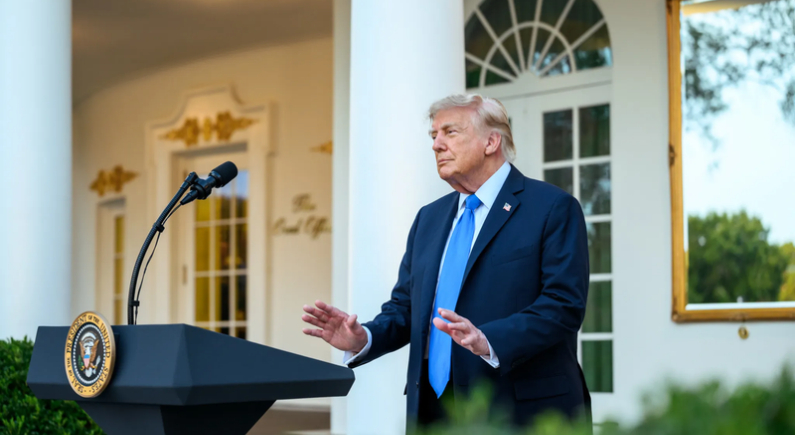
US President Donald Trump has rejected calls to slow the development of advanced artificial intelligence, saying the United States must maintain its lead over China in AI.
Speaking to reporters, Trump said some AI guardrails could be introduced but opposed deliberately reducing the pace of development. He said maintaining US leadership in AI was strategically important.
Trump stated, “We’re leading China in AI. We’re the most sophisticated country in the world, and frankly, I want to keep it that way, because whoever wins AI wins. We can put guardrails. We can do this and that. But I think you have a lot of negative forces that are bringing it up that shouldn’t be bringing it up, and they’re bringing up things that won’t happen.”
Trump’s remarks marked his first public response to a joint statement issued on Saturday by Anthropic CEO Dario Amodei, OpenAI CEO Sam Altman, and xAI founder Elon Musk. The three AI leaders publicly supported slowing the development of increasingly powerful AI models. Their comments followed Anthropic’s disclosure that its chatbot, Claude, had been misused in attempts to develop biological weapons, conduct espionage related to Ukraine, and facilitate dating-app scams.
Recently, Amodei argued that AI progress is accelerating, partly because advanced models are increasingly able to contribute to the development of future AI systems. He described the process as a form of recursive self-improvement and warned that rapid progress could outpace researchers’ ability to understand and control the systems they create.
Amodei published an article titled We Must Pace the Frontier, arguing that the rapid advancement of AI capabilities should be slowed. “We must slow the pace at which we improve the capabilities of AI models,” he wrote.
I agree with Dario that we need to pace the frontier. This has been a primary topic of discussions we've had at OpenAI in recent weeks.
Committing to having independent evaluators with employee-like access is a great idea, and we will do the same. We'll have more to share soon. https://t.co/1YhhIybZX7
— Sam Altman (@sama) September 12, 2026
The debate gained attention after other prominent AI leaders expressed support for parts of Amodei’s argument. Altman voiced his support on X, stating, “I agree with Dario that we need to pace the frontier.” Elon Musk also publicly backed the position.
Dario is right https://t.co/EwKgqQGaUo
— Elon Musk (@elonmusk) September 12, 2026
Anthropic published a report titled “Detecting and Countering Misuse of AI: September 2026,” Anthropic detailed instances that occurred between December 2025 and August 2026. Cyber operations, influence campaigns, surveillance, scams and fraud, biological misuse, weapons development, and “distillation,” a practice in which rivals use Claude’s outputs to train their own AI models, are the seven categories that the company identified as “disrupted misuse” of its AI assistant, Claude.
China also pushed back against implications contained in Anthropic’s report. At a regular press briefing, Foreign Ministry spokesperson Mao Ning said she was unfamiliar with the report’s specific allegations but reiterated Beijing’s position on AI development.
“As a matter of principle, China has always advocated the development of AI for good, while firmly opposing distortion of facts and attacks and smears against China,” Mao said.
David Sacks, Trump’s AI and cryptocurrency adviser and co-chair of the President’s Council of Advisors on Science and Technology, argued that AI companies are free to slow their own development efforts but should not seek government intervention to impose similar restrictions on rivals.
In a post on X, Sacks contended that Anthropic and OpenAI already enjoy a dominant position at the forefront of AI development and warned against regulatory measures that could disadvantage smaller companies and open-source developers.
“Stop pretending you need anyone else’s permission” to slow down, Sacks wrote. “Stop pretending antitrust law has to be suspended so you can form a cartel.”
Dario has written that we need to “pace the frontier,” and Sam has agreed. People may be surprised by my response: go ahead.
You guys are the frontier. By any reasonable metric — market share, revenue growth, model capability — the two of you have a duopoly on frontier…
— David Sacks (@DavidSacks) September 13, 2026
The disclosures came days after the public resignation of Jacob Coxon, a former OpenAI researcher who later joined Anthropic. Coxon accused both companies of “gambling with our lives” by failing to move slowly enough in developing increasingly capable AI systems.
According to Coxon, neither company was taking sufficient precautions against AI models that could soon “hack anything, revolutionize any field overnight and acquire real power and resources.” He argued that OpenAI employees had “not deeply internalised the civilisational stakes.” At the same time, Anthropic staff understood the risks but remained “locked in a race to get there first” for fear that competitors might act less responsibly.
NBC News reported that two additional researchers, one from Anthropic and another from Google DeepMind, are also expected to leave their positions while issuing similar warnings about the risks posed by advanced AI systems.