The General Manager at Blockchain Italia explains how Varla aims to bring lending, borrowing, and capital efficiency to prediction markets, while regulators and industry players debate whether these instruments should be treated as finance, information, or betting. Prediction markets have entered a phase of rapid acceleration. Originally designed as markets where users can take positions on the outcome of future events, they are becoming one of the most debated topics at the intersection of digital finance, blockchain, betting, information, and regulation. The central question remains open: will they be remembered as a new financial infrastructure or as yet another form of digital speculation?
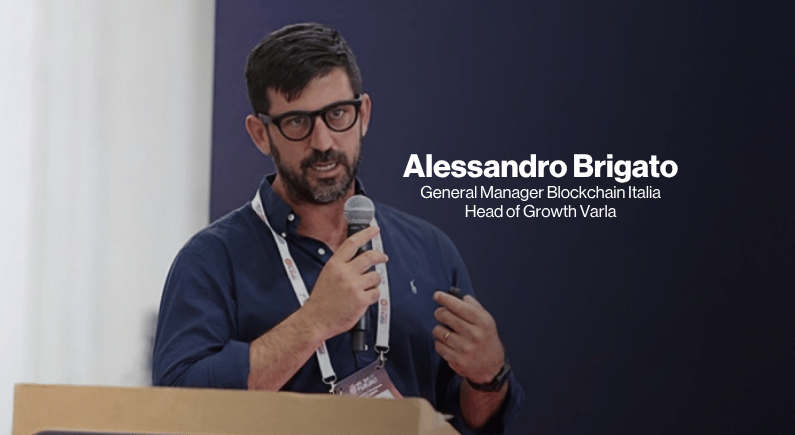
For Alessandro Brigato, General Manager at Blockchain Italia and Head of Growth at Varla, interviewed exclusively by AIBC, the answer cannot be reduced to a single category. “There is certainly speculation,” he says. “Speculation is always present when we are dealing with a new instrument.” But, according to Brigato, stopping at that interpretation would mean failing to grasp the scale of the phenomenon. The market, he notes, is growing rapidly and attracting the attention of investors, platforms, blockchain operators, and regulators. What makes prediction markets particularly relevant is their ability to cover a wide range of events: politics, sport, economics, technology, climate, regulatory decisions, macroeconomic data, and geopolitical scenarios. This is where the issue becomes more complex. These instruments may resemble a bet, yet they also generate informational signals and, thanks to blockchain, can be transformed into composable digital assets.
One of the most interesting aspects of prediction markets is their informational function. Brigato refers to the concept of the wisdom of the crowd: the idea that a market made up of many participants, each with different information, expectations, and incentives, can aggregate probabilities more efficiently than traditional tools. “It also becomes an informational tool,” Brigato explains, noting that, in some cases, the probabilities expressed by prediction markets have proved more accurate than surveys, election polls, or conventional analysis.
The point is not that the market is always right. The point is that, when there are sufficient liquidity and clear economic incentives, the price of a position can become a synthetic representation of collective expectations. This characteristic makes prediction markets different from a simple betting platform. They do not merely allow users to place a bet on an event; they can produce a signal, a continuously updated probability estimate, and a reading of sentiment and available information at a given moment.
It is precisely this hybrid nature that is creating difficulties for regulators. Prediction markets can be interpreted as informational tools, digital assets, quasi-derivative contracts, or betting-like products. The Polymarket case has become emblematic. In Italy, the Customs and Monopolies Agency (Agenzia delle Dogane e dei Monopoli – ADM), the government authority responsible for regulating gambling, ordered the domain polymarket.com to be blocked, classifying it as an unauthorised gambling website. The measure came while Polymarket was appearing as the main shirt sponsor of Italian football club Lazio. Following ADM’s decision, Lazio removed the brand from its shirts and official channels and moved to end the sponsorship agreement.
For Brigato, the case highlights one of the unresolved issues in the sector. Prediction markets are built around a permissionless and borderless logic, but in practice they still rely on centralisable elements: domains, DNS, front ends, infrastructure providers, and cloud services. “These structures, although decentralised, actually rely on domains, DNS, and front ends,” he observes. That is where the regulator can intervene, even if the underlying protocol or tokens remain on blockchain. The issue, therefore, is not only about access to a platform. It concerns the very definition of the instrument. Where does information end? Where does betting begin? When does a position on a future event become a digital asset? And which authority should regulate it?
The most innovative point in the interview concerns capital efficiency. Brigato explains the difference between a traditional bet, where capital remains locked until the event concludes, and a tokenised position on blockchain, which can be reused as collateral. The example is ante-post betting, meaning bets placed before the start or conclusion of a competition. In a traditional model, capital remains idle for weeks or months. A position in a league table can remain unchanged for an entire season.
“In ante-post betting, fundamentally, I am locking up capital,” Brigato explains. In a centralised system, that capital remains tied up until the outcome or, where offered by the platform, until a possible cash-out. With blockchain, however, the nature of the instrument changes. A position in a prediction market can be converted into a token. And if that position is a token, it can be transferred, integrated into other protocols, used as collateral and included in DeFi strategies. This is where a prediction becomes something more than a bet: it becomes a digital asset.
This is where Varla comes in, a platform that presents itself as a lending infrastructure for prediction markets. Its model allows users to deposit their prediction market positions as collateral and borrow stablecoins, without selling the original position. “At Varla, we have brought our DeFi knowledge to support prediction markets,” Brigato explains. The aim is to increase capital efficiency, allowing users to maintain exposure to the event while obtaining liquidity.
The logic is that of lending and borrowing, already tested in decentralised finance. The lender deposits liquidity and earns a yield. The borrower deposits an asset as collateral and receives a stablecoin loan. The relationship between collateral and the amount of capital that can be borrowed is governed by the loan-to-value ratio, or LTV. Brigato refers to ratios that may vary with the position’s risk. The safer the asset is considered, the larger the amount that can be borrowed; the riskier it is, the lower the capital that can be obtained. The key point is that users do not necessarily have to exit their position. They can maintain exposure to the event, obtain liquidity, and use that capital for other strategies.
From a technical standpoint, the mechanism is based on the tokenised nature of positions. Polymarket positions are represented by ERC-1155 outcome tokens on Polygon, based on the Gnosis Conditional Token Framework. This structure allows the outcomes of prediction markets to be represented on-chain. In practice, the position does not remain confined within an isolated platform. It can become part of a broader ecosystem in which smart contracts, stablecoins, and DeFi protocols interact with one another.
Brigato refers to composability, a defining feature of blockchain. It is the ability to combine different protocols as if they were interoperable modules. An asset originating from a prediction market can be used in a lending protocol; the liquidity obtained can be used elsewhere; the position can continue to exist without being sold. “We combine composability with instruments that would otherwise have operated without blockchain and in separate silos,” Brigato summarises. This is the difference from traditional finance or centralised betting: capital does not remain idle, nor is it trapped within a single platform. Instead, it can circulate within a programmable ecosystem.
Among the possible strategies, Brigato also mentions looping. The mechanism involves depositing a position as collateral, borrowing stablecoins, and using them to buy additional exposure to the same position or another. In practice, users increase their exposure without selling the initial asset. It is a form of leverage built through collateral and smart contracts, but with the logic of over-collateralisation: the loan is backed by collateral worth more than the capital received. “My debt is actually my collateral,” Brigato explains. Liquidation thresholds are managed automatically by smart contracts, which intervene when the value of the collateral falls below certain levels.
This approach opens up new possibilities, but it also introduces new complexities. Capital efficiency does not eliminate risk; it transforms it and makes it programmable, but it requires robust models for valuation, liquidation, and collateral management.
The regulatory issue is not limited to the legal definition of prediction markets. It also concerns the risks of insider information, manipulation, and informational conflicts. If a real-world event becomes a market, those who possess privileged information may gain an advantage. Brigato cites real cases: individuals who allegedly took positions on events of which they had direct knowledge or attempts to manipulate external data linked to oracles. These systems bring off-chain information into the logic used to resolve a market.
In traditional financial markets, the concept of insider trading rests on issuers, regulated instruments, procedures, disclosure obligations, and sanctions. In prediction markets, by contrast, everything is more blurred. Who is the issuer? Where does the bet take place? Which jurisdiction applies? Who should intervene? The gambling regulator, the financial regulator, or the digital markets authority? “It will be difficult to define,” Brigato observes, precisely because these instruments perform several functions at once.
Artificial intelligence adds another layer. Prediction markets aggregate probabilities, signals, data, opinions, and market behaviour. AI can use this data to develop more sophisticated forecasts by combining it with external sources, news, statistics, and probabilistic models. According to Alessandro Brigato, AI will not replace the wisdom of the crowd but will use it. “Artificial intelligence will equip itself with that data to develop thinking that will probably become increasingly accurate,” he says.
The future could therefore see a convergence between AI agents, prediction markets data, and DeFi infrastructure. Such convergence could increase informational efficiency but also raise new questions about transparency, competitive advantages, and governance.
Prediction markets today occupy a territory that remains unstable. They can be informational tools, speculative products, probability markets, digital assets, quasi-derivatives, or forms of betting. They can help interpret the future, but also expose markets to manipulation, inside information, and regulatory arbitrage. Blockchain adds a decisive element: it transforms static positions into composable assets. Through platforms such as Varla, a prediction can become collateral, collateral can generate liquidity, and liquidity can feed new strategies.
This is where the real innovation lies: not only in predicting an event, but also in making that capital usable again. The challenge now is to understand whether this new architecture can strike a balance between innovation, efficiency, and rules. Prediction markets could become a new frontier for digital finance. But only if industry and regulators can govern their risks, incentives, and boundaries.