Technological competition is no longer measured solely in patents, computing power, or the market value of digital companies. Artificial intelligence, data, cloud infrastructure, connectivity, and cybersecurity have become central to industrial policy, national security, and the balance of power between states.
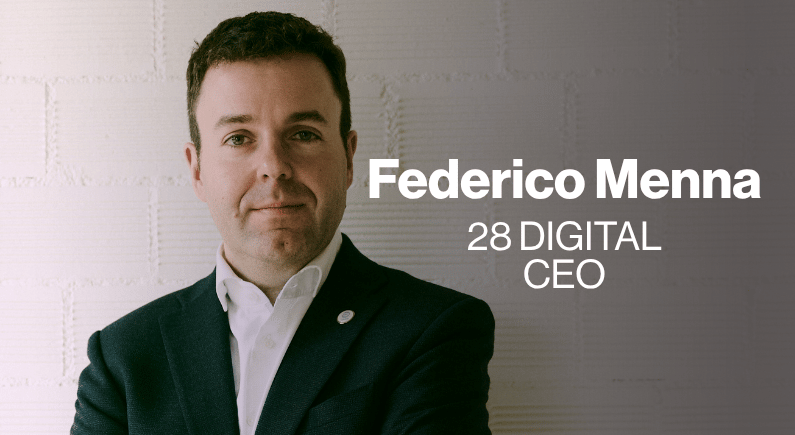
Those who control these technologies can influence entire economic systems and determine the degree of autonomy enjoyed by governments, businesses, and citizens. Federico Menna, CEO of 28DIGITAL, acknowledges that control over AI and digital infrastructure will play an increasingly important role in shaping international relations. His analysis, however, does not lead to an exclusive confrontational view of the future.
“I am an optimist, and I believe that technology, when used correctly, can enable growth, prosperity and a more inclusive society,” Menna explains in an exclusive interview with AIBC. The problem is not technology itself, but how control, knowledge and the ability to use it are distributed. “Unless we pay attention to who is gaining control and power over technology, there is a risk that the balance could become distorted.”
Technology is becoming a new expression of sovereignty. It is not, however, a form of sovereignty confined to individual nations. Major platforms operate across borders, manage infrastructure used in multiple countries, and can influence the economic and social choices of entire regions.
“It is not only national sovereignty, but transnational sovereignty as well,” Menna observes. Europe has already experienced the consequences of its dependence in several decisive areas of the digital economy. “Europe has somewhat missed the boat when it comes to the platform economy,” he admits.
Europe has taken on a leading role in regulation but has failed to develop enough operators capable of competing with major American and Asian groups. This delay does not mean the contest is over. According to Menna, Europe can still build a competitive advantage, provided it decides where to focus its resources and ambitions.
“There are other technologies in which Europe can succeed. It is important to identify the areas it wants to prioritise and to make significant commitments. We cannot expect to win at everything.”
Digital sovereignty, therefore, should not be confused with technological autarky. Sovereignty means understanding which technologies are genuinely strategic, deciding where industrial capabilities and expertise must be retained, and reducing dependencies that could become vulnerabilities.
This vision reflects the positioning of 28DIGITAL, the pan-European innovation platform formerly known as EIT Digital. The organisation adopted its new name in October 2025 and connects research institutions, universities, start-ups, established companies, investors, and public bodies.
28DIGITAL is not a conventional IT services provider. Its role is to support the transformation of scientific knowledge into market-ready innovation and to create stronger links between education, business, and capital. Its strategy is built around talent, technology, and trust, three elements that are central to Europe’s digital autonomy.
Growing dependence on digital systems has made cybersecurity essential to the functioning of businesses, governments, and public services. A cyberattack can disrupt payments, transport networks, communications, and administrative functions.
For Menna, cybersecurity must be regarded as genuine critical infrastructure, on the same level as energy, transport, and connectivity. Technical protection, however, represents only part of the response.
Menna refers to what he calls the “protect and build principle”: protecting systems while simultaneously developing broader digital skills. “Cybersecurity is about protection, but it also requires education. Everyone, including those who do not work in specialist roles, should have at least the basic skills needed to understand the risks.”
Vulnerability does not always begin with a highly sophisticated attack. It can start with a weak password, fraudulent message, or a telephone call designed to obtain confidential information. Menna points to online banking scams as an example, noting that they are becoming increasingly credible and difficult to identify.
According to Menna, the most common mistake made by businesses and governments is waiting until a problem has already emerged: “The typical response is to react rather than act proactively.”
When an incident is examined retrospectively, it often becomes clear that relatively simple measures could have prevented it or reduced its impact. No organisation can eliminate risk, but an effective strategy can make systems harder to compromise, limit the damage, and accelerate recovery.
“With the right preparatory steps, a more proactive approach and perhaps a little more courage when it comes to investment, many problems can be avoided.”
Cybersecurity is still often treated as a cost to be contained rather than an investment required to protect operational continuity and reputation. An incident does not cause technical damage alone: it can also undermine the trust of customers, citizens, partners, and investors.
Generative artificial intelligence has made the boundary between innovation and risk increasingly difficult to define. The same models that can identify vulnerabilities and automate defensive measures can also be used to create more convincing scams and accelerate attacks.
According to Menna, a new generation of cyber threats has already arrived: “I see artificial intelligence being used more for attacking than for defending.”
The ability to generate text, images, audio, and artificial voices makes it more difficult to distinguish authentic communication from attempted manipulation. Menna offers an everyday example: automated calls received on mobile phones. The same AI technology could be deployed on devices to recognise and block them.
“Attackers are better than defenders at using AI. That is a paradigm we need to change.”
The next stage could involve direct interaction between offensive and defensive artificial agents. Menna stops short of describing this as an outright war between AI systems but believes it is realistic to imagine environments in which autonomous systems carry out an increasing share of activity.
“It is highly likely that artificial intelligence will be used increasingly on both the attacking and defensive sides. At a certain point, the two systems will come into conflict.”
Alongside infrastructure and algorithms, Federico Menna identifies another European weakness: the tendency to invest in talent only once the need has become urgent.
“In some European countries, organisations wait until there is an immediate need before recruiting talent.”
It is the same reactive approach that frequently characterises cybersecurity. Action is taken only after a skills shortage has become a problem, rather than developing the necessary expertise in advance.
“Young people will be the ones shaping the future. We need to place greater trust in them, particularly when they possess skills that other generations do not have.”
International competition also depends on the ability to attract, train, and retain the people who develop strategic technologies. A continent that invests in research but fails to offer suitable career paths risks financing skills that will ultimately be valued elsewhere.
Protecting algorithms, data, and networks is essential, but it is not enough. Europe also needs people capable of understanding them. Companies that can transform them into products, capital prepared to support their growth, and institutions willing to invest before vulnerabilities become emergencies.
In Menna’s view, Europe should not attempt to pursue every segment of digital transformation. It must decide where it can build a competitive advantage, concentrate on its resources, and prevent its strongest ideas and talent from being developed and commercialised elsewhere.
The competition of the future could unfold between intelligent systems operating on both the offensive and defensive sides. Asked which side will ultimately prevail, Federico Menna closes with a remark that preserves his optimism: “The good guys will always win.”