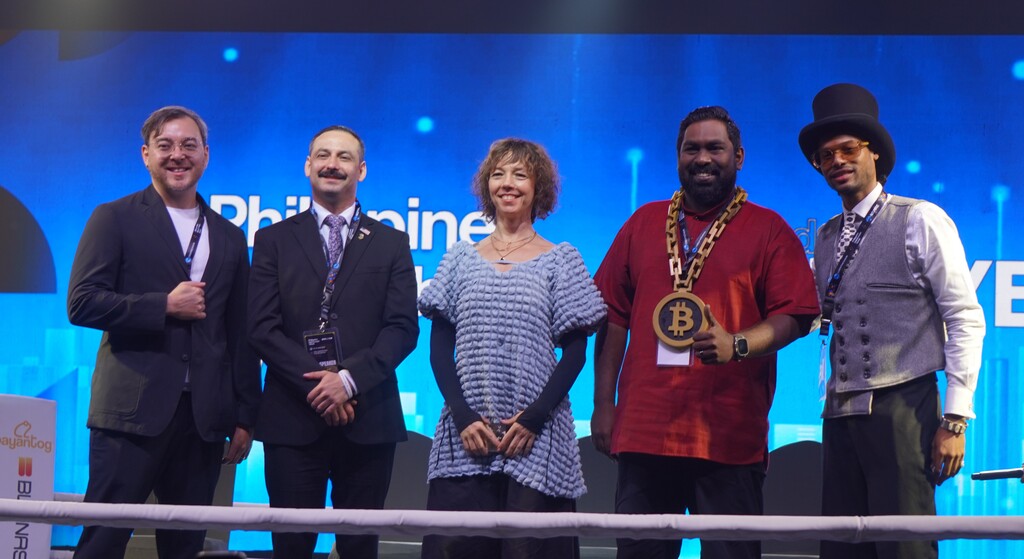
With years of promotion, blockchain adoption still struggles to get past the starting line. At the fifth edition of Philippine Blockchain Week, a panel led by Noe Jose, founder of CLSTL Council, gathered innovators and strategists to tackle a pressing question: how can blockchain evolve beyond speculation and power real-world financial systems?
The discussion featured Arravind Prabu, Founder of CryptoBilis; Richard Stangland, Chief of Staff at Lunar Digital Assets; Natalie Grineva, Business Development Manager at Nextflow; and Heslin Kim, Co-Founder and Chief Business Officer of Zenith. Together, they explored adoption hurdles, institutional integration, and the industries most likely to embrace blockchain, often without users even realising it.
Jose first asked his panelists how they would explain blockchain to their mothers. They were quick to point out how payments work, as it is considered the most familiar entry point. Stangland referred to Coinbase as a simple onboarding tool. For Prabu, frictionless remittances were highlighted, noting how blockchain enables money to reach Australia “within minutes.”
Grineva emphasised that people do not care about the technology itself. Instead, they care about solving problems. For her, a seamless user experience will be the key to mainstream adoption.
However, panelists also sent out a warning: retail adoption remains difficult despite promising use cases. Poor interfaces, steep learning curves, and irreversible on-chain mistakes make mass adoption risky. Instead, institutional and enterprise solutions may serve as bridges, gradually connecting blockchain with consumers.
Using Philippine Blockchain Week as a case study, panelists recommended practical applications. Conferences and merchants, for one, could directly state and govern crypto income. Meanwhile, QR code payments could unify fiat and crypto transactions through national QR systems. But stablecoins still offer scalable, institutional-grade payment rails.
Kim shed light on the fact that financial markets are already ahead. Stock exchanges in Japan and the U.S. have piloted blockchain initiatives for over a decade, with tokenized equities and government bonds now entering mainstream finance. Grineva added that tokenized assets and agentic AI economies represent the next frontier.
Outside of digital rails, it is essential that physical products remain. According to Praby, CryptoBilis distributed secure hardware wallets across Southeast Asia. By contrast, Grineva introduced AI-native smartphones with built-in blockchain features instead. Kim predicted that banks will eventually integrate custodial cold storage, merging traditional trust with blockchain innovation.
To better illustrate how it is beyond banking, Prabu shared a striking example from his durian farm in Malaysia. He explains that each tree carries a digital ID, with AI-managed fertilisation and pest control logged on-chain. This enables consumers to scan QR codes to verify the fruit’s origin, which fertilisers were used, and the tree’s model for blockchain in agriculture and supply chain transparency.
The panelists left the audience with three key messages. The first is education. It is critical for sustainable adoption. Next is collaboration, not reinventing the wheel, as it will drive innovation. Finally, institutional integration, rather than disruption, is the realistic path forward.
José concluded that the future of blockchain lies in a “dance between traditional institutions and new blockchain ecosystems.” The challenge now is to make that dance accessible, secure, and beneficial for everyday users.
(Source: AIBC World/YouTube)