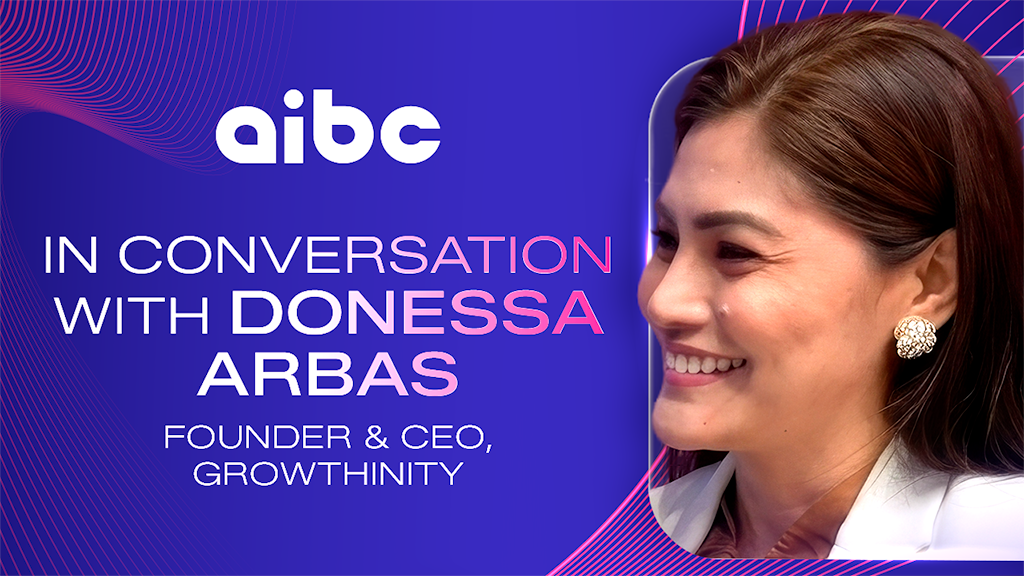
Women must move beyond being participants in Artificial Intelligence (AI) and blockchain and become contributors, policymakers and ecosystem builders if they are to influence the future of emerging technologies, according to Donessa Arbas, Founder and CEO of Growthinity.
Speaking at AIBC Asia 2026, Arbas said that greater female participation in AI and blockchain depends on improving access to education, practical literacy and opportunities for engagement.
“I believe that women should go beyond joining AI and blockchain spaces. This means that women should not only listen, should not only speak, but women are contributors, women are policy makers and women are ecosystem builders for them to be able to shape this emerging technology,” she said.
Her comments come as governments and businesses worldwide continue to debate how emerging technologies should be developed and governed. While AI adoption is accelerating across industries, women remain underrepresented in technology-related roles and leadership positions.
On being asked how women can play a more active role in AI and blockchain, Arbas identified three key requirements: access, literacy and exposure.
According to her, access begins with education in AI and blockchain, particularly because many people still view these technologies as unfamiliar or highly specialised fields.
However, she argued that education alone is not enough. Women also need practical literacy that helps them understand how emerging technologies affect livelihoods, careers, public trust, systems and frameworks.
“Once we have practical literacy, then it will lead to the third, which is exposure,” she said.
Arbas described exposure as the opportunity not only to speak about technology but also to participate in its development and implementation.
She added that industry events such as AIBC can provide what she called “strategic exposure” for women leaders by creating platforms for engagement and visibility.
Speaking about the challenges preventing more women from entering emerging technology sectors, Arbas pointed to what she described as a lack of clarity and confidence.
She said AI and blockchain are often presented as intimidating technologies that appear relevant only to engineers, software developers and IT specialists.
“Because of that lack of clarity which leads to lack of understanding then it doesn’t give us the confidence to even talk about it,” she said.
Arbas noted that many women may feel they lack the expertise required to participate in discussions around emerging technologies. She also argued that public perceptions often reinforce the idea that access to these sectors is limited to founders, chief executives, government officials or individuals with significant financial resources.
As a result, women balancing professional, family and community responsibilities may feel excluded from conversations about technology, limiting both participation and influence.
On being asked how technology can support more inclusive leadership and decision-making, Arbas argued that inclusion is fundamentally a leadership challenge rather than a technical one.
“When you talk about technical inclusion, this is not actually a technical issue. It is a leadership issue,” she said.
She stressed that AI and blockchain should not be shaped solely by software engineers and coders. Instead, educators, healthcare professionals, students, entrepreneurs and community members should also contribute to the development of these technologies.
According to Arbas, creating inclusive technology ecosystems requires leadership from policymakers and governments.
She said decision-makers should consider three questions when developing policies around emerging technologies: what problem is being solved, who benefits from the policy, and how the technology can remain sustainable for future generations.
Arbas argued that inclusion should extend beyond economic outcomes and consider long-term societal impact.
The interview also explored how women entrepreneurs can scale their businesses in an increasingly technology-driven environment.
Arbas said business owners should focus on clarity before pursuing expansion.
“The woman must have clarity first. Clarity is very important,” she said.
She encouraged entrepreneurs to clearly understand the products or services they provide and assess whether those offerings address genuine societal needs.
Speaking about technology’s role in business growth, Arbas said digital tools can help organisations scale operations, strengthen branding and improve market positioning.
She also emphasised the importance of collaboration and adaptability, particularly for small and medium-sized enterprises that may face resource constraints.
“Be quick to learn, be quick to unlearn and be quick to relearn,” she said.
Arbas added that businesses should aim to create impact beyond profitability by solving real-world problems and considering the long-term benefits they deliver to future generations.
She linked this philosophy to Growthinity’s GWISE initiative, which stands for Global Women of Impact Stewardship and Enterprise and focuses on leadership development, stewardship and community impact among women entrepreneurs.
“When our business goes beyond profitability, it involves human impact. Then your business goes beyond profitability to legacy,” she said.