
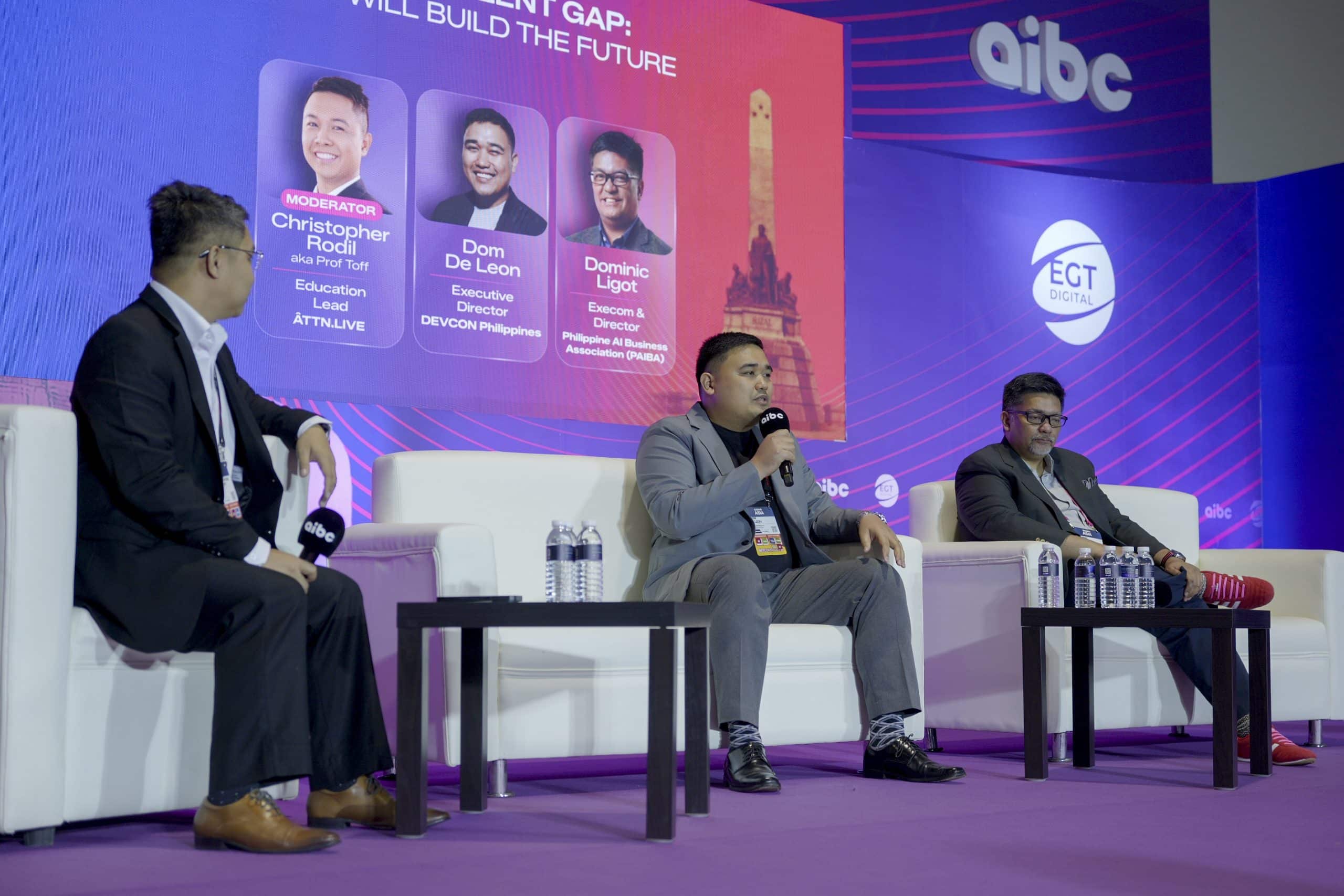
There is no real investment in AI education in the Philippines, industry experts warned.
As AI adoption accelerates, experts are pushing back on the idea of a “talent gap,” arguing the real crisis is a lack of meaningful investment, direction, and support that leave skilled workers to figure it out on their own.
Speaking at AIBC Asia in Manila, Dom De Leon, Executive Director at DEVCON Philippines, said investment in AI education can lag.
“Schools can take 11 years to change their curriculum – imagine the advancement in AI during that time,” he said. “We’re always biased towards building as you learn.”
Execom & Director at Philippine AI Business Association (PAIBA) Dominic Ligot said there was no investment.
“The investment there is is repurposing existing data. We always hear we need to upscale talent, but no one tells you what to upscale on, or what jobs to prepare people for,” he said. “99% of investment is being done by businesses themselves. There’s no investment. There’s just PR.”
For Ligot, the issue begins with how AI development is being framed. While governments and organisations frequently talk about “upskilling,” he argued that the conversation lacks clarity and substance.
“We always hear we need to upscale talent, but no one tells you what to upscale on,” he said.
Rather than coordinated national strategies, most investment is happening in silos, they argued, driven by private companies responding to immediate market needs.
This fragmented approach has created a paradox: some entrepreneurs are actively building AI tools, yet many struggle to translate them into viable products.
“We have a lot of people building hammers but not a lot of nails,” Ligot explained.
“We’re always biased towards building as you learn,” De Leon added, emphasising the growing importance of hands-on experience over formal coursework.
Despite calls for reform, support from public institutions remains limited. De Leon described government engagement as largely symbolic.
“The most support we get is MoUs and photo ops,” he said.
If there’s one area where the Philippines is widely recognised, it’s the strength of its workforce. But panellists noted that this strength is increasingly being leveraged by external players rather than domestic systems.
Global companies are eager to tap Filipino talent but this demand has not translated into local ecosystem growth at the same pace.
The result is a workforce that is globally competitive, yet locally underutilised, they argue.
Ultimately, the panel agreed that framing the issue as a talent shortage oversimplifies a deeper challenge. The real gaps, they argued, are in access, direction, and ecosystem support.
“There’s no such thing as a talent gap,” Ligot said. “The gap is awareness of how to make solutions viable.”
That includes not only technical viability , but also navigating what he called the “political-market fit”: the regulatory and institutional environment that determines whether innovation can scale.
For now, he argued, much of that burden falls on individuals.
“If you want to learn AI, you spend on it — and at the same time no one is teaching you how,” Ligot said.
As AI continues to reshape the global economy, the question is no longer just about who has the skills, but who has the systems to support them.
In the Philippines, the answer may already exist in its people. But without stronger investment, clearer direction, and institutional backing, leaders warn that capability alone won’t be enough to secure a place in the future of AI.
AIBC will return with more discussions in Rome during its flagship summit, AIBC World.