
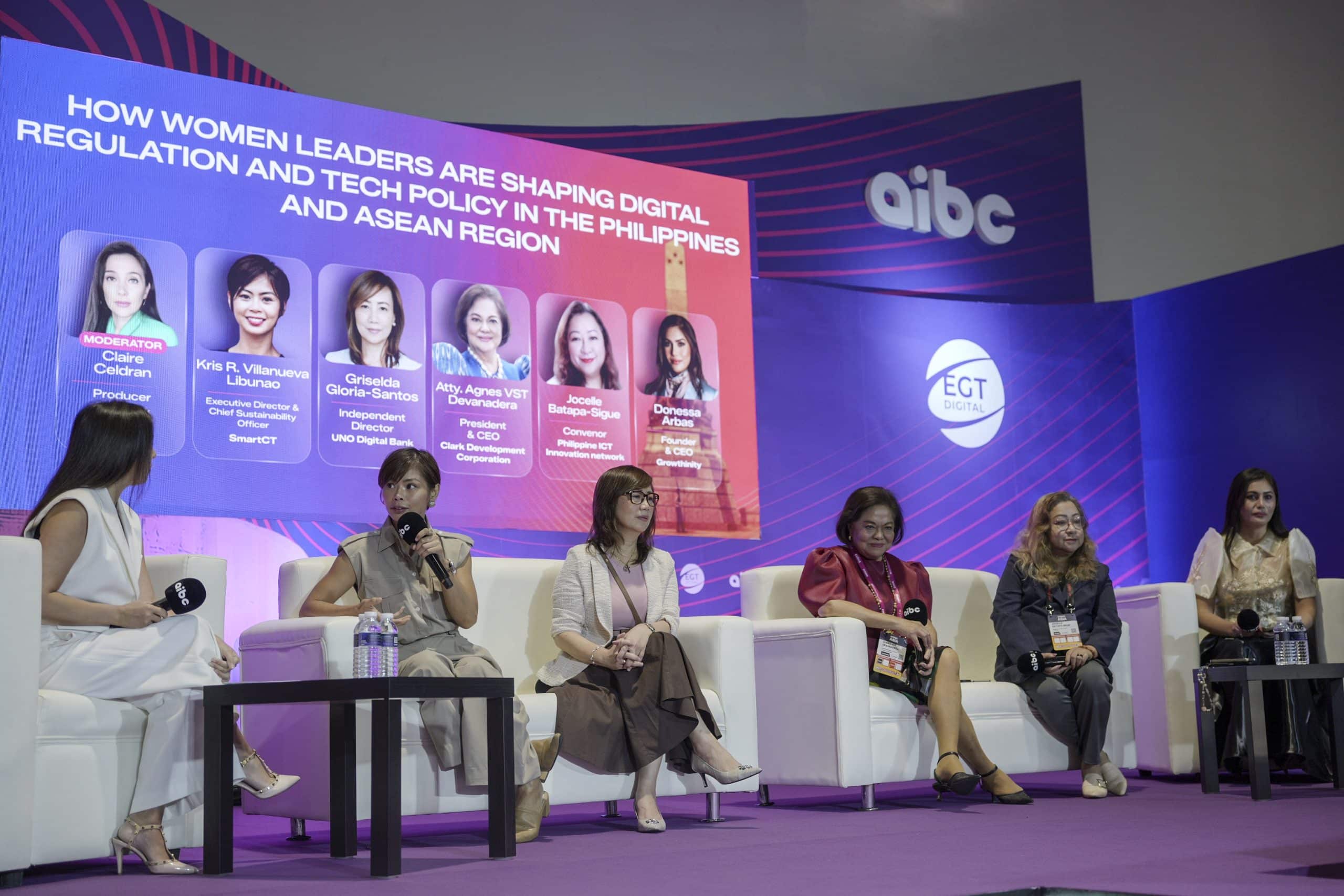
Women leaders across Southeast Asia are playing an increasingly pivotal role in shaping digital regulation and technology policy, but gaps between policy design and real-world implementation remain a major hurdle, speakers AIBC Asia 2026 said.
The panel, titled “How Women Leaders are Shaping Digital Regulation and Tech Policy in the Philippines and ASEAN Region,” brought together senior policymakers and industry figures to examine women’s influence on governance, innovation and the digital economy and how best to support them. It was moderated by Claire Celdran, producer, writer and reporter at CoinGeek.
Jocelle Batapa-Sigue, convenor of the Philippine ICT Innovation Network, stressed that while legislation exists, execution remains weak.
“Policy is a very important piece, but we need foresight in how we implement these policies,” she said. “We have so many good laws, but the problem is in implementation. Policymakers are not consulting the stakeholders affected.”
Batapa-Sigue also highlighted the importance of evidence-based policymaking, warning that the Philippines risks falling behind in AI governance.
“We need data-driven policies,” she said, citing global rankings that showed the country slipping from Tier 3 to Tier 4 in AI governance. “We have AI use-case initiatives, but no comprehensive governance and ethics framework. Human-centric AI must be embedded into policy.”
Other AIBC Asia speakers echoed concerns that regulatory frameworks are struggling to keep pace with rapid technological change.
Atty. Agnes VST Devanadera, president and CEO of Clark Development Corporation, said the speed of innovation has outstripped institutional capacity.
“Technology has moved faster than execution. Critical participation is key,” she said, adding that governance must be anchored in integrity. “Good governance is fundamental — technology alone cannot compensate for weak values.”
Griselda Gloria-Santos, independent director at UNO Digital Bank, said policymakers must ensure that digital transformation aligns with sustainability and inclusivity goals rather than being driven purely by technological progress.
“We’re so hyped about the digital economy, but it’s not just about growth of tech,” she said. “It’s about sustainability, resilience and inclusivity. Technology should not drive policy, it should enable it.”
She warned that digitalisation could exacerbate inequality if not managed carefully, noting that out of ASEAN’s roughly 680 million people, only around a quarter are fully included in the digital economy, with women among the most vulnerable groups.
“Public trust is the starting point,” she added. “Without digital inclusion as part of ESG (environmental, social and governance) performance, technology risks working against us.”
Grassroots engagement also emerged as a recurring theme. Donessa Arbas, founder and CEO of Growthinity, said inclusive innovation depends on reaching communities often left out of policymaking.
“We need to build innovation ecosystems that reach MSMEs, young professionals and aspiring entrepreneurs,” she said. “If we don’t, they remain digital consumers instead of innovators.”
Arbas emphasised empathy-driven leadership and closer collaboration with local governments, saying that understanding community needs is essential to bridging gaps in digital literacy.
Kris R. Villanueva Libunao, executive director and chief sustainability officer at SmartCT, pointed to a lack of reliable local data as a key barrier to effective policymaking.
“Local governments need to realise the importance of data,” she said. “When they claim to implement data-driven policies, often the data simply isn’t there. Data poverty becomes exclusionary.”
She cited the absence of gender-disaggregated data as one example, warning that policymakers cannot address inequalities they cannot measure.
Across the discussion, speakers returned to one central issue: the disconnect between policy ambition and delivery on the ground.
Despite these challenges, panellists agreed that women leaders are helping bridge gaps between national strategies and local realities, often bringing a more inclusive and community-focused approach to governance.
The session formed part of AIBC Asia 2026, taking place in Manila. The summit continues to position itself as a leading platform connecting emerging technology, and policy.
With future-facing topics such as AI governance, sustainability and digital inclusion high on the agenda, speakers said the stakes for effective regulation have never been higher and that closing the implementation gap will be critical to ensuring technology benefits all.
The discussions on AI governance will continue in Rome during AIBC World, which will bring together Web3 and emerging technologies experts under one roof. The summit, which will take place in November, is expected to attract thousands of delegates to Rome.