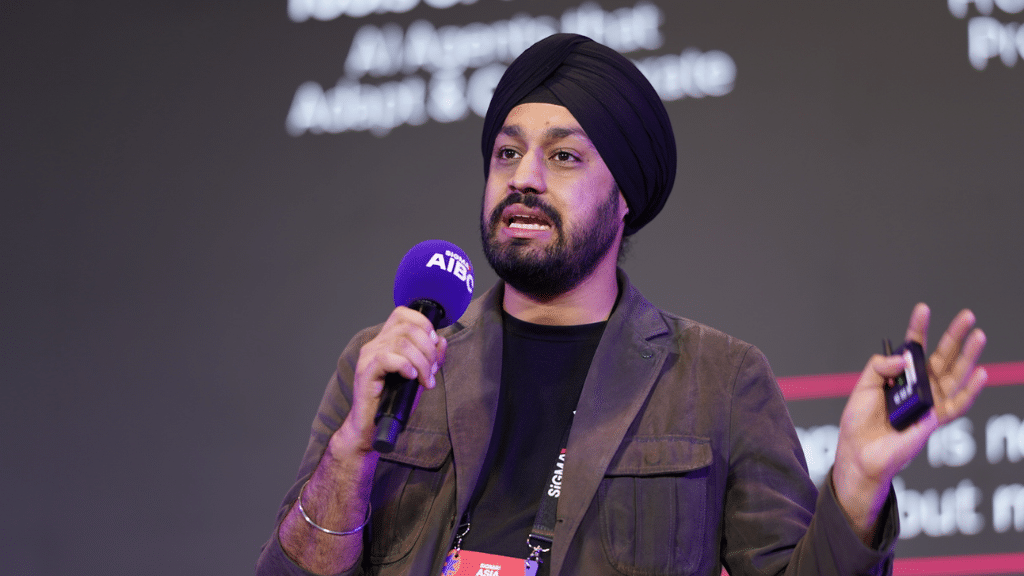
In this reflective, forward-looking piece, enterprise architect Puneet Singh, a key speaker at AIBC events who has delivered insightful panels at summits such as AIBC Asia, presents a view of 2030 where artificial intelligence has become deeply embedded in the way organisations function. Through scenarios drawn from industries such as insurance, manufacturing, banking, healthcare and customer operations, the article illustrates a shift from task automation to system-wide orchestration of decisions.
The full article that follows explores a future where intelligence is the foundation shaping how modern enterprises operate, adapt and respond.
I am writing this from a rain-heavy Monday in Mumbai in 2030. It is 7:42 a.m., and on the wall of a large insurer’s resilience cockpit, a live map blooms from yellow to orange to red as a cloudburst rolls across the city. Before the first commuter finishes a cup of tea, an AI operating layer has already fused rainfall data, flood-zone exposure, policy records, hospital network status, and satellite imagery into a forecast of where claims will spike by noon.
Multilingual alerts go out. Emergency cash lines are pre-approved. Drone inspections are queued. But the room is not empty of people. It is full of judgment. One manager slows an automated settlement because the fraud pattern looks strange. Another accelerates payout for a hospital cluster because delay would create real harm. This is what maturity looks like in 2030: the machine handles scale; humans handle consequence. That scene captures the central truth of the last few years. The future was not transformed because machines learned to write better emails, generate prettier decks, or produce usable code. Those were the early fireworks.
The real shift came later, when intelligence became abundant and enterprises stopped treating it as a feature and started building around it as infrastructure. Automation made work faster. Reimagination changed what work was. The first shift: AI left the chat window The arc of the decade now looks obvious. First, generative AI helped individuals produce. Then it helped teams coordinate. Then it began to orchestrate systems under human guardrails. The first wave created output. The second compressed response time. The third rewired the enterprise. You can see that arc most clearly on a factory floor.
A manufacturer in Chennai loses access to a critical input after a port disruption collides with a sudden change in export regulations. In the old model, procurement would escalate, engineering would wait, sales would rewrite forecasts, and leadership would schedule a war room. In 2030, the war room forms inside the operating fabric. One agent proposes three substitute materials. Another models margin impact across markets. A compliance layer rejects one option for Europe. A planning engine adjusts delivery schedules. An engineer approves the second path. What once took ten days of meetings now takes ninety minutes of informed judgment. That is the hidden gift of generative AI: not just faster tasks, but compressed coordination. The same shift changed how people experience software. At a bank in Jaipur, a relationship manager no longer clicks through eight systems to evaluate a textile exporter asking for working capital. She states an intent: build a safe offer for a cash-constrained client with strong invoice history and volatile shipping risk.
The system assembles cash-flow patterns, contract data, sector outlook, weather exposure, policy constraints, and a draft recommendation. In Bengaluru, an oncologist walks into a consultation room with scans already compared, relevant treatment options surfaced, and a plain-language explanation prepared for the patient’s family. When the father asks what the treatment means for the next six months of life, the doctor, not the model, answers. In both rooms, the lesson is the same: the most valuable human is no longer the person who can retrieve the most information. It is the person who can make the best judgment from it. The second shift: trust moved to the front office The most important transformation of all, however, happened far from the demo stage. It happened in governance. One of the defining moments I have seen this year was not in a lab, but in an audit committee. A generative decision system had improved exception handling by 31 percent. The business wanted it live immediately. The deployment was paused. Not because the model failed a benchmark, but because it could not show clear lineage for a narrow but material class of recommendations.
Five years ago, speed would have won that argument. In 2030, explanation does. Leaders learned a hard rule: what cannot be traced at scale cannot be trusted at scale. This is why the strongest firms no longer treat responsible AI as a compliance appendix. They design it into the operating model: identity, data provenance, model registries, policy layers, human escalation, red-team testing, and customer disclosure. Governance is not the brake pedal. It is the steering system. In 2030, trust is not back-office hygiene. It is front-office advantage. Clients buy confidence as much as capability. That change is visible in the market. The companies that lead are not necessarily the ones with the largest models or the loudest product launches. They are the ones that can answer the hard questions with precision. Why did the system recommend this? What data did it rely on? Where did human oversight intervene? What happens under stress?
In the age of generative AI, credibility became a product feature. The third shift: human judgment became more valuable The talent story was equally misunderstood. The decade did not simply reward people who could prompt well. It rewarded people who could frame problems, challenge assumptions, and teach systems what manuals, workflows, and dashboards never captured. In Hyderabad, a customer service agent now handles English, Hindi, Tamil, and Bengali conversations because an AI layer translates not only language, but tone, policy context, and next-best action.
She is not reading a better script. She has become a live decision node for the business. In Pune, a veteran plant supervisor becomes more valuable, not less, because he can teach the system that a faint vibration pattern on a motor, barely noticeable to a new recruit, means failure is likely long before the sensor threshold trips. When generation became cheap, discernment became premium.
This is the point many organisations missed in the late 2020s. AI did not reduce the value of human capability. It exposed which capabilities were actually rare. Routine production became easier. Judgment became scarcer. So did systems thinking, ethical reasoning, contextual awareness, and the ability to decide under ambiguity. When everyone gained access to answers, the advantage shifted to those who could ask better questions. That is why the winning enterprises of 2030 look different from the most enthusiastic enterprises of 2026. They are not merely the ones that launched the most pilots or purchased the most tools.
They are the ones that cleaned their data, redesigned workflows, rewired incentives, clarified accountability, and built trust into the architecture from day one. They stopped asking, “Where can we use AI?” and started asking, “What would this business look like if intelligence were native to every decision, every workflow, and every customer interaction?” That question shifted AI from accessory to operating model. So this letter from 2030 is not nostalgic, and it is not alarmist. It is precise. Do not measure generative AI by how many tasks it can automate. Measure it by how much distance it can remove between signal and action, between idea and execution, between complexity and clarity. Do not ask whether machines can mimic work. Ask whether leaders are prepared to redesign work, redistribute judgment, and make trust visible at scale. The future did not belong to the fastest automators.
It belonged to the boldest reimaginers. In the end, the decisive technology was not the model. It was the courage to redesign the institution around it.
As organisations continue navigating the present moment of rapid AI adoption, this “letter from 2030” serves as both a warning and a guidepost that the winners will not be those who automate the fastest, but those who reimagine the deepest.
Stay tuned for Puneet Singh’s upcoming feature in the next edition of SiGMA Magazine, where he continues this exploration of how intelligence is reshaping the foundations of modern enterprise.