

The cryptocurrency industry has officially transitioned from a period of rapid, unchecked momentum into a baseline of regulated maturity, according to the State of the Crypto Industry 2026 report of Sumsub.
The report said that the current growth in the sector is increasingly defined by rigorous regulatory scrutiny, sophisticated fraud pressures, and a race to deliver compliant onboarding at scale. It also said that platform leaders now recognise that sustainable growth belongs to those who build reliability and audit-ready controls into the core of their product infrastructure.
Andrew Sever, CEO of Sumsub, noted that the conversation has shifted from how fast platforms can grow to how well they can scale under intense scrutiny. “In 2026, sustainable growth will belong to those who build reliability into the core of their product and infrastructure from day one,” Sever said.
A fundamental shift in operational values has occurred, with 74 percent of surveyed companies now ranking verification accuracy as their most critical onboarding factor, while 39 percent of firms still prioritise raw speed above all else.
The report said that rebalancing is largely driven by real-world enforcement risks, as regulators increasingly warn that excessively rapid onboarding often signals insufficient customer due diligence. Seven out of ten respondents, or 72 percent, admit they would go back five years to strengthen their internal processes first.
According to the report, the nature of fraud has evolved from opportunistic abuse toward more automated, systemic, and repeatable patterns. Global fraud rates stabilised at 2.2 percent in 2025, a plateau that defenders believe reflects security measures catching up to attackers rather than a decline in sophistication.
Consequently, 57 percent of organisations are now prioritising AI-powered fraud detection to combat coordinated mule networks and synthetic identities. Experts suggest that AI is turning compliance from simple paperwork into advanced pattern recognition.
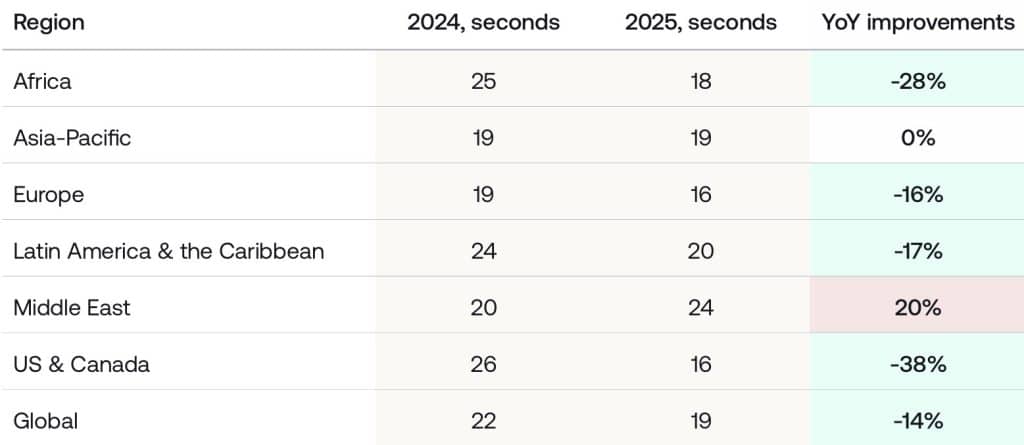
Average verification time per region. (Source: Sumsub)
Despite the heightened focus on accuracy, the report said that the industry continues to optimise its technical flows, with global average verification times falling from 22 seconds in 2024 to 19 seconds in 2025.
This 14 percent year-on-year improvement suggests better orchestration and fewer unnecessary steps rather than just faster processing. Regional performance varies wildly; for instance, the U.S. and Canada saw a 38 percent drop in time to 16 seconds, while the Middle East saw a 20 percent increase to 24 seconds as platforms added steps to align with new supervisory expectations. Non-document verification methods are also gaining traction, helping to reduce drop-offs in mobile-first emerging markets.
The expansion of the Financial Action Task Force (FATF) Travel Rule has become one of the most consequential regulatory developments, yet only 23 percent of companies report full compliance.
The report said that unhosted wallets remain a regulatory flashpoint, as authorities push for a risk-based approach to transfers involving self-custody. Currently, 61 percent of companies rely on user self-declarations for these wallets, though nearly 40 percent have moved toward more robust cryptographic signature verification.
The transaction profile of the crypto market is undergoing a structural transformation from retail trading to business-grade flows. While individuals still account for 88 percent of the total transaction count, company-to-company activity has surged to represent 44 percent of the total transaction volume.
The report said that this evolution is supported by the rising role of stablecoins, which increased their share of transaction counts to 36 percent in 2025. These assets are increasingly viewed as default infrastructure for mainstream finance, used for treasury management and cross-border settlements. By the end of 2026, stablecoins are expected to be embedded as the operational layer of mainstream finance.