- Roadshow to Rome
- Exhibitors
- Agenda
- Speakers
- Media Partners
- News

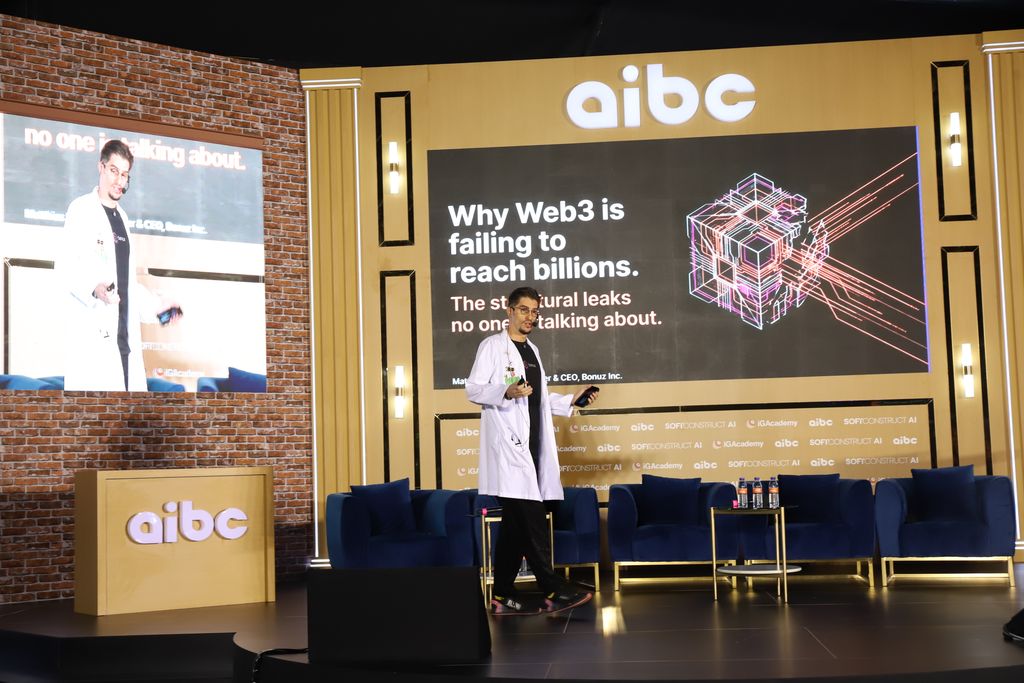
Speaking on the AIBC stage during the second day of the AIBC Eurasia conference, Matthias Mende, Founder and CEO of Bonuz, delivered a compelling keynote which looked at why crypto is yet to secure mass adoption and how the next new wave of Web could help close this gap.
Mende believes that the problem doesn’t lie solely with adoption. Six billion of us are online, and today, around 716 million own crypto – yet only 40 to 70 million are active, self custodian users.
So why can’t we reach the next billion users. The answer: The internet has structural leaks. Systems fail, says Mende, because they don’t survive scale, change, and time.
Four main problems present themself. Firstly, the issue of sovereignty. Only 1% of humanity is actually self-sovereign – in other words, from your doting followers on Instagram to your lock-in credentials – nothing you own online is actually, really and truly yours. “99% of the digital world is rented.”
The second leak is the trust crisis. In an age of crafty AI, scams and fraud is everywhere, with AI-generated content becoming more and more indistinguishable from human content. $100B+ is lost every year as a result of global ad fraud and $1.3B to influencer fraud, while 30-50% of campaign engagement is driven by bots, says Mende.
Another hurdle to climb is what Mende calls the Broken Loyalty Program. Shockingly over $48B loyalty points are wasted annually in a system designed to waste value – points expire, devalue and can’t be transferred or shared between programs. Why, asks Mende, can’t they be aggregated?
Lastly, the engagement verification gap. Engagement is easy to fake, he explains. Billions are spent on creating campaigns without any real data on who actually showed up. Brands may get estimated reports on interaction, but valuable individual-level data is often a missing part of the picture. There are no timestamps and no proof, because interactions happen off-chain. As he says, “impressions are not people.”
These are not new problems Mende notes. So why hasn’t Web3 solved them?
“Web3 asked people to leave existing systems, this approach has failed.” One of the biggest issues is the infrastructure. As he rightly says, for most people out there remembering and storing seed phrases and private keys is a security nightmare. The tech is complex and expensive and people are generally reluctant to switch over to something out of their comfort zone. “The jargon feels alienating. The solution is not to replace systems, but to stabilize them.”
To do this we must build an identity that persists across platforms, rather than starting from scratch. Building relationships that survive platform changes, communities become portable this way, he explains. We need verifiable access without intermediaries to help make coordination automatic so that trust can become default.
In response, Bonuz has built something they call the Human Layer. This is not a replacement for the old systems, he stresses, but an upgrade. New features – wallets that link to smart contracts, and pluggable layers for brands, so that legacy apps can tap into engagement in a seamless and user friendly way. “The blockchain should feel invisible – users should not feel like they are on-chain.”
The industry is still in its infancy, Mende concludes. “Blockchain has traditionally always been used for financial use cases. But it has superpowers that go far beyond fintech – the list is endless: gating, memberships, NFTs, vouchers and so on.”
Industries like digital identity will hit a trillion dollars by 2035, the creator economy will go beyond $480B by 2027, event ticketing is set to reach $288B by 2030 and the loyalty market will reach $60B by 2030.
Reality will become programable, we wont open apps but activate layers, says Mende. “Every action becomes data, every tap, scan and visit becomes a verifiable data point. It’s also about the value you add – your proof of presence builds a reputation, making your experiences into credentials, helping brands identify persons of value.
“Intent was never enough, outcomes are everything, giving interoperability by design.”