- Roadshow to Rome
- Exhibitors
- Agenda
- Speakers
- Media Partners
- News

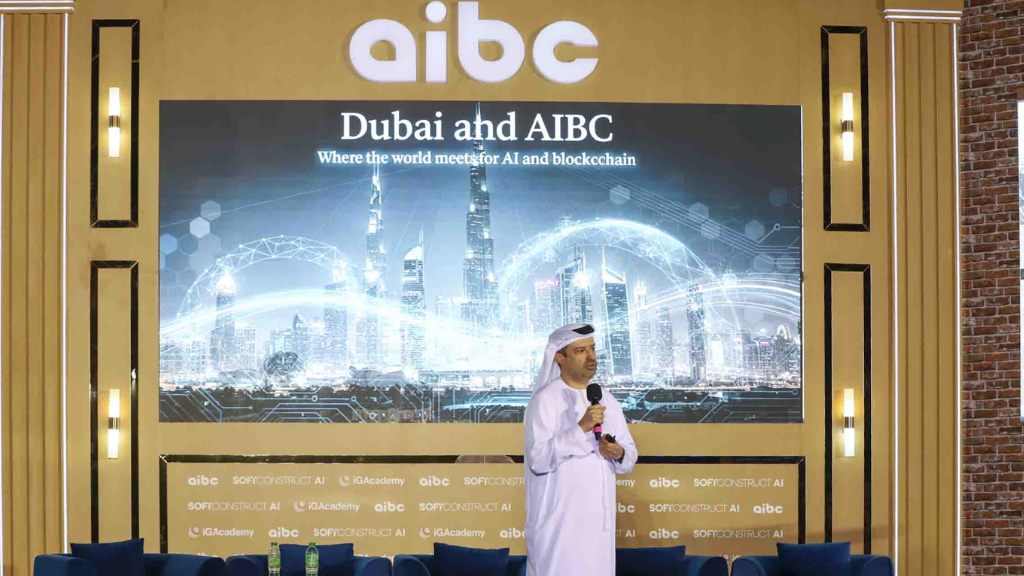
During AIBC Eurasia 2026, on 10 February, the AIBC Stage at Dubai Festival City, Festival Arena welcomed attendees for a keynote speech from Dr Marwan Alzarouni, CEO of Dubai Blockchain Center. As one of the region’s most recognised voices in digital transformation, Dr Alzarouni took the opportunity to spotlight how Dubai is shaping the future of AI, blockchain, fintech and digital infrastructure and why the UAE continues to stand out as one of the most innovation-ready environments in the world.
In a keynote packed with bold vision and practical insight, he made it clear that Dubai’s success is not driven by hype, but by long-term strategy, government alignment, and a relentless focus on real-world adoption.
Dr Alzarouni opened by acknowledging the strong history between Dubai and AIBC, highlighting how the summit has consistently played a role in supporting the region’s technology ecosystem. He reflected on the fact that AIBC was among the first major events hosted at the venue during the COVID era, proving that the city could continue delivering world-class platforms even under global pressure. That same ambition, he suggested, is reflected in Dubai’s wider approach to innovation, where challenges are opportunities to raise the standard.
Central to his keynote was Dubai’s leadership in both artificial intelligence and blockchain, which he described as “a match made in heaven.” While many global markets are only now beginning to seriously explore how the two technologies can merge, Dr Alzarouni stressed that the UAE has already been laying the groundwork for years.
He pointed to the UAE’s early commitment to AI governance, noting that the country appointed its first Minister of Artificial Intelligence in 2017, followed by the creation of an ethics committee designed to support “transparent and accountable AI adoption,” offering what he described as a toolset the rest of the world can learn from. “AI is no different,” he said, explaining that Dubai’s attitude toward emerging technology has always been proactive, open and structured, focused on building trust alongside innovation.
On blockchain, he highlighted how the UAE has “set the standard” through a clear government roadmap, including a four-year plan to bring blockchain solutions into public sector operations. Rather than chasing trends, the focus has been on applying blockchain where it adds genuine value. “It’s about using the technology for its value take, rather than what the hype was about,” he noted.
One of the keynote’s strongest messages was that Dubai’s true innovation advantage lies in its infrastructure. Dr Alzarouni reminded the audience that the UAE’s digital transformation began long before the world started using terms like Web3 or smart cities.
“What people don’t know is that in 2000 we launched e-government,” he explained, describing how Dubai evolved from e-government into smart government, becoming a world leader in paperless and mobile-first services. He highlighted how government departments now operate under a unified digital identity system, meaning residents and businesses can access services through a single login.
“You can do everything on your phone. It’s not a dream, it’s a reality,” he said. For developers and founders, he emphasised that this creates a launchpad for innovation, allowing companies to go to market faster because the digital backbone is already in place.
Dr Alzarouni also touched on the rapid acceleration of AI capabilities, referencing the rise of autonomous agents and recent developments in the sector. While the opportunities are vast, he warned that progress is also “scary when it comes to things like security,” stressing the importance of building responsibly.
He further highlighted Zand AED, describing the UAE’s move toward regulated stablecoins as a major milestone, one that has enabled the country to digitalise financial infrastructure without relying on international providers. He outlined that in the future, the key focus areas where Dubai is aiming to drive adoption and investment, include sustainable manufacturing, logistics, fintech and proptech, as well as the expansion of real estate sandbox environments.
He also pointed to the next step in digital automation, with systems that not only complete tasks, but can pay for tasks, opening the door for AI-driven commerce and entirely new digital economies. Dubai’s vision, he concluded, is being shaped through long-term planning, including the Dubai Economic Agenda (D33) launched in 2023, which he described as setting the pace for the next decade of growth.
Stay tuned for more highlights and exclusive insights as we continue our coverage from AIBC Eurasia 2026.