- Roadshow to Rome
- Exhibitors
- Agenda
- Speakers
- Media Partners
- News

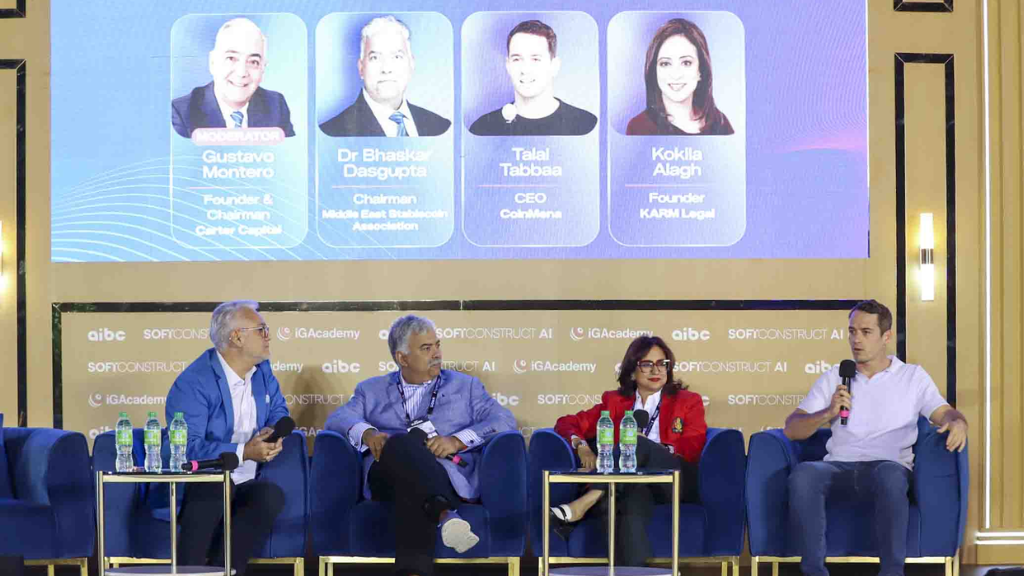
During AIBC Eurasia 2026 in Dubai on 10 February 2026, the AIBC Stage at Dubai Festival City hosted a timely panel titled Stablecoins: Prospect for the Gulf and Global Applications. Moderated by Gustavo Montero, Founder & Chairman, Carter Capital, the session brought together key industry voices including Dr Bhaskar Dasgupta, Chairman, Middle East Stablecoin Association, Talal Tabba, CEO, CoinMENA and Kokila Alagh, Founder, KARM Legal to explore how stablecoins are evolving into a serious financial tool for cross-border trade, payments, and regional innovation.
Opening the discussion, Montero set the tone by framing stablecoins as part of a much bigger economic transformation. “What people need to understand about the crypto industry is that the system is changing,” he said. “There are going to be massive glitches to this… it’s the change of system we’re living in.”
When asked what a stablecoin means from a legal and practical perspective, Alagh highlighted how regulation is already reshaping the language around digital assets. She explained that frameworks such as MiCA have moved away from the term stablecoin altogether, stating that “they have decided not to call these stablecoin,” instead categorising them as asset-referenced tokens depending on what provides their stability. She noted that stablecoins derive trust from being “backed… by money or legal tenders back to back,” while still remaining transferable and tradeable as a unit.
Dr Dasgupta added historical context, describing stablecoins as a modern reinvention of an older financial reality. “What we have just done is reinvent the currency we had before,” he said. “The coins themselves had intrinsic value.” However, he argued that the key evolution is programmability, “For the first time money can be programmed… money can do some magic things.”
Tabba offered an industry-grounded view from the exchange side, noting that stablecoins are already the dominant use case. “I started a crypto exchange but we basically sell stablecoins at this stage,” he said, adding that businesses using Tether are “at a big advantage.” He also suggested that “non-dollar stablecoins” may struggle to gain global traction, given the dominance of the dollar as a store of value.
The panel also explored how stablecoins are diversifying beyond USDT-style models. Dr Dasgupta explained that with growing demand and experimentation, new structures are rapidly emerging. “We have about 150 members, there are roughly about 40 stablecoins coming out at various stages.” He predicted that the next wave will include corporate-backed stablecoins designed for closed ecosystems, where “you can go to a grocery store or airline with this coin,” leading to “automation of the payment structure.”
Tabba drew a sharp comparison between stablecoins and existing corporate payment models, saying he sees “the similarity between Tether and Starbucks,” referencing how Starbucks gift cards hold customer funds while offering no interest. He described corporate-issued stablecoins as inevitable, believing “in a future where each company will transfer to other stablecoins.”
On the regulatory environment, Alagh noted the UAE’s proactive stance, saying the region has created a framework where “virtual assets are loved by the regulators.” She explained that globally regulators are aligned on one key principle, “Any stablecoin has to be at par of the value and redeemed without any friction.” However, she warned that regulation will always remain local. “All regulators globally are very clear that any stablecoin needs to be regulated in that country. If you want to be in that monetary system you need to be recognised by that country” she said.
Tabba agreed that tighter jurisdictions may resist adoption. “For emerging countries who have strict requirements they’re gonna hate stablecoins,” he said. Dr Dasgupta closed with a regulator’s lens, stressing that “the first and foremost thing is investor protection,” while ensuring “the ecosystem is safe” and “people can do business.” As stablecoins continue gaining traction, the panel emphasis that the Gulf is positioned to play a major role in shaping their real-world applications.
Stay tuned as we continue to bring coverage across the AIBC Eurasia 2026 summit in Dubai.