- Roadshow to Rome
- Exhibitors
- Agenda
- Speakers
- Media Partners
- News

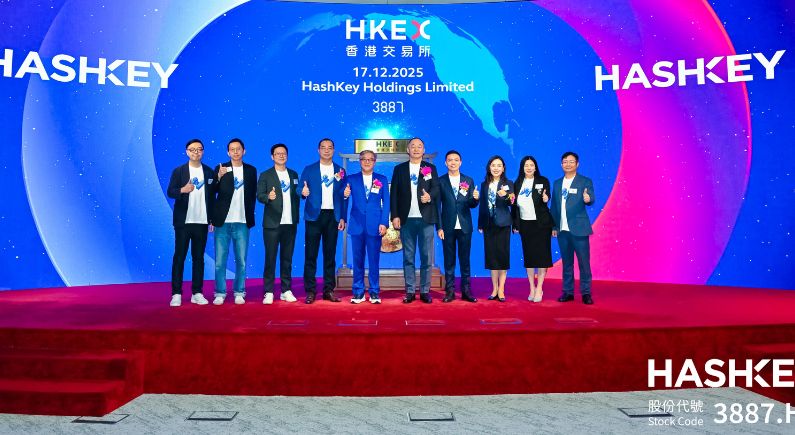
HashKey Holdings Ltd, founded in 2018, set out to integrate digital assets into regulated financial systems. The company positioned itself as a link between traditional finance and the growing digital asset sector in Asia. HashKey provides asset management, brokerage, tokenisation, staking, and over‑the‑counter trading, and operates Hong Kong’s largest licensed cryptocurrency exchange. Its services cater to both institutional and retail investors.
HashKey raised about HK$1.6 billion (approx. $208 million) through its Initial public offering (IPO), pricing shares at HK$6.68 each, near the top of its range. The company became the first cryptocurrency firm to list on the Hong Kong Stock Exchange. The listing highlights that regulated crypto businesses can operate within Hong Kong’s financial framework.
HashKey shares closed at HK$6.67 (approx. $0.87), down 0.15 percent from the offer price. The stock rose as much as 6.6 percent during the session before falling 8.4 percent to its intraday low. The Hang Seng Index rose almost 0.9 percent while HashKey ended flat, highlighting how crypto‑linked stocks are treated differently from ordinary shares. The market’s caution is reflected in the modest performance, which is noteworthy in contrast to the broader decline in cryptocurrency.
🎉 HashKey Holdings Limited is officially listed on the Main Board of HKEX!
As Asia’s first publicly listed digital asset company via an IPO in Hong Kong, this milestone marks the company's entry into a new stage of development and establishes a stronger foundation for its… pic.twitter.com/v22cmEntUX
— HashKey Group (@HashKeyGroup) December 17, 2025
Despite market volatility, the institutional tranche was oversubscribed 5.5 times, showing high participation. Due to strong interest from individual investors, retail demand reached around 394 times oversubscription. The oversubscription during a wider decline indicates that investors are paying attention to more than just short‑term price fluctuations.
Bitcoin fell by as much as 36 percent after reaching record highs above $126,000, reflecting sharp market swings. Other cryptocurrencies also moved lower, creating a challenging environment for crypto‑related listings.
Chairman and CEO Xiao Feng said short‑term volatility does not affect his outlook on digital assets. He noted that clearer rules and compliance frameworks are important for sustainable industry growth. Xiao added that crypto markets move in cycles and the company is focused on long‑term development.
Xiao stated, “My confidence is only growing stronger, and I am more optimistic than 10 years ago because there is more regulation and compliance guidance for us to follow, which will allow the industry to grow further.”
Mainland China banned cryptocurrency trading in 2021, citing risks such as fraud and pyramid schemes. Hong Kong has adopted policies supportive of digital assets to strengthen its role as a financial hub. HashKey operates within this framework, following national rules while using Hong Kong’s regulatory autonomy.
The business is still loss‑making, but it is prioritising cash flow and reinvestment ahead of immediate profits. Like early‑stage digital companies, management is adopting a growth‑first strategy. Instead of focusing on quick profits, the plan aims to establish digital finance infrastructure.
Funds will be directed towards blockchain infrastructure, cybersecurity, and trading platforms. Alliances and regional expansion are also part of the plans. Operations continue to revolve around compliance.
Hong Kong’s Stock Exchange raised over $34 billion this year, its strongest since 2021. Crypto listings such as HashKey’s add diversity to the market. More IPOs are scheduled for December, indicating renewed activity.
Asia’s adoption rate leaves room for expansion. Tokenisation and wealth management could reshape asset ownership. Strong compliance may serve as a competitive strength. Short‑term volatility is expected, but long‑term prospects remain. Investors with patience gain exposure to regulated crypto growth.