- Roadshow to Rome
- Exhibitors
- Agenda
- Speakers
- Media Partners
- News


Cryptocurrency payments connected to suspected human trafficking networks increased by 85% in 2025, according to Chainalysis. This increase is equivalent to hundreds of millions of dollars flowing into exploitation-based systems via public blockchains.
Even if the figures show financial activity, each transaction has a personal connection to actual people whose lives are impacted. However, the majority of transactions take place on public blockchains, which means that each payment creates a digital record. Investigators are becoming more adept at linking those digital traces to actual activities, even though wallet addresses do not give names.
With corporate-style organisational frameworks, Telegram and other encrypted chat apps have evolved into hubs for organised “international escort” networks. By employing branded channels, tiered service packages, structured pricing, and customer support, these organisations masquerade as legitimate businesses despite their exploitative bases. Rates that are advertised range from over $1,100 for extended arrangements to roughly $420 for hourly services.
Large-scale activities including group reservations, long-term contracts, or cross-border coordination are indicated by the fact that over half of the reported transactions total more than $10,000. These patterns show how trafficking networks maintain high-value exploitation by using professional models.
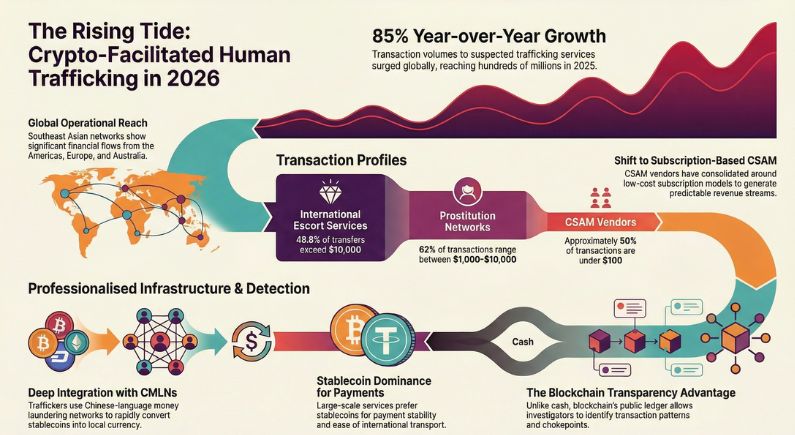
Source: Chainalysis
A growing concern in Southeast Asia involves fake job postings that lure people with promises of legitimate work. Once recruited, victims often have their passports taken and their movement restricted, leaving them trapped in compounds where they are forced to run long-term crypto fraud schemes.
Many of the individuals carrying out these schemes are victims themselves, coerced into the work. According to blockchain data, recruiting costs range from $1,000 to $10,000 per person, which corresponds to levels promoted on platforms connected to human trafficking and reflects the cost traffickers place on human captivity.
According to recent reports, subscription-based models, which are frequently priced under $100 per month, have become more prevalent in the Child Sexual Abuse Material (CSAM) marketplace. Over 5,800 cryptocurrency addresses brought in over $530,000 in 2025, according to one darkweb case. Every transaction demonstrates how digital payment systems are being exploited to continue widespread child exploitation and symbolises continued harm to children.
Indicating that demand is worldwide rather than regional, significant cryptocurrency movements connected to trafficking networks have been tracked to several nations, including the US, UK, Brazil, Spain, and Australia. Many of these operations have their headquarters in South East Asia, where the region’s conveniently accessible infrastructure and more relaxed police make it easier to run large-scale networks. Despite the fact that the monies come from several continents, they are often organised and used in Southeast Asia.
In 2025, the Internet Watch Foundation documented 312,030 cases of photographs and recordings of child sexual abuse, a 7% rise from the year before. On average, that number equates to around 850 reports every day. In order to scale and become more reliable while blending in with regular web traffic, many trafficking operations depend on U.S.-based hosting and infrastructure.
Using blockchain tracing to track digital records that resulted in actual arrests, German authorities recently took down “KidFlix,” a platform that disseminated content on child sexual abuse. Arrests of people who consume such content have also gone up in the US as investigators get better at examining blockchain activities. Once thought to be a barrier to anonymity, cryptocurrency is now frequently used as proof in these situations.
Crypto exchanges are increasingly using AI-driven monitoring systems to detect suspicious activity, flagging patterns that might otherwise go unnoticed. At the same time, law enforcement agencies, analytics firms, NGOs, and exchanges are working together more closely to address exploitation in digital spaces.