- Roadshow to Rome
- Exhibitors
- Agenda
- Speakers
- Media Partners
- News


The 2026 Crypto Crime Report by Chainalysis highlights the growing scale and sophistication of illicit activity in the digital asset ecosystem. According to the report, cryptocurrency addresses linked to illegal activities received at least $154 billion in 2025, marking a record year for measurable on-chain crime. The surge is largely attributed to nation-state actors such as Russia and North Korea, who are increasingly using blockchain networks to evade sanctions and conduct major cyber theft operations.
The report also points to the rise of professionalised money-laundering networks, particularly Chinese-language groups offering “as-a-service” laundering models. Meanwhile, stablecoins have become the preferred medium for illicit transfers due to their price stability and ease of cross-border movement. However, the transparency of public blockchains continues to help investigators trace and measure these activities more effectively.
In 2025, cryptocurrency saw its most turbulent year, with illicit activity on public blockchains reaching $154 billion — a sharp 162 percent increase from the year before. Even so, these transactions made up less than 1 percent of overall crypto activity, showing that most use remains legitimate.
The biggest change came from state-linked operations, as sanctioned entities received nearly 700 percent more value than in previous years. This surge highlights how geopolitical tensions are increasingly spilling into the digital asset space, turning blockchain into a tool for governments seeking to bypass restrictions.
In order to get around sanctions, Russia launched the ruble-backed A7A5 coin in 2025. Within a year, it processed over $93 billion in transactions. Sanctioned companies used the token as a settlement system to carry on cross-border transactions outside of conventional banking channels.
Iran also expanded its use of digital assets, with addresses linked to the Islamic Revolutionary Guard Corps moving over $3 billion. These funds supported networks of regional groups, including Hezbollah, Hamas, and the Houthis, showing how cryptocurrencies are increasingly being used to sustain state and proxy activities under international pressure.
In 2025, Chinese-language money laundering networks became a major force in the crypto underworld, handling about 20 percent of all on-chain laundering. These networks processed $16.1 billion that year, offering services to groups ranging from fraud operations to North Korean hackers. Their methods included brokers who rented out personal bank accounts and organised “money mule motorcades” that layered transactions to obscure origins. Some of these services moved as much as a billion dollars in under eight months, showing how efficient and entrenched these laundering systems have become.
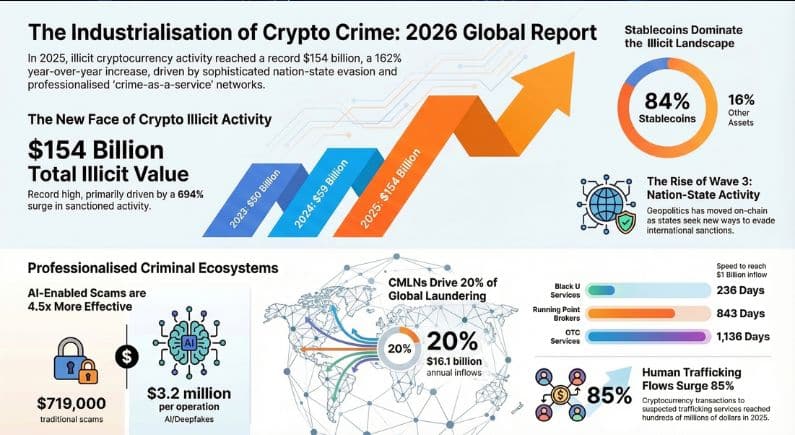
Crypto Crime Report 2026 (Source: Chainalysis)
Scams in the cryptocurrency market hit all-time highs in 2025, with losses estimated at $17 billion as more bogus wallets were discovered. The average payment per victim increased significantly, reaching almost $2,700, a rise of more than 250%. Deepfakes and face-swapping schemes were made possible by artificial intelligence, which significantly increased the profitability of scams.
The average return from AI-driven operations was $3.2 million, whereas traditional schemes made less than $720,000. The number of impersonation frauds, in which thieves pretend to be reputable businesses or government institutions, has skyrocketed by 1,400 percent. One large campaign, disguised as “E-ZPass” toll fee notices, tricked more than a million people across 121 countries, showing how widespread and aggressive these tactics have become.
In 2025, crypto transactions linked to human trafficking grew sharply, rising 85 percent compared to the previous year. Much of this activity was tied to scam compounds in Southeast Asia, where people were tricked with fake job offers and then forced to run fraud schemes under threats of violence.
In order to transfer money across borders, trafficking networks—including those connected to so-called “international escort” services—have been using stablecoins more and more. These flows have been tracked across nations including Brazil, the US, and the UK. Blockchain openness has made it possible for investigators to track the money despite the size of these operations, providing a unique opportunity to destroy the networks behind these crimes.
Blockchain data provided unique insight into the battle against the opioid crisis in 2025. Beginning in the middle of 2023, cryptocurrency payments to Chinese providers of fentanyl precursors fell precipitously. This decline was followed by a discernible decrease in overdose deaths in the US. Despite pressure from law enforcement, darknet markets continued to operate.
After Abacus Market was shut down, TorZon quickly became the main marketplace for Western users, serving as a central hub in the global drug trade. This mix of disruption and resilience shows how blockchain transparency can help track illicit flows, even as underground networks adapt to enforcement efforts.
The number of recorded ransomware assaults increased by almost 50 percent in 2025. However, overall payments decreased somewhat to $820 million, indicating that more firms refusing to pay and tighter backups are beginning to reduce illicit revenues.
Law enforcement is now concentrating on the infrastructure that sustains these organisations, focusing on hosting and proxy services that give various gangs and state-affiliated actors cover. Instead, than pursuing specific perpetrators, authorities hope to damage the larger ransomware ecosystem by interfering with this shared infrastructure.
The increase of cryptocurrency-related crimes in 2025 brought attention to the dangers and special transparency of blockchain systems. Blockchain records establish a public ledger that enables tracking, in contrast to traditional finance, where data is frequently concealed. Even when criminal activity increases, this visibility provides regulators and investigators with a better understanding of unlawful flows.
In 2026, more cooperation between private businesses and law enforcement will be essential. By utilising sophisticated analytics to decipher blockchain data, the emphasis may change from responding to crimes after they occur to preventing them from spreading, ensuring that the digital economy grows in a safer environment.
If you are serious about scaling in Frontier Tech, AIBC Eurasia in Dubai and Ras Al Khaimah, 8–11 February 2027, is where 14,000 industry pioneers will define what comes next.