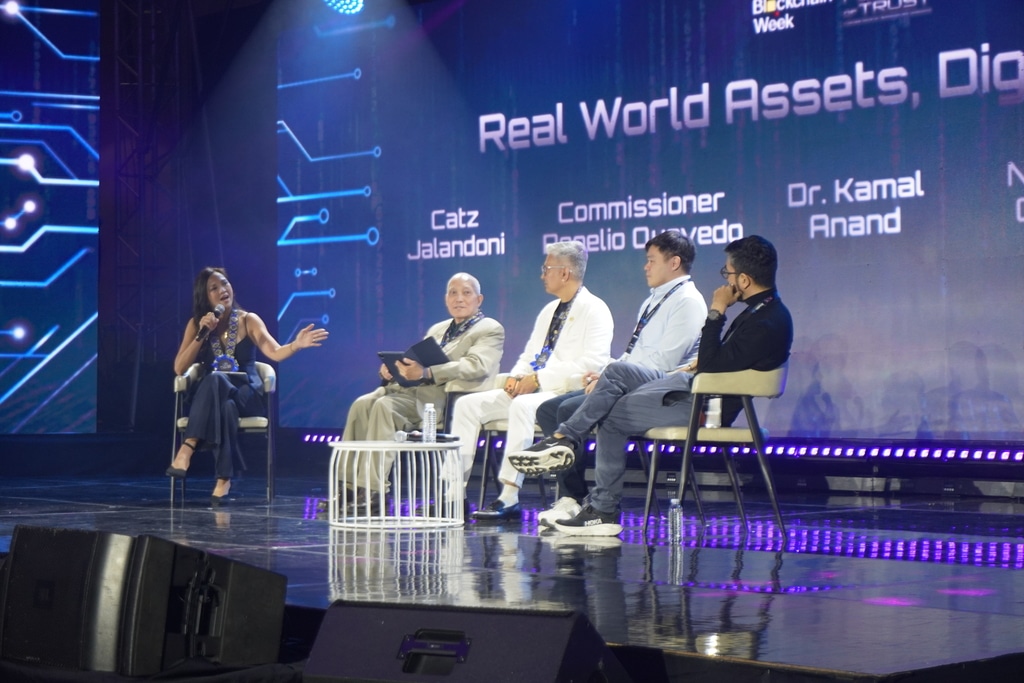
Tokenisation is transforming finance in the Philippines, breaking down barriers that once kept ordinary investors out of markets dominated by institutions. At the fifth edition of Philippine Blockchain Week (PBW), held at the SXM Convention Complex, on 19 June, the panel “Real World Assets, Digital Trust” brought together industry leaders and regulators.
Their consensus: blockchain-driven tokenisation is no longer about possibility. It is about trust, infrastructure, and mainstream adoption. The session was moderated by Catherine Jalandoni, President of the Global AI Council Philippines.
For several decades, financial systems depended on layers of intermediaries to validate ownership and facilitate transactions. Although efficient, this model often pushes out small investors because of high costs and limited access. But tokenisation changes that equation. By fractionalising ownership of assets such as gold, bonds, and real estate, blockchain technology opens markets once reserved for the wealthy to everyday Filipinos.
Nichel Gaba, CEO of PDAX, compared the shift to the Internet’s disruption of traditional industries: “Today you can buy very fractional amounts of gold, whereas in the past you couldn’t do that. You can buy fractional amounts of fixed-income security or a bond, whereas before you couldn’t do that.” His point underscores how tokenisation democratises finance, turning exclusivity into accessibility.
Yet accessibility alone is not enough. Luis Buenaventura of Talino Fintech Foundry cautioned that education remains the biggest hurdle: “The average Filipino needs to understand the distinction between cryptocurrency, a token, and a real-world asset. Otherwise, what they see on screen feels abstract.” Building trust means making digital ownership tangible, whether through redemption features, institutional recognition, or campaigns that show investors the vaults where tokenised gold is stored.
According to Rogelio Quevedo, Commissioner of the Securities and Exchange Commission (SEC), the regulator strengthened its role in bridging innovation with legal confidence. “Blockchain is the technology, but it cannot substitute for the legal questions investors must have answered.” He also highlighted that tokenisation could invigorate the Philippine stock exchange if paired with clear rules and standardised disclosures.
Together, these voices highlight a pivotal moment: the Philippines is not just adopting blockchain. It is shaping how tokenised real-world assets can achieve credibility, inclusivity, and scale in a market hungry for innovation.
Panelist Dr. Kamal Anand, CEO of MyGuides, described his experience in tokenising gold, a commodity historically valued across cultures. “Gold is finite. You can’t make it in a lab,” Anand said.
He also noted how blockchain enables fractional ownership and government oversight of audited gold. Moreover, he forecast that paper currency may fade within decades. Digital assets would offer transparency and control against money laundering.
Panelists agreed that the Philippines is uniquely positioned for blockchain innovation. With a young, tech-savvy population and high adoption rates, the country offers fertile ground for tokenised assets. “[The] Philippines is far ahead in the curve of blockchain,” Anand observed, while Buenaventura pointed to the challenge of bridging generational trust gaps between digital-native youth and more sceptical older investors.
As the discussion closed, panelists identified the critical factors for mainstream adoption, beginning with education. Doing so helps investors understand what tokenised assets truly represent. Infrastructure is another factor. It enables them to establish credible issuers, platforms, and intermediaries. Additionally, transparency enables clarity for both users and regulators. Finally, regulatory cooperation aligns innovation with legal certainty and investor protection.
(Source: World Economic Forum/YouTube)