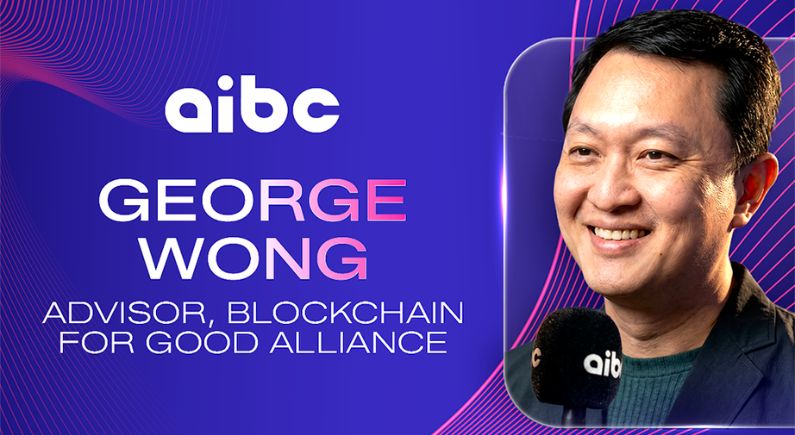
As artificial intelligence systems grow increasingly autonomous, a pressing question has emerged in boardrooms across Asia: who audits the auditors? Speaking at AIBC Asia 2026, George Wong, Advisor for the Blockchain for Good Alliance, delivered an eye-opening answer that challenges conventional thinking in both the AI and blockchain sectors.
Wong, who serves as an operating partner overseeing portfolio companies in the Web3 and AI space, argues that the convergence of these two technologies is no longer theoretical. He stated, “The convergence comes from necessity rather than being nice to have”.
Wong outlined how blockchain technology could solve some of AI’s most pressing problems whilst simultaneously opening doors to enterprise tokenisation at scale. His insights suggest that the next 12 months could be transformative for both sectors in Asia and beyond.
In response to a question about AI and blockchain, Wong challenged a common industry misconception. As these intelligent systems become increasingly autonomous, they need to manage transactions, make payments, and handle subscriptions independently. This is where blockchain steps in. Smart contracts can automatically facilitate these transactions, and AI agents can have their own wallets and conduct peer-to-peer transactions using cryptocurrency.
Wong noted, “One of the biggest areas of growth in AI right now is AI agents. What’s becoming increasingly clear is that AI agents will soon be able to transact on your behalf. This is where decentralised technologies come in. With blockchain and smart contracts, you can enable an AI agent to have its own wallet and carry out automated transactions.”
However, there is one element that many people appear to be forgetting. Because of their inherent nature, AI systems can make errors in your requests or misinterpret them.
Wong stressed, AI agents do something, they can do so behind your back. If they misinterpret instructions and not everyone is skilled at using AI or prompting it correctly, it becomes difficult to monitor their actions. How do you audit what they do when you have no visibility into their work? Without decentralised technology, records can be altered or even removed from transaction history. With immutable systems, however, every transaction can be permanently tracked.”
While blockchain technology offers openness and ownership, public faith in it is limited. One obvious example is FTX, although it is not the only one. When sovereign wealth funds or other entities suffer losses, the entire crypto economy is rattled, and individuals become fearful.
However, Wong provided a nuanced perspective. “The technology is not the issue; the problem is due diligence.” Hacks are frequently the result of inadequate security measures deployed by exchanges and platforms.
Wong further added this brings us to a sad reality. There is a knowledge gap in conventional companies. For one reason, most banks and financial organisations want at least 10-15 years of banking expertise for jobs involving blockchain technology.
Wong explained, “They end up hiring within their own pool, and then they expect those people to learn blockchain from scratch. That’s where the vulnerability comes from.”
When the conversation turned to tokenisation beyond cryptocurrency-native users, Wong shared a project he’s currently developing in Singapore. Rather than discussing stablecoins, he highlighted the tokenisation of bills of lading. He defined of lading as a document that secures the rights to cargo in transit, saying, “It essentially represents ownership or the right to receive goods being shipped from oil shipments to other bulk commodities.”
This agreement details of the person claiming ownership of the cargo being transported from one place to another. Nonetheless, these documents are still provided in PDF format via email, so their legitimacy cannot be checked. Blockchain technology provides a safer option for many sectors.
Wong explained the broader application, noting that more industries are now exploring these models, particularly as documents can be tokenised and verified by trusted authorities, such as government agencies. He said this creates a new kind of financial dynamic, explaining, “If I’m shipping barrels of oil that take three months to arrive but need cash today, I can tokenise the rights to that shipment and sell them to a financier.”
He added that, instead of relying on traditional bank funding, businesses can access liquidity by selling these tokenised rights at a discount. “The investor effectively buys the rights to the future delivery and earns returns when the shipment is completed,” he said.
Wong pointed the technique transforms ownership rights into an investment instrument, allowing financiers such as fund management firms and commodity corporations to participate and earn money on a recurring basis. It is crucial to emphasize that this is not a new method. “At an enterprise level, tokenisation becomes very compelling, as it builds on familiar financial structures while improving efficiency and access to capital,” he noted.
Speaking about Asia’s role in maintaining momentum in digital asset adoption, Wong noted that Southeast Asia’s diversity is both a strength and a challenge. Every country has different conditions, regulations, and readiness levels.
Singapore, he observed, is following an institutional pathway. “It’s like the Switzerland of Asia,” he said approvingly. “The government has embraced these technologies and is moving forward. The momentum will be there, but it’s going to be institutionally driven.”
Malaysia is also beginning to embrace blockchain through government initiatives, though Wong acknowledges there’s still a knowledge gap to overcome. Thailand, Vietnam, and Indonesia each have their own unique approaches.
Further, Wong identified two parallel tracks for sustaining momentum in the region. The top-down approach involves government policy support. Governments don’t necessarily need to provide financial backing, but they should create an enabling ecosystem for innovation.
Simultaneously, there’s an equally important bottom-up approach. “Right now, what’s really ripe for innovation is start-ups with solid use cases going into enterprises and demonstrating real results,” Wong observed.
Wong highlighted a recurring idea from the discussion, emphasising the urgent need for independent AI audits and positioning them as a potential key near-term use case for blockchain technology.
Consider the current situation. Every major AI provider essentially polices itself, which creates obvious conflicts of interest. “There’s no independent audit,” Wong pointed out.
Wong explained that it is when someone manipulates an AI system into ignoring its original instructions. Wong shared, “With blockchain, when something breaks policy, you can not only stop it but also have time to determine why it happened. You can detect whether it was prompt injected or if there was a malicious actor involved. That’s crucial for compliance and liability.”