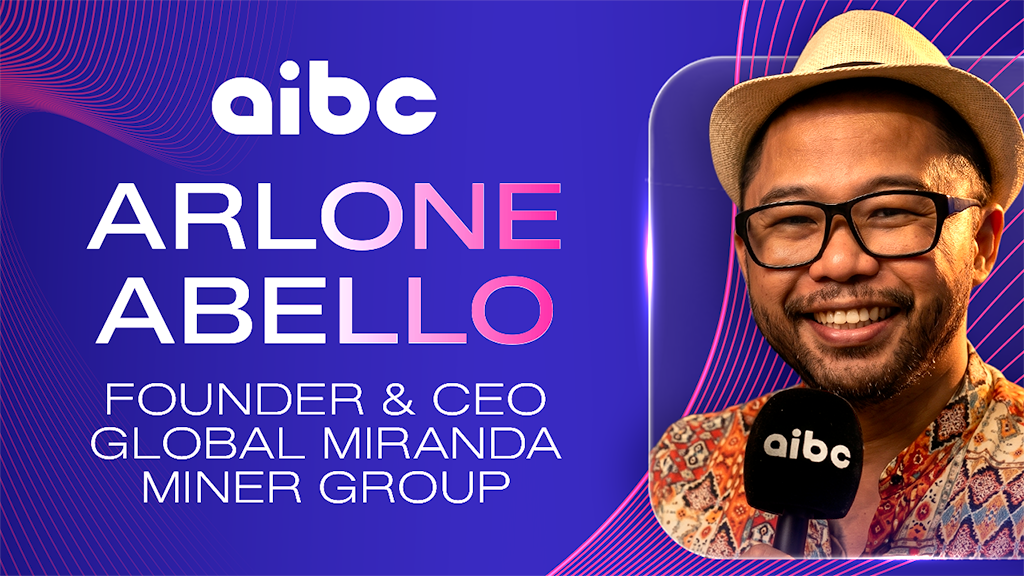
When it comes to crypto, Arlone Abello is not selling the dream of sudden wealth. Interviewed during AIBC Asia 2026, the founder and chief executive of Global Miranda Miner Group, said financial literacy has become a matter of safety in a market still shaped by hype, social media and sudden collapses.
“Financial literacy is important in the sense that misinformation, or miseducation, has cost lives in cryptocurrency,” Abello told AIBC.
“In 2022, Luna’s market capitalisation, once worth about $10bn, collapsed,” he said. “Many traders were left financially and mentally distressed, and some even took their own lives.”
Luna, a token linked to the Terra blockchain project, became one of the defining failures of the last crypto downturn, wiping out billions in value and exposing how quickly confidence can disappear in digital assets.
Regulators and educators are trying to catch up with a sector that has moved from the margins of finance into the wallets of retail investors. A recent report by the Organisation for Economic Co-operation and Development (OECD) warned that people with low digital financial literacy and limited financial resilience may be especially vulnerable to crypto’s volatility and gaps in consumer protection.
Abello said the most persistent misconception among new users was that crypto offered a shortcut to wealth, describing it as “the quick-rich mentality”.
That expectation, he argued, is fed by online personalities who show only their gains.
“Influencers will always show their profits, the good money they have made, the thousands or even millions of dollars they have earned from crypto,” he said. “That creates ‘FOMO’, the Fear Of Missing Out.”
For first-time investors, Abello said education should start with two basic questions: how much risk they can tolerate and how long they can wait to reach a financial goal. Without that grounding, he said, even routine volatility can become frightening.
He pointed to a recent fall in bitcoin’s price as an example of how quickly sentiment can turn. “That kind of volatility can shock the community,” he said. “If you are not aware, if you are not educated, you may sell your position too quickly, or lose a lot of money.”
The OECD, whose research is often used by governments to shape economic and consumer-protection rules, has made a similar point. Its report says higher levels of digital financial literacy can help people use crypto-assets in line with their own risk appetite and better understand the risks involved. It also says public authorities should explicitly address “the characteristics, opportunities and risks of crypto-assets” as part of financial literacy policies.
Abello’s message was not that governments should keep crypto at arm’s length. On the contrary, he said regulation could help the industry mature.
In the Philippines, he said he had represented traders through his role as founder of the Association of Cryptocurrency Traders in the Philippines, including in recent talks with the central bank about anti-money laundering proposals and virtual asset service providers.
“For me, regulation means clarity,” he said. “When the government regulates, you are no longer walking on eggshells. You are no longer walking through a minefield.”
Clear rules, he said, could encourage more cautious investors to enter the market and give companies confidence to build. “Clarity means innovation and progress,” he said. “It allows the sector to grow and become more widely adopted.”
Asked where blockchain could find its strongest use in Asia, Abello named two areas: tokenising real-world assets and combining blockchain with artificial intelligence.
Supporters of tokenisation say it could make assets easier to trade and divide into smaller ownership shares, though the model still depends on regulation and reliable links between the token and the asset it claims to represent.
“Everything you see, our microphone, our chair, our energy, even air and water, can be tokenised and recorded on a blockchain,” Abello said.
His second bet was on using blockchain records to make AI systems more accountable. “Sometimes AI can go rogue,” he said. “We now have technology that can keep a record of everything AI does. If you put that on a blockchain, it becomes immutable. No one can change it.”
In theory, important actions taken by an AI system could be recorded on a blockchain, creating a tamper-resistant history of how the technology was used and turning blockchain into an audit trail for artificial intelligence.
For Abello, the next wave of adoption will depend less on speculation than on whether users, companies and governments can learn the rules of the game before more people get hurt.