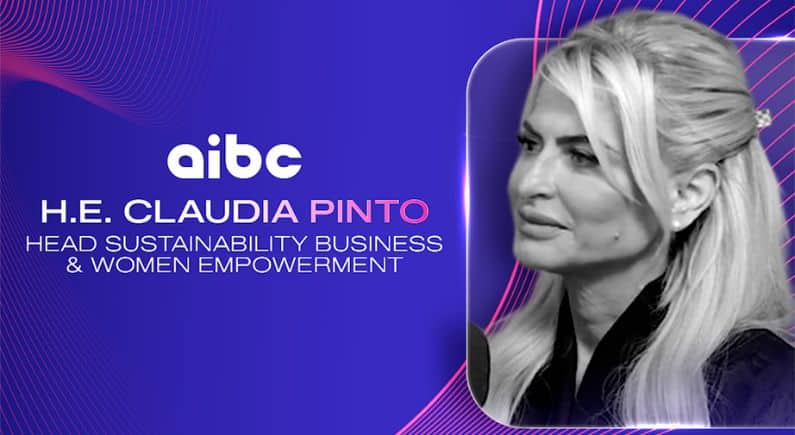
Dubai is taking a “rules-first” approach to emerging digital technologies, positioning regulation not as a constraint but as an enabler of growth, according to H.E. Claudia Pinto, Head of Sustainability Business & Women Empowerment.
“It’s really beautiful, the new era of technology we are entering, blockchain, AI,” Pinto said, speaking exclusively at AIBC Eurasia 2026. “But we really have to pay attention to how we direct this. We create the barriers and the rules, the proper rules, and how companies have to fulfill [them] to succeed.” Her remarks highlight a defining feature of Dubai’s digital economy strategy: aligning innovation with governance from the outset, rather than regulating after disruption.
While many global markets struggle to keep pace with rapid advances in artificial intelligence and digital finance, Dubai has embedded oversight directly into its growth model. The emirate has appointed dedicated leadership roles, such as a Minister of Artificial Intelligence and cybersecurity authorities.
Pinto emphasised that the goal is not to slow innovation, but to channel it responsibly. “We have numerous programs, so everyone follows the proper strategy, so they can merge in the market in a safe way,” she said, pointing to frameworks that guide companies entering sectors like fintech, blockchain and digital payments.
This approach aligns with the work of regulators such as the Dubai Virtual Assets Regulatory Authority, which has introduced licensing regimes for crypto firms, and the Dubai International Financial Centre, which continues to expand fintech oversight and innovation sandboxes.
At the core of Dubai’s model is the idea that trust is a prerequisite for scale, particularly in areas like digital payments and online platforms. Pinto underscored this point: “It’s about how people can have access to online platforms, to transfer monies, but in a safe way. This is what we are looking [at as] most important.”
In May, Dubai started accepting crypto payments for public services. The Dubai Department of Finance (DOF) and Crypto.com signed an agreement to accept crypto payments for government services. Now, residents and businesses can use Crypto.com’s digital wallets to pay for government services. The crypto assets can be instantly converted into UAE dirhams, ensuring seamless fund transfers to the DOF’s accounts.
(Source: AIBC World/YouTube)
Concerns around fraud, data privacy and AI misuse have intensified globally. According to international financial watchdogs, including the International Monetary Fund (IMF) and the World Bank, digital payment fraud and cyber risks remain among the fastest-growing threats in fintech ecosystems. Pinto said Dubai’s proactive stance, building guardrails early, aims to mitigate these risks while maintaining investor confidence.
Beyond technology, Pinto framed women’s empowerment as a core pillar of Dubai’s sustainability strategy, rather than a parallel social goal. “Women are one of the most important KPIs,” she said. “When we empower women, we empower the whole society.”
As founder of the Empowering Women Middle East initiative, Pinto highlighted how the platform combines philanthropy with business partnerships to create what she describes as “social profit”, alongside financial returns. She argued that sustainable cities require not just strong companies and innovation, but also inclusive systems that prioritise well-being, education and family structures.
“When women are happy, kids are happy, society is happy,” she said, linking gender inclusion directly to broader societal stability and economic resilience. This perspective aligns with Dubai’s wider policy direction, including initiatives such as the “Year of the Community” and “Year of the Family”, which aim to integrate social well-being into economic development.
Dubai’s policy direction for 2025–2026 places an emphasis on integrating social well-being into economic development, positioning family stability as the foundational driver of economic prosperity. Following the 2025 “Year of the Community”, the UAE has designated 2026 as the “Year of the Family”.
Dubai’s strategy contrasts with the more reactive regulatory approaches seen in parts of the US and Europe, where policymakers are still adapting to the rapid expansion of generative AI and decentralised finance.
Meanwhile, Dubai is attempting to turn regulation into a competitive differentiator, attracting companies that prioritise clarity and market certainty. This structured ecosystem is also designed to streamline market entry. “How they merge [into the market] and make sure they are doing well and in a safe way,” Pinto said, describing a system where compliance is integrated into business scaling rather than treated as a later hurdle.
Pinto framed this governance model as part of a broader sustainability vision, one that goes beyond environmental metrics to include economic resilience and social well-being. “Dubai is working to be one of the most sustainable cities in the world,” she said, adding that sustainability requires a “holistic approach” that integrates technology, regulation, and societal outcomes like happiness and inclusion.
In this context, safe digital infrastructure becomes part of the city’s long-term sustainability framework, ensuring that innovation contributes positively to both economic growth and quality of life. By combining AI governance with women empowerment and sustainability goals, Pinto suggests that Dubai is positioning itself not just as a fast adopter of emerging technologies, but as a system builder for how those technologies should evolve. “We need AI, we need these platforms,” she said. “But we need them in the right way.”