

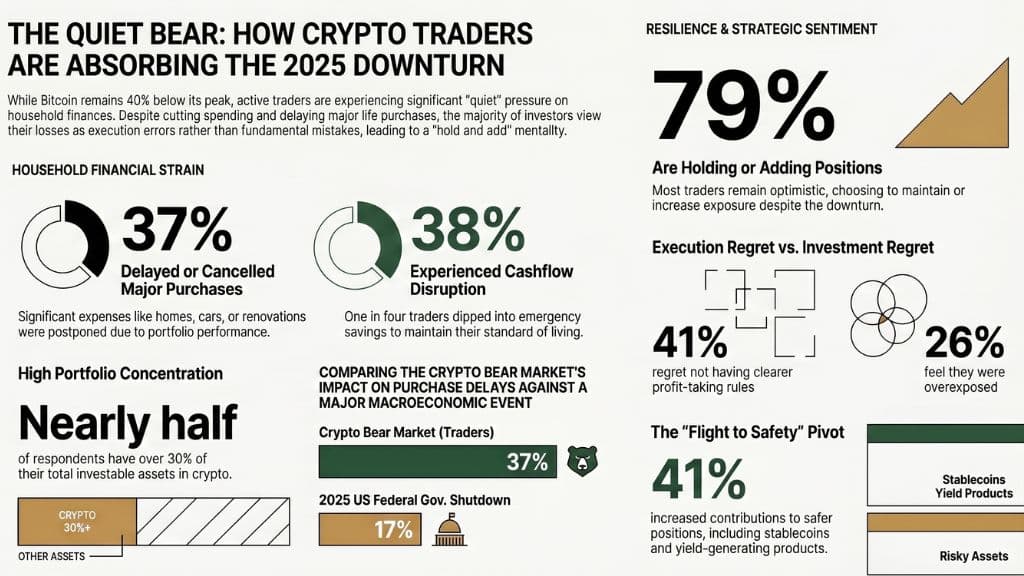
A CEX.IO survey of 1,100 U.S. users demonstrates how the decline in cryptocurrency is impacting daily life. Nearly 47 per cent of Bitcoin’s circulation supply is lost, as it is currently selling close to $77,000 and roughly 40 per cent below its October 2025 top. According to the survey, 10 per cent of participants made major financial sacrifices in order to maintain their positions, while 36 per cent of respondents reduced daily spending due to cryptocurrency losses.
The survey also found that 37 per cent of participants delayed or cancelled purchases, including 21 per cent who postponed major financial decisions such as buying a home or car. Analysts describe the current cycle as a more gradual, less volatile downturn than in 2022, with limited panic selling. However, market data indicates the bear phase may continue into late 2026 as conditions evolve.
A recent survey shows how crypto losses are affecting the everyday lives of retail traders. About 36 per cent have cut back on non-crypto spending, and 10 per cent made significant sacrifices to keep their investments. The impact extends to bigger decisions, too. Around 37 per cent of users delayed or cancelled purchases, and for 21 per cent of those, it was a major milestone, such as buying a home, a car, or renovating a property. The pattern is similar to what happens during large economic disruptions, showing how deeply crypto investments influence personal finances.
Many crypto investors keep their holdings private, not out of secrecy but because these investments can be personal and complex. Only a small number of people fully share what they own or its value, since explaining crypto often requires discussing wallets, tokens and prices that change by the minute.
Unlike traditional assets, there are no simple statements to show, and decisions are usually made alone, which adds to the sense of independence. There is also an emotional side: losses can be hard to talk about, especially when they stem from personal choices.
During bear markets, this silence can turn into emotional isolation, with financial stress becoming something people deal with privately. Constant price swings and market uncertainty can affect sleep and mental wellbeing, making downturns not just a financial challenge but also a psychological one.
Bear market strains household budgets (Source: CEX.IO)
Many crypto investors are feeling cashflow pressure beneath the surface. About 38 per cent reported financial disruption, with some dipping into savings or emergency funds to cover daily expenses, resources meant for emergencies such as job loss or medical needs.
The stress shows up in other ways, too: 12 per cent admitted to missing or delaying bill payments because of crypto-related pressures. That’s a serious sign, since it affects essential obligations. And these numbers may understate the reality, as people are often reluctant to share financial struggles tied to personal investment choices.
Nearly half of retail investors have more than 30 per cent of their assets tied up in crypto, creating a heavy concentration in one volatile market. When prices fall, the impact ripples through the rest of their financial lives, making everyday stability harder to maintain.
Most traders haven’t changed how they earn money despite the financial pressure from crypto volatility. About 73 per cent continue with the same income streams, showing either resilience or a decision to wait things out rather than make big lifestyle changes. Only 9 per cent have taken on extra work, which suggests that while the strain is real, it hasn’t yet led to widespread shifts in how people approach their earnings.
Many investors say their biggest regret isn’t putting too much money into crypto but failing to set clear exit strategies. About 41 per cent wish they had defined rules for taking profits, underscoring the importance of planning in volatile markets. Despite setbacks, most still believe in Bitcoin’s future, 79 per cent are holding or adding to their positions. For many, this isn’t denial but conviction that the asset will recover over time.
Long-term Bitcoin holders have continued to add more than 1 million BTC in recent months, according to latest on-chain data, demonstrating their faith in the asset despite market volatility. Even while selling pressure has been mostly restrained, almost half of the whole Bitcoin supply is currently in the red. This combination implies that large holders are still demonstrating commitment by growing their positions even while many investors are experiencing unrealised losses.