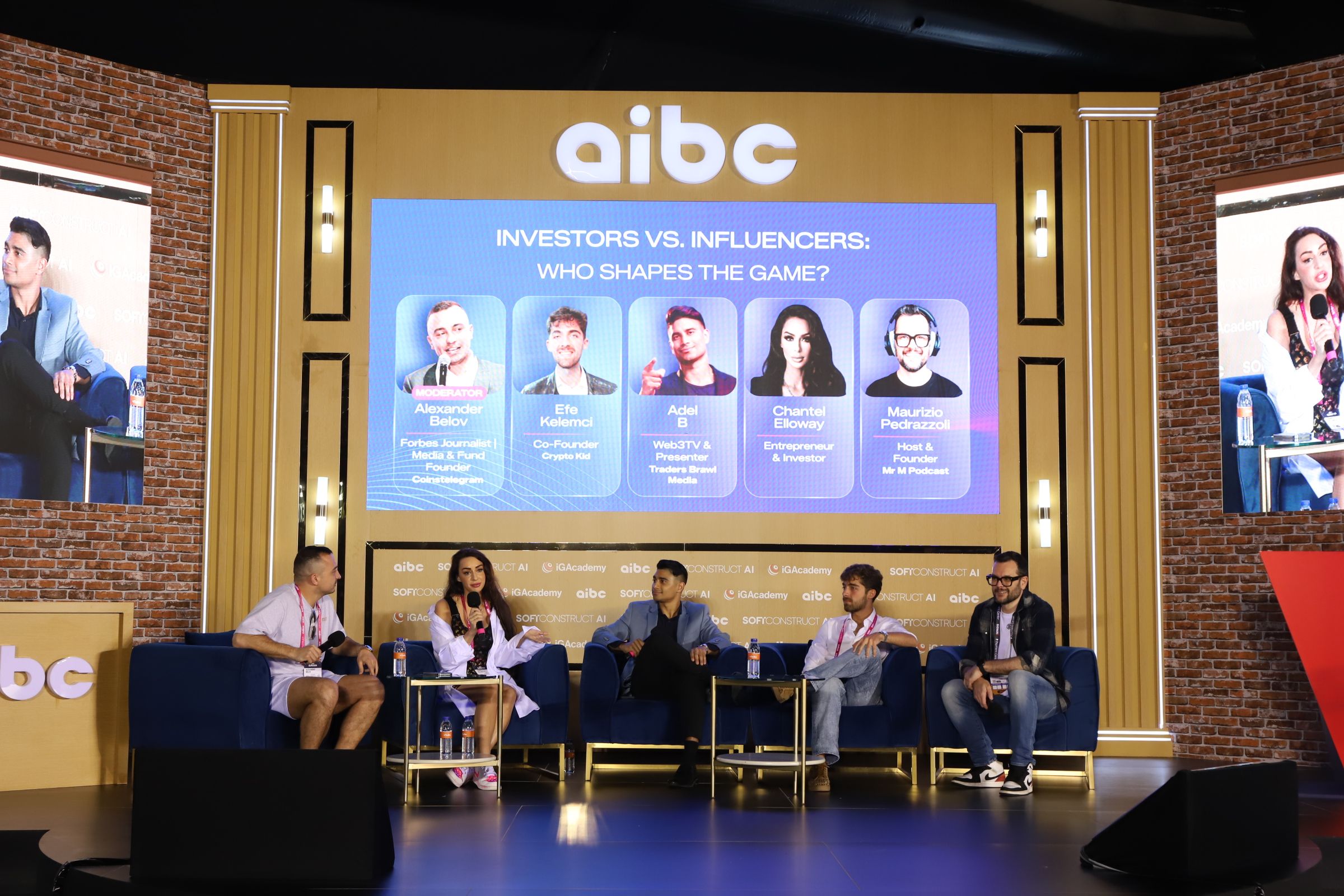
At the AIBC Eurasia Summit in Dubai on 11 February 2026, a panel of investors, analysts and media personalities tackled a pressing question for the digital asset sector – who holds more power in today’s market, the investor or the influencer? Moderated by Alexander Belov, Forbes journalist, media and fund founder at Coinstelegram, the discussion quickly expanded into liquidity cycles, regulatory tightening in the UAE, AI disruption and the psychology behind trading. The panel featured Chantel Elloway, entrepreneur and investor; Adel B, Web3TV presenter and founder of Traders Bae Media; and Efe Kelemci, co-founder of Crypto Kid.
Opening the debate, the panel agreed that the dichotomy between investor and influencer is increasingly blurred. Chantel Elloway framed it as a matter of timing and market structure.
“Investors are gonna be shaping the way things are… but of course, we need influencers… so it goes hand in hand,” she said, highlighting how institutional participation and audience-driven adoption now operate in tandem.
Adel B offered a vivid analogy. “Capital is like the engine, but influencers are the steering wheel. You need both,” he explained, arguing that independent creators are reshaping narratives, no longer relying solely on institutional media to amplify projects.
Efe Kelemci stressed the educational dimension. “Not everybody knows how to invest and not everybody knows why investing is important in the first place,” he noted, positioning influencers as a bridge between complex financial markets and everyday participants.
For podcaster Maurizio Pedrazzoli, the distinction is artificial. “I think a good investor is also an influencer,” he said, pointing out that conviction naturally drives advocacy.
The conversation shifted to current market conditions. Belov observed that some startups are struggling to find funding and asked whether this reflects a capital drought or weaker projects.
Adel B pointed to regulatory evolution in the UAE. With compliance now central, investors are more cautious. “Now, with more regulations in place… is this compliant? Is this going to scale?” he said, suggesting that founders must refine their roadmaps before capital flows.
Elloway described a broader structural shift, referencing a consolidation trend in which a handful of dominant crypto assets may define the next cycle. “It’s not just about the tokenization of something, it’s about who’s behind it,” she said.
Kelemci compared today’s liquidity to 2021’s stimulus-fuelled boom. “People don’t have money to invest,” he said, forecasting that broader monetary changes could eventually restore liquidity.
Pedrazzoli urged a longer horizon. “If you invest in something… your timeframe cannot be six months,” he said, arguing that confusion between trading and investing fuels disappointment.
Responsibility was a common thread throughout. Belov questioned whether or not influencers should only promote projects they have personally invested in.
Kelemci acknowledged that he suffers from exposure bias. “When I am discussing an asset, it is likely that I already have capital allocated to it,” he stated, admitting that there is an emotional side to market changes, but promoting transparency above all.
Pedrazzoli echoed that same sentiment. He stated that it is “impossible to differentiate an investor from an influencer.” He added that the level of excitement generated by many of the influencers may be misinterpreted as self-serving.
Elloway expanded on the concept of many different types of information existing in the era of AI. “We need to have safeguards put in place for the type of information we have access to,” she advised, and stated that it is becoming more difficult to tell fact from fiction.
Artificial intelligence dominated the latter half of the panel. Could AI replace traders and influencers altogether?
Adel B shared a personal anecdote about AI-generated content replacing human presenters. “This is the beginning of the end,” he said, reflecting on automation’s impact on media roles.
Kelemci remained more optimistic about human resilience. “Humans will always have value,” he argued, emphasizing emotion, identity and trust as irreplaceable qualities in both analysis and entertainment.
Pedrazzoli captured the mood succinctly. “The next five years are gonna shape what’s gonna happen in the next 50,” he said, describing himself as both excited and apprehensive.
On AI trading, opinions diverged but converged on one point – markets are rooted in psychology. While machines may outperform in structured environments such as chess, crypto markets remain influenced by human emotion and behavioural cycles.
A final question for the panel was about demographics and whether or not influencers create institutional or retail investor capital.
Kelemci noted that his audience is older, which suggests that older investors hold capital. Elloway expressed the importance of having a good financial education, saying that educating others is her “only purpose for now.” Adel B, who had more skepticism, cautioned the audience that “not everything on the Internet is accurate”.
Belov ended by encouraging the audience to stay positive about the crypto markets for years to come. The panel did not resolve the argument of whether investors or influencers are driving demand. Still, it did provide a very clear message about the close relationship between Influencers and Capital in today’s market.
Stay ahead of the rest with more insights, interviews and breaking news at SiGMA News: https://sigma.world/news