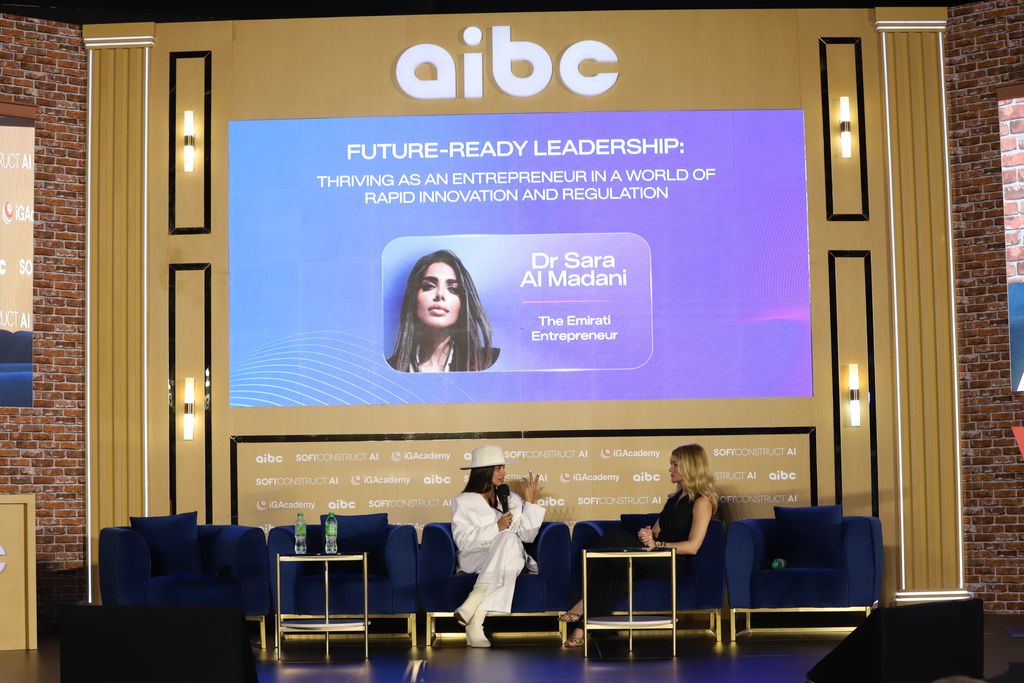
The AIBC Eurasia Summit in Dubai offered a strategic forum for senior decision-makers to explore leadership in an era of rapid innovation and evolving regulatory frameworks. On 10 February 2026, the AIBC Eurasia Stage hosted a keynote and conversational panel titled “Future-Ready Leadership: Thriving as an Entrepreneur in a World of Rapid Innovation and Regulation”. The session featured Dr Sara Al Madani, the Emirati entrepreneur renowned for her multi-sector ventures, alongside Olga Yaroshevsky, Managing Director of AIBC, in a dialogue exploring what it takes to lead effectively in high-speed, regulated markets.
According to Dr Al Madani, leadership is a strategic capability, rather than simply reacting to situations. As change happens more rapidly than ever before in our world, speed and experience are no longer the only factors determining success for an entrepreneur; they also need to balance ambition with governance, ensuring that their innovation pipelines align not only with regulations but also have the potential to create sustainable development in the future.
As an example, Dr Al Madani used the UAE to show how governments create ecosystems that attract foreign direct investment while providing the necessary operational standards. To lead effectively in that type of environment requires entrepreneurs to be aware of where a government is going in terms of policy, understand what regulatory requirements a company must meet, and identify what other countries expect from their companies. Entrepreneurs who proactively engage the dynamics among these factors have a much higher likelihood of scaling their businesses responsibly.
A central takeaway from the conversation around the mindset of future-ready leader was about staying calm and being open to learning and changing your tactics, while leading through a period of constant change. Dr Al Madani noted, “If you are using yesterday’s mindset to lead your business, then you’re going to drive your business into a dead-end road.” This serves as a reminder that as leaders, we need to constantly be recalibrating our leadership approach due to the rapid changes in technology and regulation.
According to Olga Yaroshevsky, although many policymakers may seem slow to respond to new and emerging technologies such as Artificial Intelligence (AI), Cryptocurrency (crypto) and Blockchain, proactive engagement with policymakers can convert policy making into a competitive advantage. The leaders who have an early understanding of the rules and proactively engage with policymakers can develop businesses that are ethical, compliant and scalable.
In addition, there was considerable discussion about the need for organisations to build resilience within their organisations. According to Dr Al Madani, innovation is no longer an option; therefore, organisations must adopt a culture of adaptability and embed this culture of adaptability through leadership and operations. One way to accomplish this is to automate tasks and processes using AI, so that leaders have time to devote to their creative side and develop strategic visions for their organisations. “Automation allows me to be creative. It allows me to do so many things,” explained Dr Al Madani as she expressed how technology is used to augment her creative ability rather than replace her creativity.
According to Yaroshevsky, having a transparent communication and talent strategy will help organisations to develop resilience within their organisations. Both speakers discussed the value of creating an environment where people are held accountable, enabling them to take informed risks, and creating teams that can adapt quickly to changing market conditions are essential for organisations to thrive in an ever-changing landscape.
Insights into how to build resilience as an entrepreneur were also provided by Dr Al Madani when discussing the role of failure as a learning experience. With experience founding over 25 companies, she stated that the ability to take risks and the capacity to “fail fast” become the way to build long term success. Another key element of this discussion was tied to ethical leadership; Dr Al Madani encouraged those involved in developing new technologies to keep ethics as a priority when creating anything new, so that the innovations developed will positively impact the world.
The panelists also examined contextual leadership. Effective global leaders exhibit a combination of awareness and contextual knowledge of their local environments, which acts as a foundation to adapt the governance model or partnerships into something that makes sense for that market. In the UAE, the development of scalable entrepreneurs has been achieved through engagement from both regulators and the broader ecosystem of stakeholders, while creating an atmosphere of trust between the stakeholders and the regulators.
The session concluded with a shared message that leadership is a continuous investment. Future-ready leaders embrace change, invest in learning, and cultivate resilience within themselves and their organisations. As Dr Al Madani noted, the ultimate goal of entrepreneurship is freedom—freedom to innovate, create, and thrive without compromising well-being or ethical standards.
For more insights into AIBC Eurasia and upcoming summits, visit the SiGMA Website for further information.